11 trailer categories. 580+ in stock. Vermont dealer with 15 years of experience and free nationwide delivery to all 50 states.
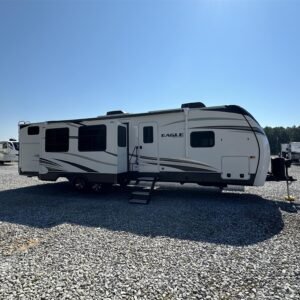
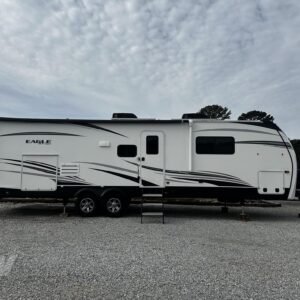
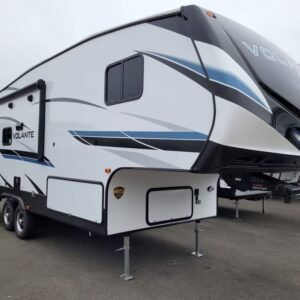
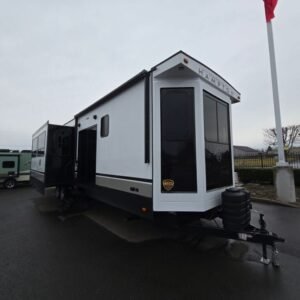
PrimeLoad Trailers carries 100+ travel trailers, destination campers, and family RVs from established North American manufacturers. Every unit on this page ships free to all 50 US states from our Underhill, Vermont yard. We work with Crossroads (Hampton, Redwood), Forest River, and Jayco lines, ranging from compact weekend campers to full-feature destination trailers with multiple slide-outs.
The right travel trailer depends on three things: how you tow, where you sleep, and how long you stay. A 25-foot single-axle camper that weighs 4,500 pounds dry tows behind most half-ton pickups and SUVs. A 38-foot double-axle destination trailer with three slide-outs and a fully appointed kitchen weighs 9,000+ pounds dry and needs a 3/4-ton truck or larger to tow safely with cargo on board.
Before you shop, know your tow vehicle's exact tow rating (in the owner's manual, NOT the marketing brochure), the gross vehicle weight rating (GVWR), and your hitch type. The dry weight on the trailer spec sheet is the unloaded factory weight. Add 1,000 to 2,500 pounds for water (40 to 80 gallons fresh, plus grey and black tanks), propane (60+ pounds full), batteries, gear, food, and people. Real-world towed weight is almost always 1,500 to 3,000 pounds higher than the dry weight number.
Slide-outs add living space but also weight, complexity, and points of failure. A single-slide trailer adds about 50 square feet of floor space. A triple-slide adds 150+ square feet but doubles the maintenance surface area. For weekend campers, single-slide or no-slide layouts are simpler and lighter. For destination trailers parked at a campground for the season or full-time RV living, multiple slides earn their weight.
Holding tank capacity matters more than most first-time buyers expect. A 30-gallon black tank fills in 3 to 5 days of normal family use. A 40-gallon grey tank fills in 2 to 3 days if you shower onboard. If you are boondocking (camping without hookups), tank capacity is the limit on how long you can stay before dumping. If you are always at full-hookup campgrounds, smaller tanks and lighter weight are often the better trade.
Build quality varies widely in the RV industry. Look for laminated walls (vs stick-and-tin), aluminum frame construction (vs wood), residential-grade flooring, and reputable axle and wheel components. The brands we carry are chosen because their warranty support, parts availability, and resale value hold up over the long haul.
We work with Crossroads RV, Forest River, and Jayco. Each brand has distinct strengths for different buyer profiles.
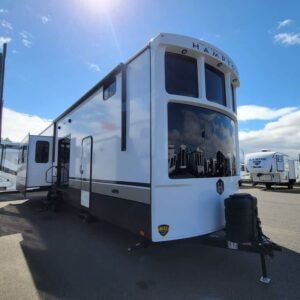
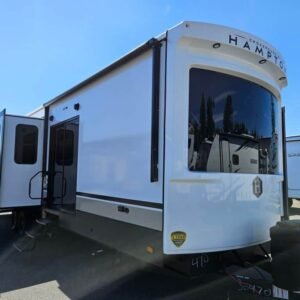
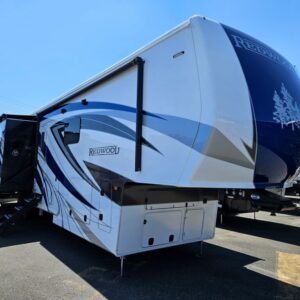
Hampton and Redwood lines. Destination travel trailers built for extended stays and seasonal camping. Strong fit-and-finish, generous floor plans, and full residential kitchen and bathroom appointments. Most popular in the 35 to 40 foot range.
One of the largest RV groups in North America. Wide selection across price points from compact weekend campers to full-feature family trailers. Strong dealer support network and parts availability across all 50 states.
Known for solid construction and the industry's strongest standard warranty. Family-owned manufacturer with a long reputation for build quality. Good fit for buyers prioritizing long-term durability over feature count.
Common buyer profiles for our RV and camper inventory.
Shorter, lighter trailers (20 to 28 feet, 4,000 to 6,500 lbs dry) that tow behind a half-ton pickup or full-size SUV. Single-slide or no-slide layouts. Used 10 to 25 weekends per year, parked at home or in storage between trips.
Mid-size bunkhouse layouts (28 to 34 feet, 6,500 to 8,500 lbs dry) with dedicated kids bunks, larger holding tanks, and full kitchens. Built for week-long family trips during summer and school breaks.
Larger trailers (35 to 42 feet, 9,000 to 12,000 lbs dry) parked at a single campground for the camping season. Multiple slide-outs, residential-style appliances, and full bathroom appointments. Often used by retirees and seasonal residents.
High-capacity trailers built for year-round occupancy. Larger holding tanks, more battery capacity, dual heat sources, and four-season insulation packages. Buyers tend to prioritize residential features and long-term durability over towing weight.
Buyers who tow south for winter and north for summer. Mid-to-large trailers with strong climate-control systems and durable build packages that handle the long-distance towing miles.
Every travel trailer or camper on this page ships free to all 50 US states. We coordinate the haul from our Underhill, Vermont yard direct to your address. No surcharges. No minimums. No fuel fees buried in the quote. The price you see in the quote is what you pay at delivery.
Delivery typically takes 5 to 14 business days from order confirmation depending on your state and the carrier route. Hawaii and Alaska are handled case by case; contact us for a custom quote.
For pickup at our Vermont yard, see the Vermont Trailer Dealer page for directions and hours.
Check your owner's manual for the exact tow rating, NOT the marketing brochure. Half-ton trucks typically tow 7,000 to 9,000 pounds. 3/4-ton trucks handle 10,000 to 14,000 pounds. 1-ton trucks pull 14,000 to 20,000+ pounds. Add 1,500 to 3,000 pounds to a trailer's dry weight to estimate real-world towed weight with water, gear, and people.
Most travel trailers and campers ship within 5 to 14 business days from order confirmation. We coordinate the haul from our Vermont yard direct to your address. Delivery is free to all 50 US states with no surcharges or minimums.
The carrier delivers to your address and drops the trailer in a location you specify. Initial setup (leveling, hooking up to hookups, slide-out testing) is typically the buyer's responsibility, though we walk you through the setup over the phone if needed. For first-time buyers, we recommend reviewing the owner's manual and slide-out operation videos before delivery.
A travel trailer connects to a bumper-pull hitch behind the tow vehicle. A fifth-wheel uses a hitch mounted in the bed of a pickup truck. Fifth-wheels generally have better towing stability and more interior space at a given length, but require a pickup truck with bed-mounted hitch hardware. Travel trailers tow behind any vehicle with the right tow rating and a standard ball hitch.
Our inventory is mostly new and recent-year trailers from current production. Each product page lists the model year and condition. If you have questions about a specific unit's history, we share what we know up front.
We do not provide financing directly. Most buyers finance through their bank, credit union, or an RV-specific lender like Good Sam, Bank of the West, or Essex Credit. We provide the invoice and any documents your lender requires for funding.
Our 30-day return window covers manufacturing defects and shipping damage. Buyer remorse returns and modifications made post-delivery are not covered. See our return policy at /refund-return-policy/ for full details.
Tell us how you will use the trailer, what tow vehicle you have, and your timeline. We send a free quote with model recommendations and total delivered price within 24 hours.
Or call us at (802) 203-7891