Looking for aluminum trailers for sale? You’ve found one of the largest online lineups in America, with free delivery to all 50 states. This guide walks you through every detail you need before you buy, from sizes and lift mechanisms to 2026 pricing and brand reputations.
Aluminum Trailers For Sale in 2026: What Smart Buyers Watch For
The trailer industry has shifted under buyers’ feet over the last three years. Anyone shopping aluminum trailers for sale in 2026 faces more transparent pricing, better delivery logistics, and bigger spec sheets than ever. The federal FMCSA CDL rules for towing have not changed (no CDL needed under 26,001 lbs combined GVWR), but how dealers package aluminum trailers for sale listings has. Free nationwide delivery, side-by-side spec comparisons, and out-the-door pricing are now the norm at any reputable dealer. Don’t accept anything less.
Brand selection matters too. The NHTSA tire safety standards govern how every trailer-rated tire performs at GVWR; brands that buy lower-rated tires to hit a price point are easy to spot once you know what to look for. Whether you’re a first-time buyer or your fifth purchase, finding the right aluminum trailers for sale comes down to two things: matching capacity to use and trusting the brand to back the build. This guide walks you through every variable that matters before you sign.
nn
Shopping for aluminum trailers for sale used to mean a 10 percent premium and a phone call to a specialty builder. In 2026, aluminum has gone mainstream. Sport Haven, ATC, Mission, and Cargo Pro all stock dealer lots with units that ride lighter, last longer, and resell for more than equivalent steel rigs.
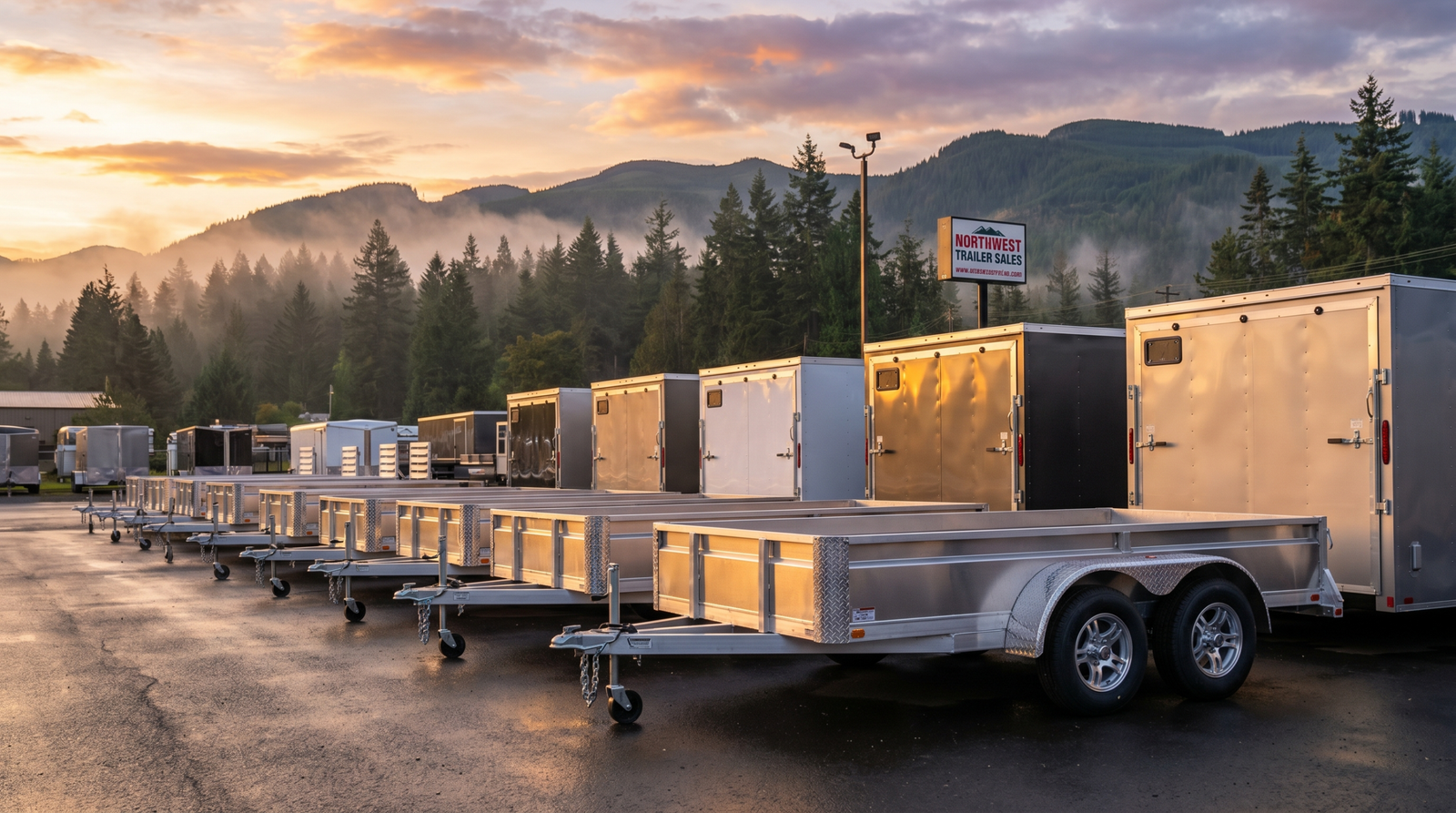
The catch is that aluminum is not always the right call. Pricing is higher, weld repairs cost more, and the heaviest GVWR work still belongs to steel. This guide walks through every angle a buyer needs in 2026: the real cost over 10 years, where aluminum wins and loses, the brands worth shortlisting, and the construction details that separate a bargain from a regret. PrimeLoad Trailers stocks 50 aluminum units in Woodland, WA, and ships them free to all 50 states, so buyers anywhere can pull from the same shortlist a Pacific Northwest customer would.
Why Aluminum Trailers Have Taken Over the Premium Segment
Aluminum is not a fad. The shift away from steel started with horse and snowmobile trailers in the 1990s, moved into car haulers and enclosed cargo through the 2000s, and now dominates the utility segment too. Four reasons drive that shift, and every one of them shows up on the spec sheet.
Corrosion resistance is the headline feature. Aluminum forms a thin oxide layer the moment it hits air. That layer is invisible, hard, and self-healing, which means salt spray, rain, and pressure washer abuse cannot eat through to the structure underneath. Steel needs paint, powder coat, or galvanizing to fight rust, and every nick in that coating becomes an entry point. Drive a steel utility trailer for five winters in a salt-belt state and the frame edges start to bubble. Drive an aluminum trailer through the same five winters and the frame still looks like the day it left the factory.
Weight savings are real and measurable. An aluminum trailer typically weighs 10 to 15 percent less than a comparable steel build. A 6×12 enclosed cargo trailer in steel might weigh 1,650 pounds empty. The same trailer in aluminum drops to roughly 1,350 pounds. That 300-pound difference is 300 pounds of additional payload, 300 pounds less load on the tow vehicle, and a measurable bump in fuel economy on long hauls.
Lifespan stretches further. A well-cared-for aluminum trailer routinely sees 25 to 30 years of service. Steel trailers in dry climates can match that, but in any environment with salt, rain, or coastal humidity, steel typically taps out at 12 to 18 years before the floor pan, frame welds, or fender wells need major work.
Resale value holds. Buyers can pull up sold listings on equipment trader sites and see it directly. A 10-year-old aluminum utility trailer in good shape sells for roughly 60 to 70 percent of its original price. A 10-year-old steel trailer of the same size and condition sells for 35 to 45 percent. The aluminum premium pays itself back at trade-in time.
Aluminum vs Steel: Real Cost Over 10 Years
The upfront sticker is the trap. Buyers see a 25 to 35 percent price gap and assume steel saves money. Run the math over a decade and the picture flips. Here is what a typical 7×14 enclosed cargo trailer looks like in 2026 dollars.
- Initial purchase, steel: $7,200
- Initial purchase, aluminum: $9,400 (a $2,200 premium, roughly 30 percent)
- Fuel savings over 10 years, aluminum: $600 to $900 (assuming 8,000 miles per year and 0.3 to 0.5 MPG improvement on the tow vehicle)
- Repair and refinish, steel: $1,200 to $1,800 (rust treatment around year five, repaint or partial floor replacement around year eight)
- Repair and refinish, aluminum: $200 to $400 (mostly hardware, hinges, and seals)
- Resale value at year 10, steel: roughly $2,800
- Resale value at year 10, aluminum: roughly $5,900
Add it up. The steel trailer costs $7,200 to buy, eats $1,500 in repairs, and returns $2,800 at resale, for a net 10-year cost of $5,900. The aluminum trailer costs $9,400 to buy, eats $300 in repairs, returns $5,900 at resale, and saves $750 on fuel, for a net 10-year cost of $3,050. Aluminum saves nearly $2,850 over the decade on this example.
That math shifts depending on climate, mileage, and storage. Buyers who keep a trailer in a heated garage in Arizona and tow 500 miles a year close most of the gap. Buyers in Maine, Michigan, or coastal Florida who tow 12,000 miles a year see aluminum win by an even bigger margin. The detailed breakdown lives in our Aluminum vs Steel 10-Year Cost Comparison.
Where Aluminum Wins Decisively
Not every buyer needs aluminum, but four customer profiles see clear, measurable benefits that justify the premium every time.
Coastal climates. Salt air is corrosive even when the trailer never touches the ocean. Buyers within 30 miles of either coast, especially the Gulf Coast and the Pacific Northwest, see steel trailers age twice as fast as inland units. Aluminum simply ignores salt air.
Salt-belt states. Magnesium chloride and rock salt on winter roads are more aggressive than ocean spray. Wisconsin, Michigan, Ohio, Pennsylvania, New York, the New England states, and the upper Midwest in general are aluminum territory. A steel utility trailer used year-round in Buffalo will not see its 15th birthday in usable shape.
Daily towing operations. Landscapers, delivery operators, mobile contractors, and fleet operators who put 15,000 to 25,000 miles a year on a trailer hit the fuel-savings break-even point inside four years. After that, every gallon saved is profit.
Weight-sensitive haulers. Buyers towing with half-ton trucks or SUVs near their max tow rating gain real headroom by switching to aluminum. The same is true for buyers running tag-axle setups where every pound of trailer weight subtracts from payload. A snowmobile trailer carrying four sleds, or a car hauler near its 7,000-pound GVWR, both benefit directly.
Where Steel Still Wins
Aluminum is not a universal answer. Three categories still belong to steel, and recommending aluminum in those categories would be doing buyers a disservice.
Heaviest GVWR ratings, 20,000 pounds and above. Gooseneck dump trailers, heavy equipment haulers, and commercial flatbeds in the 25,000 to 30,000-pound range are still built primarily in steel. Aluminum versions exist, but they cost a fortune and the structural advantages of steel I-beams in deep frame sections are real. If a buyer needs to haul a 22,000-pound mini excavator, steel is the answer.
Budget builds where rust is not a concern. A homeowner in Phoenix who needs a 5×8 utility trailer for occasional dump runs, stores it under a covered carport, and plans to keep it 10 years is the perfect steel customer. The trailer never sees salt, never sits in standing water, and the upfront savings stay in the buyer’s pocket.
Repair simplicity for welding shops. Steel welds with a stick, MIG, or flux-core machine that any farmer or fabrication shop already owns. Aluminum welding requires a TIG setup, argon gas, and operator skill. If a buyer plans to modify, weld brackets to, or repair a trailer at home, steel is dramatically easier to live with.
Aluminum Trailer Types
Every major trailer category now offers aluminum options, though some are more common than others. Here is the full landscape.
- Utility trailers. The biggest aluminum category by volume. Open decks, mesh or aluminum plank floors, single or tandem axle. The bread and butter of brands like Sport Haven and Aluma.
- Enclosed cargo trailers. All-aluminum frame and skin construction is the premium build. ATC and Mission dominate this segment with units running from 6×12 contractor trailers to 8.5×28 race-team haulers.
- Open car haulers. Aluminum car haulers in 18 to 24-foot lengths are popular with collector-car owners and weekend racers. Lower tow weight matters when you are pulling a 3,800-pound classic.
- Snowmobile trailers. Aluminum is nearly universal here. Salt exposure and the need to fit four sleds without overloading a half-ton truck both push buyers toward aluminum.
- Equipment trailers. Aluminum versions exist in the 7,000 to 14,000-pound GVWR range. Above that, steel takes over.
- Livestock trailers. Aluminum is standard in the horse and stock segment. Featherlite, Sundowner, and 4-Star are the names.
- Dump trailers. Rare in aluminum. The forces involved in tipping loaded gravel or dirt favor steel construction. A few specialty builders offer aluminum dump bodies, but availability is thin.
Aluminum Trailer Sizes by Type
Sizing is consistent across brands and predictable once a buyer knows the categories.
Utility trailers run from 5×8 single-axle starter units up through 7×16 tandem-axle workhorses. The most popular sizes are 6×10, 6×12, and 7×14. PrimeLoad stocks the Sport Haven 7×16 aluminum utility trailer for landscape and contractor buyers, the Sport Haven 6×10 aluminum utility as the everyday workhorse, and the Sport Haven 5×10 for buyers with smaller tow vehicles.
Enclosed cargo trailers start at 6×12 single-axle and scale up through 7×14, 7×16, 8.5×20, 8.5×24, and 8.5×28 tandem-axle units. The 7×14 and 8.5×20 are the most-stocked sizes nationwide.
Aluminum car haulers typically come in 18, 20, and 24-foot bed lengths. An 18-foot hauler fits most classic cars and modern sports cars. A 20-foot hauler fits full-size sedans and short-bed pickups. A 24-foot hauler handles dually pickups, extended-cab tow rigs, and most racing applications. The deck material decision matters separately from the frame material.
Snowmobile trailers come in 8.5×12 (two-place), 8.5×18 (four-place), and 8.5×22 (six-place) sizes most commonly.
Top Aluminum Brands Compared
Five brands cover most of the aluminum market PrimeLoad customers actually shop. Each one earned its place for different reasons.
Sport Haven. The utility and cargo specialist. Sport Haven builds in Indiana with a focus on the 5×10 through 7×16 utility segment plus a growing enclosed cargo lineup. They run extruded aluminum floors as standard, torsion axles on most models, and aluminum wheels at competitive price points. PrimeLoad runs Sport Haven as the volume aluminum line because the build quality is high and the price is reasonable.
ATC (Aluminum Trailer Company). The premium aluminum brand. ATC builds enclosed cargo, race haulers, motorcycle trailers, and toy haulers in Indiana with one of the heaviest-duty aluminum cargo platforms on the market. Premium pricing, premium fit and finish, and the build quality to back it up.
Mission Trailers. Maine-built, salt-belt focused. Mission builds aluminum utility, enclosed cargo, and snowmobile trailers with the upper Northeast climate firmly in mind. The fit and finish reflects that origin: heavier extrusions, sealed seams, and corrosion-resistant hardware throughout. A favorite of New England and upper Midwest buyers.
Cargo Pro. Solid mid-market aluminum cargo. Cargo Pro builds enclosed cargo trailers in the 6×12 through 8.5×24 range with a balance of price and build quality that hits the sweet spot for contractors, motorcycle owners, and small-business operators.
Hillsboro. Aluminum truck beds and flatbed-style trailers. Hillsboro is a different category from the utility and cargo brands. They build aluminum truck beds and aluminum flatbed trailers for ranch, ag, and equipment customers. If a buyer is looking for an aluminum flatbed or a replacement aluminum truck body, Hillsboro is the call.
Construction Differences That Matter
Two aluminum trailers at the same price can have wildly different build quality. The differences live in three places.
Extruded aluminum floor vs aluminum sheet over wood. The premium build is an extruded aluminum floor: solid aluminum planks, typically 0.190 to 0.250 inches thick, locked together with tongue-and-groove joints. The floor is structural, drains water, and never rots. The budget build is aluminum sheet skin over a treated plywood subfloor. Cheaper to build, lighter than wood-only, but the wood eventually delaminates and the sheet eventually dents. Buyers paying aluminum prices should insist on extruded floors.
Integrated aluminum frame vs hybrid steel-frame-with-aluminum-skin. A real aluminum trailer has an aluminum frame, aluminum cross-members, and aluminum skin. A hybrid trailer has a steel frame underneath with aluminum skin and trim on top. Hybrid units are cheaper and heavier than full-aluminum, and they still rust at the frame. Always ask whether the frame is aluminum.
Riveted vs welded skin. Most all-aluminum cargo trailers use riveted aluminum skin panels rather than welded. Rivets allow the panels to expand and contract with temperature without cracking, which is exactly what aluminum does. Welded skin looks cleaner from a distance but is more prone to stress cracks at the seams over time. Riveted is the durable choice and is the industry standard on quality builds.
Key Features to Check on Aluminum
Beyond the frame and floor, five details separate a quality aluminum trailer from a stripped-down build.
- Torsion axles. Aluminum trailers usually run torsion axles instead of leaf-spring axles. Torsion axles ride smoother, sit lower, and need less maintenance. They cost more to replace if they fail, but they outlast leaf springs in normal use.
- Aluminum wheels. Steel wheels rust. Aluminum wheels do not. On a trailer where every other component is aluminum, steel wheels are a strange place to save 80 dollars. Spec aluminum wheels.
- Stainless steel hardware. Hinges, latches, fasteners, and grab handles should all be stainless. Galvanized hardware works on a steel trailer but rusts on the cut edges. Stainless lasts forever.
- Aluminum trim vs vinyl trim. Premium builds use aluminum trim around door frames, fender wells, and roof seams. Budget builds use vinyl trim that yellows, cracks, and falls off after five summers in the sun.
- LED lighting. All trailers should have LED lights at this point, but it is worth confirming. LEDs draw less current and last 10 times longer than incandescent bulbs.
Buyers should also confirm the GVWR matches the use case. A great walkthrough of how to read GVWR ratings and match them to payload lives in our trailer GVWR guide.
Aluminum Trailer Pricing in 2026
Real numbers from PrimeLoad inventory and the broader 2026 market.
- 5×10 aluminum utility trailer: $2,800 to $3,600. Single axle, 2,990-pound GVWR typical.
- 6×10 aluminum utility trailer: $3,200 to $4,200. Single axle, 2,990-pound GVWR typical.
- 6×12 aluminum utility trailer: $3,600 to $4,800. Single axle, 2,990-pound GVWR typical.
- 7×14 aluminum utility trailer, tandem axle: $5,400 to $6,800. 7,000-pound GVWR typical.
- 7×16 aluminum utility trailer, tandem axle: $5,900 to $7,400. 7,000-pound GVWR typical.
- 6×12 enclosed aluminum cargo trailer: $7,800 to $9,800. Single axle, 2,990-pound GVWR typical.
- 7×14 enclosed aluminum cargo trailer, tandem axle: $9,400 to $12,800. 7,000-pound GVWR.
- 8.5×20 enclosed aluminum cargo trailer: $14,500 to $19,800. 9,990-pound GVWR typical.
- 8.5×24 race-style enclosed aluminum: $18,500 to $26,000. Tandem 5,200-pound torsion axles common.
- 20-foot aluminum open car hauler: $7,200 to $9,800. Tandem 3,500-pound axles, 7,000-pound GVWR.
The premium over equivalent steel trailers runs 20 to 35 percent depending on category. Utility trailers see the smallest gap. High-end enclosed cargo sees the biggest. Pricing has been steady through 2026 after the aluminum commodity spikes of 2022 and 2023 settled out.
Free Nationwide Delivery
PrimeLoad delivers every aluminum trailer in stock to all 50 states at no extra charge. The process is simple and a buyer in Florida pays the same trailer price a buyer in Washington pays.
- Pick the trailer. Browse the aluminum trailer inventory online or call the lot. We have 50 aluminum units in stock at any given time, so most buyers find a match without a special order.
- Get the quote. Submit the quote request form with the destination zip code. Pricing is locked, delivery is free, and there are no hidden fees.
- Confirm the order. Sign paperwork electronically, complete payment, and lock the build or pull-from-stock decision.
- Schedule delivery. A licensed and insured driver picks the trailer and routes it to the buyer’s address. Most deliveries land in 5 to 14 days depending on distance.
- Inspect at delivery. The buyer walks the trailer with the driver, signs off on condition, and gets keys, paperwork, and registration documents on the spot.
The free delivery offer applies to every aluminum trailer in inventory, no minimum order, no fine print. Independent for 15 years out of Woodland, WA, PrimeLoad has shipped trailers to all 50 states and has the logistics dialed in.
How to Compare Aluminum Trailers For Sale Side-by-Side
Most buyers comparing aluminum trailers for sale get one or two spec lines wrong on their first pass.
Three numbers settle most decisions when you’re shopping aluminum trailers for sale: GVWR rating, frame gauge, and hydraulic pump brand. Spec sheets that bury these are a yellow flag.
Brand matters too. Reputable dealers list every aluminum trailer with full specs visible. We carry aluminum trailers for sale from every major manufacturer in our nationwide inventory.
Pricing on aluminum trailers for sale has stabilized in 2026 after the steel swings of the early 2020s. Whether you’re looking at entry-level aluminum trailer models or commercial-grade builds, the buying framework in this guide gives you a clean way to evaluate every option.
Ready to start? Browse aluminum trailers for sale on our inventory page to see every model with real photos, full specs, and our delivered out-the-door price.
Frequently Asked Questions
Is aluminum worth the premium over steel?
For most buyers, yes. The 10-year math favors aluminum in any climate with salt, humidity, or coastal exposure, and aluminum holds 60 to 70 percent of its value at year 10 versus 35 to 45 percent for steel. Buyers in dry climates with low annual mileage and long covered storage see a closer call, but even then aluminum usually wins on resale alone.
What maintenance does an aluminum trailer need?
Less than steel, but not zero. Wash the trailer every few months to clear road salt and grime. Lubricate hinges, latches, and ramp pivots twice a year. Check torsion axles, wheel bearings, and brake components on the standard schedule (every 12,000 miles or annually). An optional acid bath every two to three years restores cosmetic shine on polished aluminum. No painting, no rust treatment, no annual frame inspection.
How does aluminum hold up for resale in salt-belt states?
Better than any other material. Buyers in Michigan, Wisconsin, Maine, and the Northeast actively seek out aluminum trailers on the used market because the alternative is a 10-year-old steel trailer with rust at every weld. A clean aluminum unit in a salt-belt market sells fast and often at the upper end of the price range.
How do you repair a dent in aluminum?
Small dents in aluminum sheet can be pulled with a slide hammer or pushed from behind, similar to auto body work. Larger structural damage requires aluminum TIG welding, which costs roughly 1.5 to 2 times what a comparable steel weld repair runs. The trade-off is that aluminum dents far less often than steel rusts. Most aluminum trailers go through a 25-year service life with no welding repairs at all.
How long does an aluminum trailer last?
Twenty-five to 30 years is typical with reasonable care. The frame, floor, and skin will all outlast the original tires, axles, hardware, and lighting. Owners typically replace consumable components two or three times during the trailer’s life and the structural aluminum keeps going.
How much do aluminum brands really differ?
More than buyers expect. Sport Haven, ATC, and Mission all build excellent aluminum trailers but with different priorities. Sport Haven hits the value-utility sweet spot. ATC builds the premium enclosed cargo segment. Mission focuses on heavy-duty salt-belt construction. Cargo Pro slots in as a strong mid-market enclosed builder. Hillsboro is the answer for aluminum truck beds and flatbeds. The brand decision should match the use case and budget, not just the badge.
Can I tow an aluminum trailer with a smaller vehicle?
Often, yes, and that is one of aluminum’s biggest selling points. A 6×12 aluminum utility trailer at 1,150 pounds empty plus 1,500 pounds of payload comes in at 2,650 pounds, well within the tow rating of most mid-size SUVs and small pickups. The same load on a steel trailer might push a vehicle to its limit. Always check the tow vehicle’s actual rated capacity, but aluminum opens up tow possibilities steel cannot.
Ready to Find Your Aluminum Trailer?
PrimeLoad Trailers stocks 50 aluminum units in Woodland, WA, with brands including Sport Haven, ATC, Mission, Cargo Pro, and Hillsboro. Every trailer ships free to all 50 US states, with no hidden fees and no surprises. Independent for 15 years, the team knows aluminum trailers cold and walks every buyer through the right size, the right brand, and the right spec for the use case.
Browse the full aluminum trailer inventory, dig deeper on the 10-year cost comparison, or jump straight to a free delivered quote with the destination zip code. Most quotes land in the same business day, and most trailers ship within two weeks of order confirmation.