Looking for a dump trailer tarp kit? If you haul gravel, mulch, demolition waste, or anything else that can leak, blow, or fall, the right dump trailer tarp kit is not optional — it’s federal law and state law and a frame-fatigue saver. This guide compares every type of system on the market in 2026 (manual hand-crank, side-roll, electric, automatic flip), ranks the top brands, breaks down pricing, and tells you which one is right for your trailer and your daily haul.
Why You Actually Need a Dump Trailer Tarp Kit
Most buyers underestimate the rules. The federal FMCSA 49 CFR 393.100 cargo securement standard requires that loose aggregates, debris, and any material that can shift, blow, or fall be contained on every public road. A dump trailer tarp kit is the simplest, cheapest way to comply. Skip it and you risk fines, an out-of-service order at a roadside inspection, or worse — a windshield claim from the driver behind you.
State laws stack on top of federal. Most states fine $50–$500 for an uncovered or improperly secured load; 15 states allow imprisonment for repeat offenders or causing damage. The penalty is per-load, per-stop. One contractor in Colorado we know paid $1,150 in fines over three weeks before he finally bought a dump trailer tarp kit. The kit cost $400.
Beyond legal: a tarp keeps your load dry (matters for mulch, sand, and topsoil weight), prevents blow-back into your truck cab on the highway, and signals to insurance adjusters that you operate professionally. If you’re shopping dump trailers for sale, factor a tarp kit into the budget from day one.
The Four Types of Dump Trailer Tarp Kits
Every dump trailer tarp kit on the market falls into one of four categories. The right pick depends on trailer size, how often you tarp, and your budget.
1. Manual Hand-Crank Roller
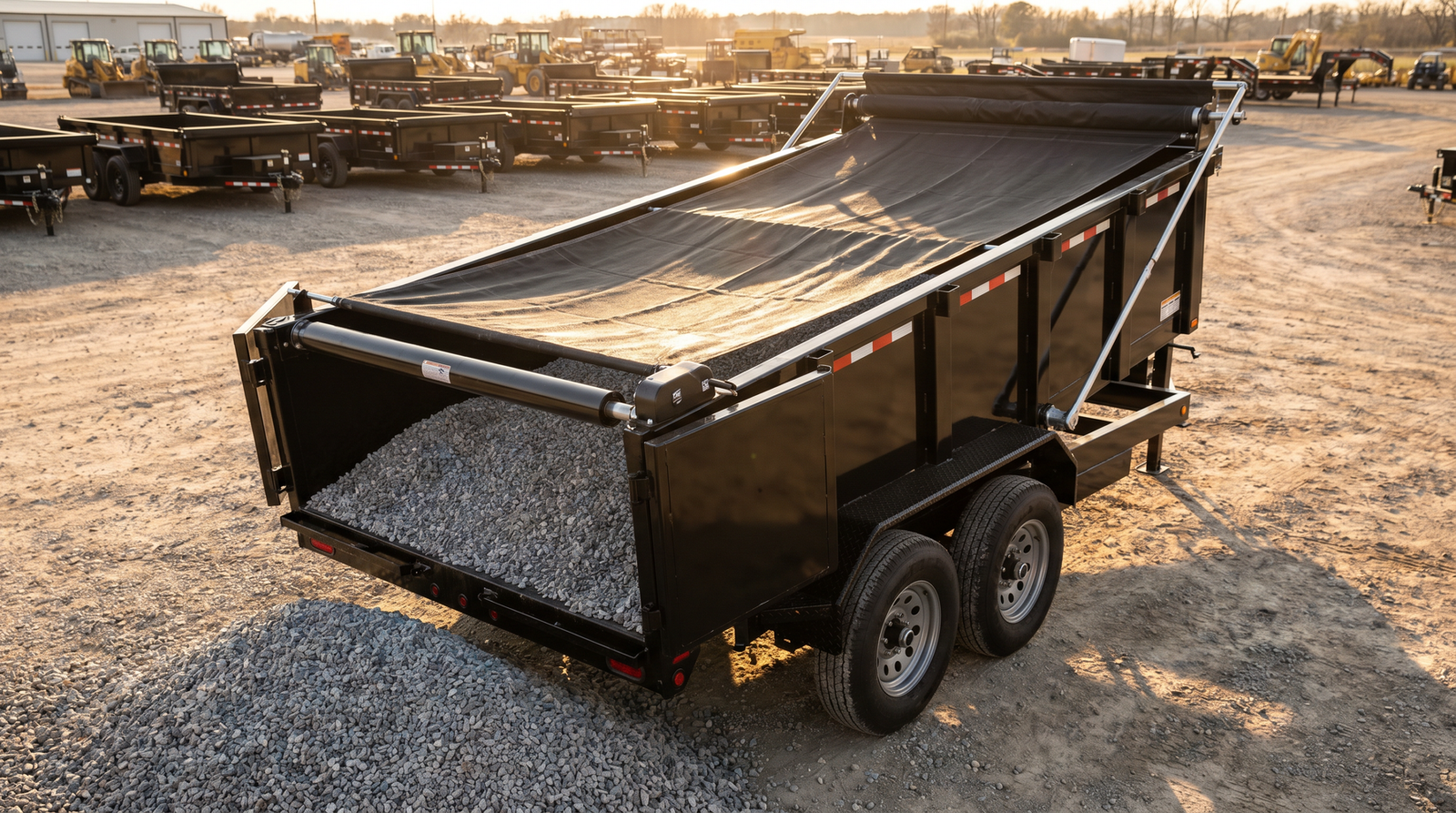
The basic kit. A spring-loaded roller mounts at the front of the bed; you walk back and pull a hand crank or a strap to roll the tarp over the load and tie it off. Cost: $250–$450 installed. Best for: 5×8, 5×10, and small 6×12 dump trailers used a few times a week. Pros: cheap, mechanically simple, almost nothing to break. Cons: rolling is awkward in wind, slower than electric, and you have to climb on the trailer to fix tangles.
2. Manual Side-Roll (Wind-Up)
A wind-up arm at the front of the bed cranks the tarp open and closed via a hand-operated gearbox. Stronger geared mechanism than the basic roller, easier to operate one-handed. Cost: $400–$650 installed. Best for: 7×12, 7×14, and 7×16 dumps where reach matters. Pros: faster than hand-crank, smoother operation, durable in cold weather. Cons: still manual, still requires walking around the trailer.
3. Electric Roll-Top
A 12-volt motor (powered off the trailer’s pump battery or a dedicated battery) drives the same roller mechanism with a dash-mounted or wireless remote. The most popular upgrade in the dump trailer tarp kit category. Cost: $650–$1,200 installed. Best for: anyone tarping 5+ times per day or working in wet/cold climates. Pros: tarp open or closed in 8–12 seconds, hit the switch from the cab, dramatically reduces wear and tear on your back. Cons: motor and wiring add failure points, replacement motors run $150–$300.
4. Automatic Flip-Tarp (Side-Arm)
A spring-loaded side-arm sweeps the tarp over the load like a rainbow arc, controlled from the cab. Most expensive, most rugged, and the choice of municipal and high-frequency commercial fleets. Cost: $1,500–$3,500 installed. Best for: gooseneck deckover dumps, 8×20+ trailers, contractors hauling 10+ loads per day. Pros: fastest open/close cycle in the industry, holds up to wind better than rollers, no walking around the trailer. Cons: high price, requires structural mounts, more parts to maintain.
Top Dump Trailer Tarp Kit Brands Compared in 2026
Five brands dominate the dump trailer tarp kit market. Here’s where each one wins and where each one falls short.
Mytee Products
Mytee’s DTR Series is the value play. Telescoping aluminum roller fits 60–96 inch beds, double-pocket mesh PVC tarp standard, available in manual or electric. Pros: best price-to-quality ratio, parts are easy to source. Cons: motor on the electric kit is good but not best in class. Ideal for: small landscaping crews and DIY buyers.
Roll·Rite
Roll·Rite’s TarpMaster Series is the gold standard for electric roll-top systems. Built in Michigan, used by municipal fleets nationwide. Their 12V motor is rated for 100,000+ cycles. Pros: bulletproof reliability, excellent dealer network, motors covered by 3-year warranty. Cons: 20–30% premium over Mytee. Ideal for: contractors running 1+ trailers daily.
Donovan / Shurco
Donovan (now part of Shurco) is the original North American tarp kit company. Their automatic flip-tarp system is what you’ll see on most municipal dump trucks. Pros: rugged enough to survive a rollover, parts cross-compatible with truck units, lifetime support. Cons: starts around $1,800 — overkill for most homeowner-grade dump trailers. Ideal for: commercial fleets, ready-mix, and waste haulers.
Mountain Tarp
Specializes in heavy-duty mesh and vinyl tarps with a focus on agriculture and aggregate. Their roller systems sit between Mytee and Roll·Rite on price. Pros: tarp fabric quality is excellent, good for chunky aggregates that abrade cheaper materials. Cons: smaller distribution network on the West Coast. Ideal for: farmers, ranchers, and quarry hauling.
Buyers Products
Buyers makes the OEM tarp kit you’ll find pre-installed on many CAM, BWise, and Big Tex factory dump trailers. Solid mid-tier kit at a fair price. Pros: factory fitment guaranteed if your trailer came with the prep, easy upgrade path to electric. Cons: tarp fabric is average; expect to replace at year 5–6. Ideal for: factory-equipped trailer buyers.
| Brand | Best Type | Typical 2026 Price | Best For |
|---|---|---|---|
| Mytee Products | Manual or Electric Roll | $300 / $700 | Value, DIY install |
| Roll·Rite TarpMaster | Electric Roll | $900–$1,200 | Daily commercial use |
| Donovan / Shurco | Automatic Flip | $1,800–$3,500 | Fleet, municipal, severe duty |
| Mountain Tarp | Manual or Electric | $450–$950 | Aggregate, farm |
| Buyers Products | Manual or Electric Roll | $400–$850 | OEM upgrade, factory prep |
How to Pick the Right Dump Trailer Tarp Kit
Three questions settle most decisions. First, how often do you tarp? If it’s 1–2 loads a week, manual is fine. If it’s 3+ loads a day, electric pays for itself in saved time within the first season.
Second, how long is your bed? Roller systems work on 8–16 foot beds without issue. Beds longer than 16 feet (deckover gooseneck dumps, for instance) need either a longer roller axle or an automatic flip-tarp — a single roller arm can’t keep tension over 18+ feet without sag.
Third, what’s your climate? In the salt belt or wet Pacific Northwest, the motor and switch are your weak point. Pay the premium for a sealed Roll·Rite motor or upgrade the switch to a marine-grade unit. Cheap motors fail at year 2 in wet climates.
DIY vs Professional Installation
Manual hand-crank kits are genuinely DIY. Two people, three hours, basic hand tools. Drill four mounting holes, bolt the brackets, install the roller, attach the tarp. The kit ships with a printed manual that’s clear enough for a homeowner.
Electric kits are borderline. Mounting is the same, but you have to run a 10-gauge power cable from the trailer battery box to the motor, install an in-line fuse, and route a control cable to the cab connector. If you’ve never crimped a 12V terminal, pay a trailer shop $150–$250 to install. The wiring is what fails on most cheap installs, and a shop has the right crimper and heat-shrink.
Automatic flip-tarp systems are professional install only. The pivot mounts have to be welded or bolted to the frame at exact angles, and the cab control wiring is more complex. Budget $300–$500 for install on top of the kit price. Skip this only if you’re a fabricator yourself.
Maintenance and Lifespan
A well-maintained dump trailer tarp kit lasts 8–12 years. The fabric is the first thing to go — expect to replace the tarp itself every 4–7 years depending on UV exposure and abrasion from the loads you haul. Rocky aggregate is the harshest; topsoil and mulch are the easiest.
Lubrication matters. Every 90 days, hit the roller bearings with a marine-grade grease and the gearbox with the oil specified in the manual. Wipe down the tarp itself once a season with mild soap and water to prevent UV degradation. For more on overall trailer upkeep, see our dump trailer maintenance tips.
Motor failures on electric kits are usually preventable. Charge the deep-cycle battery after every use, keep the motor cover sealed, and check the in-line fuse twice a year. A blown 30A fuse fakes a “dead motor” 70% of the time — always check the fuse before you assume the worst.
State Legal Requirements: Quick Reference
Twenty-eight states explicitly require covered loads for dump operations. Another 14 require it implicitly under “securement” rules. Here are the major ones. TrailersPlus has a complete state-by-state list if your state isn’t here.
- California: Required for all aggregates and waste; $160–$1,000 fine.
- Colorado: Tarp or cover required for aggregates, trash, recyclables.
- Texas: Required if any material can escape; $25–$200 fine plus possible misdemeanor.
- Florida: Required; $60–$1,000 fine plus possible imprisonment.
- Washington: Required for any visible material; $216 base fine.
- New York: Required; $150–$500 fine.
Common Questions About Dump Trailer Tarp Kits
Can I install a dump trailer tarp kit on a trailer that wasn’t pre-wired?
Yes. Most factory dump trailers have a 12V wire run from the front box to the rear, but if yours doesn’t, a basic install runs a 10-gauge cable along the frame in 1–2 hours. Buyers, Mytee, and Roll·Rite all sell wiring kits as add-ons.
What size tarp do I need?
Add 12 inches to your bed length and 24 inches to your bed width. A 6×12 trailer with 24-inch sides needs a 7×14 tarp minimum. Going larger gives slack for tucking around irregular loads.
Mesh tarp or solid vinyl tarp?
Mesh for aggregates, mulch, leaves, and most trade haul — it sheds water and weight. Solid vinyl for fine dust, ash, asbestos abatement, or anything that absolutely cannot blow out. Solid is heavier and slower to roll but seals tighter.
Will a tarp kit fit my gooseneck deckover dump?
Most rollers fit up to 16-foot beds. Anything longer needs either a custom-length roller axle or an automatic flip-tarp. Both Roll·Rite and Donovan make 18–20 foot rollers as special order.
How long does a quality tarp itself last?
4–7 years for mesh, 5–9 years for solid vinyl. UV exposure is the biggest factor; covered storage adds 2–3 years.
Is a dump trailer tarp kit tax deductible?
If the trailer is used for business, yes — the tarp kit is part of the equipment cost basis and can be expensed in the year of purchase under Section 179. Talk to your CPA before filing.
Ready to Buy?
The right dump trailer tarp kit is one of the most underrated upgrades you can make. It pays for itself in fines avoided, time saved, and equipment longevity within a single season for any working contractor.
Browse dump trailers for sale on our inventory page — every model lists which tarp kit options are factory-prepped, so you can spec your trailer and tarp together for a clean delivered price.
Need help picking? Request a free delivered quote with your tarp kit preferences and we’ll send a complete out-the-door price within one business day. Free delivery to all 50 states from PrimeLoad Trailers.