Looking for camper trailers for sale? You’ve found one of the largest online lineups in America, with free delivery to all 50 states. This guide walks you through every detail you need before you buy, from sizes and lift mechanisms to 2026 pricing and brand reputations.
Camper Trailers For Sale in 2026: What Smart Buyers Watch For
The trailer industry has shifted under buyers’ feet over the last three years. Anyone shopping camper trailers for sale in 2026 faces more transparent pricing, better delivery logistics, and bigger spec sheets than ever. The federal FMCSA CDL rules for towing have not changed (no CDL needed under 26,001 lbs combined GVWR), but how dealers package camper trailers for sale listings has. Free nationwide delivery, side-by-side spec comparisons, and out-the-door pricing are now the norm at any reputable dealer. Don’t accept anything less.
Brand selection matters too. The NHTSA tire safety standards govern how every trailer-rated tire performs at GVWR; brands that buy lower-rated tires to hit a price point are easy to spot once you know what to look for. Whether you’re a first-time buyer or your fifth purchase, finding the right camper trailers for sale comes down to two things: matching capacity to use and trusting the brand to back the build. This guide walks you through every variable that matters before you sign.
nn
Walk onto any RV lot in May and you will see two kinds of shoppers. The first knows exactly what they want, has their tow vehicle figured out, and just needs a price. The second has been scrolling listings for three months and feels more confused than when they started. This guide is built for the second shopper, and it should sharpen up the first one too.
At PrimeLoad Trailers in Woodland, WA, we have spent 15 years selling camper trailers to families, retirees, weekend warriors, and full-timers. Travel trailers are our biggest single category right now with 102 units in stock across brands like Dutchmen Kodiak, Crossroads RV, Forest River, Jayco, Wildwood, Salem, Cherokee, Hampton, Redwood, and Cascade. Every one of them ships with free nationwide delivery to all 50 US states. This article covers what actually matters when you are shopping camper trailers for sale, written by people who handle them every single day.
Camper, Travel Trailer, RV: Terminology Sorted
The words get used interchangeably online, but on a sales lot they mean different things. Getting the language right saves you hours of looking at the wrong product.
- Pop-up camper: A folding hard-sided base with canvas or vinyl tent walls that pop up at the campsite. Light, cheap, low ceiling, and you set them up every night.
- Hybrid camper: A hard-sided travel trailer with fold-out tent bunks on one or both ends. You get more sleeping room without the towed length, but the tent ends are not great in heavy rain or cold weather.
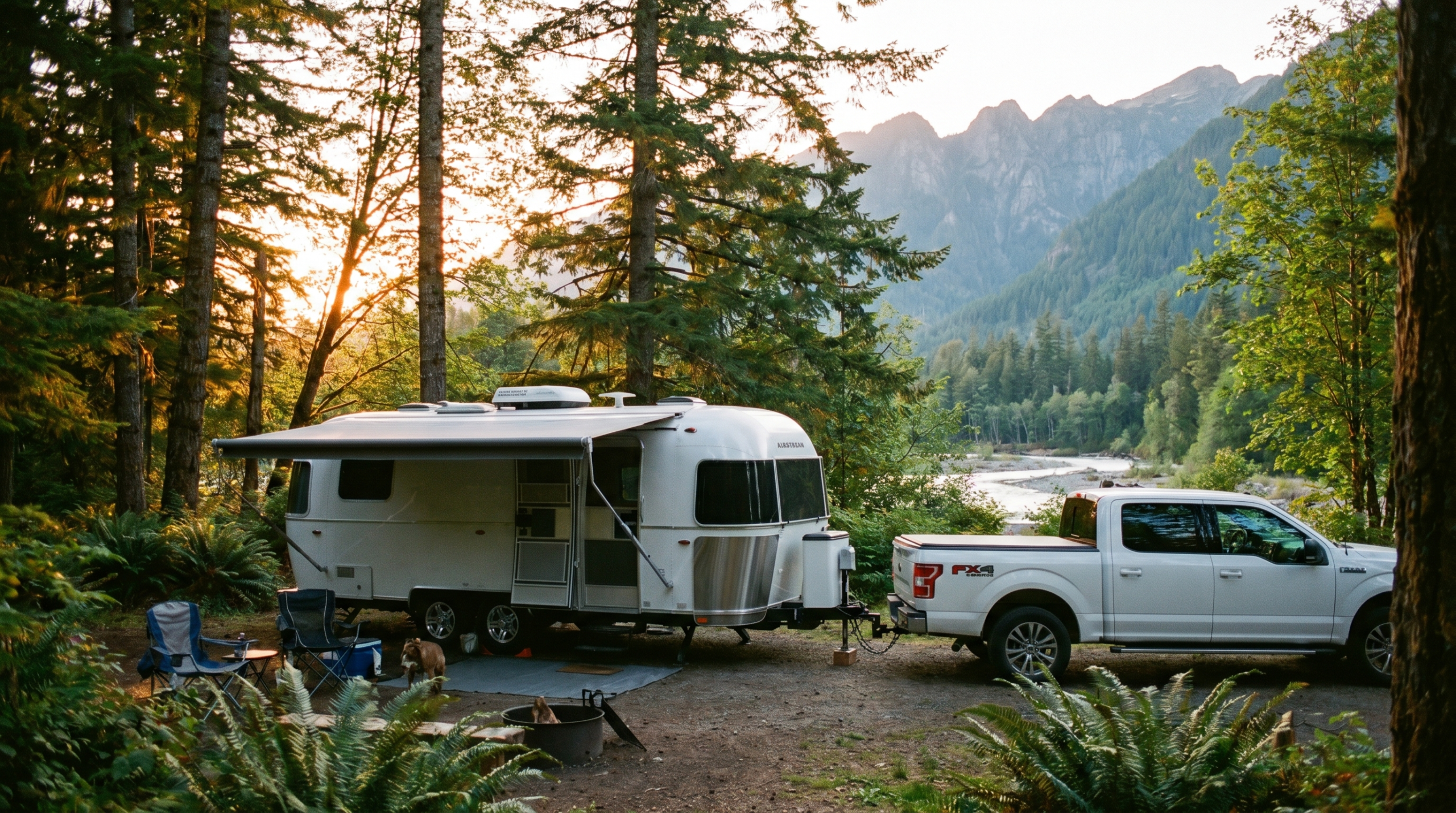
- Travel trailer: The most common category. Hard-sided, fully enclosed, towed by a bumper-pull or frame-mounted hitch on a truck or capable SUV. Length runs from about 13 ft to 40 ft.
- Fifth-wheel: A trailer that connects to a hitch in the bed of a pickup truck, not on the rear bumper. More stable in the wind, taller interior, but requires a 3/4-ton or 1-ton truck for most models.
- Toy hauler: A travel trailer or fifth-wheel with a rear garage and ramp door for hauling motorcycles, ATVs, side-by-sides, kayaks, or e-bikes. The garage usually doubles as bunk space when the toys are unloaded.
- Teardrop: A small, aerodynamic camper with a sleeping cabin and a rear galley hatch. Often under 2,000 lb dry, towable by midsize SUVs and even some sedans.
If somebody calls anything on wheels an RV and you ask follow-up questions, the conversation moves faster.
Travel Trailer Sizes Explained
Length matters more than almost any other spec. It controls what you can tow, where you can park, and which campgrounds will accept you. Here is how the four common size brackets break down.
Under 20 ft
Best for couples, solo travelers, and anyone with a half-ton SUV or midsize truck. Dry weights typically run 2,800 to 4,500 lb. You can park these in a standard driveway, tow them through tight forest service roads, and fit them into national park sites that ban anything over 21 ft. The trade-off is a tight bathroom, no real bunkhouse, and one slide-out at most.
20 ft to 25 ft
The sweet spot for small families and first-time buyers. Dry weights run 4,500 to 6,500 lb. You get a real queen bedroom, a dinette that converts to a bed, and often a single set of bunks. Most half-ton trucks and full-size SUVs can tow these comfortably. Our top movers in this bracket are the Dutchmen Kodiak SE and Forest River Salem Cruise Lite.
26 ft to 30 ft
Family trailers. Dry weights jump to 6,000 to 8,000 lb. Floor plans now include double bunks, a real bathroom with a tub, and one or two slides. The 2024 Dutchmen Kodiak SE 27SBH sits right in this range and is a strong family pick. Read our breakdown of the best travel trailer under 30 feet for first-time buyers if you are shopping this size.
30 ft and Up
Full-time and snowbird territory. Dry weights start at 7,500 lb and climb past 11,000 lb. Multiple slides, residential refrigerators, washer/dryer prep, and king beds become standard. You will need a 3/4-ton truck or a strong half-ton with the right tow package. Storage at home becomes a real consideration since most HOAs and city ordinances restrict rigs over 28 ft from sitting in a driveway.
Half-Ton Towable vs Heavier Towables
This is where most first-time buyers get tripped up. The sticker on the trailer says one weight. Your truck door jamb says another. The actual math involves four numbers.
Dry weight (UVW): What the trailer weighs empty from the factory. No water, no propane, no gear, no people.
GVWR: Gross Vehicle Weight Rating. The most the trailer is allowed to weigh fully loaded. This is the number to plan around.
Tongue weight: The downward force the trailer puts on the hitch ball. Usually 10 to 15 percent of the loaded trailer weight. A 7,500 lb loaded trailer puts 750 to 1,125 lb on your hitch.
Payload: What your truck can carry, including passengers, cargo, and tongue weight. Find this on the yellow sticker inside the driver door. A 2024 F-150 SuperCrew with the 2.7L might only have 1,400 lb of payload, which gets eaten fast by a family of four and a 900 lb tongue.
Quick rule: take the trailer’s GVWR, multiply by 0.13, and that is the tongue weight you should plan for. If your remaining payload after passengers and gear is less than that number, you need a bigger truck or a smaller trailer. Half-ton towable means a trailer with a GVWR around 7,500 lb or less, paired with a properly equipped half-ton pickup. Anything heavier really does want a 3/4-ton.
Best Camper Trailers by Use
Match the trailer to how you will actually use it, not how you imagine using it after three glasses of wine on a Friday night.
Weekend Camper
You want under 25 ft, single axle or light tandem, basic kitchen and bathroom. The Forest River Salem FSX, Wildwood X-Lite, and Dutchmen Kodiak SE 24RBSL all hit this brief. Dry weight under 5,500 lb keeps your tow vehicle options open.
Family Vacation
Bunkhouse floor plan, 26 to 30 ft, a real bathroom, outdoor kitchen if you can swing it. Look at the 2025 Dutchmen Kodiak Ultra-Lite 280BHSL, the Jayco Jay Flight bunkhouse models, and Cherokee Grey Wolf bunk plans.
Full-Time RVer
You need 30 ft or more, multiple slides, residential fridge, true four-season insulation, and ducted heat. Redwood fifth-wheels, larger Jayco Eagle units, and the 2025 Dutchmen Kodiak Ultimate 2921FKDS with the front kitchen and dual slides all live in this category.
Snowbird
Lighter than full-time, but still long enough to live in for three to four months. Look for sun-belt friendly features: high-output AC, light exterior color, electric awning, and good kitchen counter space. A 28 to 32 ft single-slide travel trailer is the sweet spot.
Off-Grid Boondocking
Solar prep, large fresh water tank (50+ gallons), 12-volt fridge option, and good ground clearance. The Cherokee Black Label and Forest River No Boundaries lines are built for this. Battery setup matters more than length.
Toy Hauler
Rear garage with ramp door, fuel station, dedicated 30-amp generator. Sizes from 24 ft (one motorcycle, one ATV) to 41 ft (full UTV plus side-by-side). Cherokee Wolf Pack and Forest River XLR Boost are the volume sellers.
Top Brands Compared
Brand reputation in the RV world shifts every few years as parent companies change owners and supplier relationships. Here is how the brands we carry stack up in 2026.
Dutchmen Kodiak
Mid-tier value with surprisingly strong build quality for the price point. Aluminum-framed walls, Azdel composite skin, and 12-volt LED everything as standard. The Kodiak SE, Ultra-Lite, and Ultimate trims cover everything from weekend rigs to full-time floor plans. Customer feedback is consistently strong on warranty support too.
Crossroads RV
Owned by Thor Industries. The Volante and Cruiser Aire travel trailers compete in the mid-tier with solid floor plans and good towing weight ratios. They run a hair lighter than Dutchmen for similar floor plans.
Forest River
The largest RV manufacturer in North America. Forest River umbrella covers Salem, Wildwood, Cherokee, Cedar Creek, R-Pod, and dozens more sub-brands. Build quality varies by sub-brand, but the consistent strength is parts availability. If something breaks, every dealer in the country can source the part.
Jayco
Premium build for the mainstream price bracket. The 2-year warranty (most competitors offer 1) and the Magnum Truss roof system are real differentiators. Jay Flight bunkhouse models are a perennial top seller for families.
Wildwood
Entry-level pricing inside the Forest River umbrella. Floor plans are practical, finishes are basic, but the price gets families on the road. Good first trailer if your budget is tight.
Cherokee
The Cherokee, Grey Wolf, and Wolf Pup lines stretch across price tiers. Grey Wolf bunkhouse models are a top family pick, and the Wolf Pack toy haulers compete head to head with XLR.
Floor Plans That Work
A great floor plan ages well. A bad one nags at you for the entire ownership period. Five layouts dominate the market.
Bunkhouse: Double bunks at the rear with a private bedroom up front. Best for families with two or more kids. The kids get their own zone, and you get the door-closing master.
Rear kitchen: The galley is at the back of the trailer, often with a window over the sink. You sacrifice rear lounging space, but you gain a much bigger kitchen and counter run. Couples love this layout.
Front bedroom: The traditional layout. Master up front, living and kitchen in the middle, dinette or sofa in the rear. Predictable, balanced weight distribution, easy to service.
Mid-bath: Bathroom in the middle of the trailer instead of the rear corner. Splits living areas from sleeping, gives you more bathroom space, and improves traffic flow.
Slide-out variants: One slide on the curb side opens the living room. Opposing slides on both sides feel huge but add weight and break points. Three or more slides really only make sense in 35 ft and longer rigs.
Toy hauler garage: 10 ft, 12 ft, and 14 ft garage lengths are standard. The garage doubles as a second living room, a workshop, or bunk space when the side bunks fold down.
What to Check Before Buying
Whether new or used, walk through this checklist on every trailer you seriously consider. New trailers are not immune to factory defects, and used trailers hide their history.
- Delamination: Stand at the front and rear corners, then sight down the side walls. Any wave, ripple, or bubble in the fiberglass means the outer skin has separated from the underlying foam. Repair runs $4,000 to $12,000.
- Soft spots: Walk every square foot of the floor. Press gently along window walls and around the toilet. Spongy areas mean water has gotten into the subfloor. This is the single most expensive defect to fix.
- Roof condition: Climb up if the dealer allows it. Check for cracked sealant around the AC, vents, antennas, and skylights. Reseal jobs run $300 to $800 if caught early. A delaminated roof is closer to $5,000.
- Axle weight rating: Look at the axle ID tag. The combined axle rating must equal or exceed the trailer’s GVWR. Underrated axles are a red flag on used units that have been modified.
- Water heater: Pull the cover. Look for corrosion on the burner tube and rust streaks on the tank. Atwood and Suburban units are field-serviceable.
- AC unit BTU: 13,500 BTU is standard. 15,000 BTU is preferred if you camp south of Tennessee in summer. A second bedroom AC unit becomes meaningful in trailers over 32 ft.
- Tank capacities: Fresh water 30 to 60 gallons. Gray water 30 to 80 gallons. Black water 30 to 50 gallons. Bigger tanks equal longer boondocking stretches.
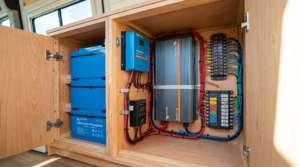
- Battery setup: A single Group 24 lead-acid battery is bare minimum. Two 6-volt golf cart batteries in series, or a 100Ah lithium, is a real upgrade. Check the battery box for corrosion and proper hold-downs.
- Solar prep: Most modern trailers have a roof-mounted solar plug and a wall-mounted controller pre-wire. Confirm both. Adding solar to a non-prepped trailer adds $400 to $700 in labor.
- Slide-out integrity: Run every slide all the way out, then all the way in, and listen. Grinding, hesitation, or uneven sealing means the rails or motor need attention.
If buying used, get an independent RV inspection. The $300 to $500 fee saves an average of $4,000 in surprises, according to the National RV Inspectors Association data. Our new vs used trailer comparison goes deeper on the financial side of that decision.
Towing Considerations
The trailer is only half the system. Set the tow vehicle up right, and a 7,000 lb trailer feels stable at 65 mph. Skip a step, and the same trailer turns into a white-knuckle ride.
Weight distribution hitch: Required for any trailer over about 5,000 lb loaded. The bars transfer tongue weight back onto the trailer axles and forward onto the truck’s front axle. Equal-i-zer and Andersen are the two top brands.
Sway control: Built into most modern weight distribution hitches as friction sway control. For longer trailers and windier routes, a dual-cam or 4-point sway system is worth the upgrade.
Brake controller: Federal law in most states requires electric trailer brakes on any trailer over 3,000 lb GVWR. The controller mounts under the dash and modulates braking force from the trailer. Many newer trucks have this factory-integrated.
Payload truck math: Run this simple check before you sign. Open your truck door. Find the yellow payload sticker. Subtract passenger weight, subtract gear in the bed, subtract weight distribution hitch weight (about 100 lb), then subtract estimated tongue weight. If the number is positive, you are good. If it is negative or single digits, get a bigger truck or a lighter trailer.
Camper Trailer Pricing in 2026
Pricing softened in late 2025 as inventory caught up with demand and interest rates eased. Here is what real out-the-door pricing looks like in 2026, before any incentives.
- Pop-ups and small teardrops: $9,000 to $22,000
- Single-axle travel trailers under 22 ft: $18,000 to $32,000
- Mid-size travel trailers 22 to 28 ft: $26,000 to $48,000
- Large travel trailers 28 to 34 ft: $38,000 to $62,000
- Premium travel trailers and entry fifth-wheels: $55,000 to $85,000
- Full-spec fifth-wheels: $75,000 to $140,000
- Toy haulers: $42,000 to $110,000 depending on garage length and finish level
Used pricing typically runs 20 to 35 percent below new MSRP for trailers 2 to 4 years old, and 40 to 55 percent below for 5 to 8 year old units in good condition. The sweet spot for used buyers is 2 to 3 model years old, where you get most of the depreciation hit absorbed by the previous owner without inheriting major maintenance issues yet.
Free Nationwide Delivery
Here is the part that surprises most online shoppers. PrimeLoad delivers every trailer we sell to all 50 US states for free. No fuel surcharge, no per-mile fee, no gimmick.
How it works:
- You browse our 102 in-stock travel trailers online or call us. We can walk through any unit by video tour.
- You pick the trailer and lock in pricing. We confirm specs, finance options, and your delivery address.
- We schedule a transport carrier from our Woodland, WA yard. Most deliveries arrive within 7 to 14 days.
- Your trailer arrives at your driveway, RV storage lot, or campground gate. We provide setup support and a delivery walk-through by phone.
The reason this works: we sell enough volume that we have established carrier relationships across the country, and we build the freight cost into our pricing model rather than tacking it on at the end. A buyer in Florida pays the same advertised price as a buyer 20 minutes from our lot in Vancouver, WA. Get a quote and see the all-in number for yourself.
How to Compare Camper Trailers For Sale Side-by-Side
Most buyers comparing camper trailers for sale get one or two spec lines wrong on their first pass.
Three numbers settle most decisions when you’re shopping camper trailers for sale: GVWR rating, frame gauge, and hydraulic pump brand. Spec sheets that bury these are a yellow flag.
Brand matters too. Reputable dealers list every camper trailer with full specs visible. We carry camper trailers for sale from every major manufacturer in our nationwide inventory.
Pricing on camper trailers for sale has stabilized in 2026 after the steel swings of the early 2020s. Whether you’re looking at entry-level camper trailer models or commercial-grade builds, the buying framework in this guide gives you a clean way to evaluate every option.
Ready to start? Browse camper trailers for sale on our inventory page to see every model with real photos, full specs, and our delivered out-the-door price.
Frequently Asked Questions
What truck do I need to tow a camper trailer?
For trailers under 5,000 lb GVWR, a midsize SUV or truck with a tow package handles the job. For 5,000 to 7,500 lb GVWR, a properly equipped half-ton like an F-150, Silverado 1500, or Ram 1500 with a tow package is the standard answer. For trailers over 7,500 lb GVWR, step up to a 3/4-ton like an F-250, Silverado 2500, or Ram 2500. Always run the payload math, not just the tow rating.
How much does camper trailer insurance cost?
Annual premiums run $300 to $1,200 for most travel trailers depending on value, coverage limits, and how often you use it. Full-timers pay more (typically $1,500 to $3,000) because the policy doubles as homeowners coverage. We break this down in our trailer insurance guide.
Where do I store a camper trailer when I am not using it?
Three options. Indoor storage runs $150 to $400 per month and protects from sun and weather. Outdoor covered storage runs $80 to $200 per month. Open lot storage runs $40 to $120 per month. Many owners store at home if their HOA and local ordinances allow it. Check rules before you buy because some neighborhoods prohibit RVs over 24 ft from sitting in a driveway.
Do I need to winterize a camper trailer?
Yes, if temperatures will drop below freezing where the trailer is stored. Winterizing involves draining the fresh water system, blowing out the lines with compressed air, and pumping RV antifreeze through every faucet, toilet, and drain. The job takes about an hour and costs $20 in antifreeze, or $80 to $150 at a service center. Skipping winterization causes burst water lines that run $400 to $1,500 to repair.
How well do camper trailers hold their resale value?
Travel trailers depreciate roughly 18 to 22 percent in year one, then 8 to 12 percent annually for years two through five. Premium brands (Airstream, Oliver, Jayco) hold value better than entry-level. Toy haulers tend to hold value well because used inventory is thinner. Bunkhouses depreciate faster because the bunk floor plan ages out of family use.
Should I buy new or used?
New gives you a factory warranty, current floor plans, and zero hidden history. Used saves you 30 to 50 percent on the same square footage at the cost of inheriting whatever the previous owner did or did not maintain. For first-time buyers who plan to keep the trailer five plus years, new often pencils out better. For occasional users, lightly used (2 to 3 years old) offers the best value per dollar.
How long do camper trailers last?
A well-maintained travel trailer lasts 15 to 25 years. The two killers are water intrusion (resealed roofs every 2 to 3 years prevents this) and tire age (replace every 5 to 7 years regardless of tread). Frame and structure typically outlast both.
Ready to Find Your Camper Trailer?
You now know more about camper trailers for sale than 90 percent of buyers walking onto a lot today. The next step is matching that knowledge to actual inventory.
PrimeLoad has 102 camper trailers in stock right now across Dutchmen Kodiak, Crossroads RV, Forest River, Jayco, Wildwood, Salem, Cherokee, Hampton, Redwood, and Cascade. Every unit ships free to your driveway anywhere in the 50 states. We have been doing this for 15 years from our independent yard in Woodland, WA, and we answer the phone the same way whether you are buying your first weekend trailer or your fourth full-time rig.
Browse the full inventory: Travel trailers for sale at PrimeLoad
Want a personalized quote with delivery to your zip code? Request your free quote here
Call us, email us, or hit the quote form. We will respond same day with real numbers, real availability, and real delivery timelines. No pressure, no padding, just the trailer that fits your truck, your family, and your budget.