First-time travel trailer buyers almost always start by looking at the biggest, most-amenitized models on the lot. The 38-foot fifth-wheel with three slide-outs, residential kitchen, king bed, and washer-dryer hookup is appealing on paper. The reality of towing it home is humbling.
For most first-time buyers, the right trailer is shorter, lighter, and simpler than they initially expect. Under 30 feet is the sweet spot. This guide explains why and what to look for.
Why 30 Feet Is the Sweet Spot
Towability. Trailers under 30 feet weigh 4,500 to 7,500 lbs dry, which means 6,500 to 9,500 lbs loaded. Most modern half-ton pickups and full-size SUVs handle this without weight-distribution gymnastics. Above 30 feet, dry weights climb to 8,500+ lbs and you\’re towing 11,000+ lbs loaded, which pushes most half-ton trucks beyond comfortable operating range.
Campsite access. Many state parks, national parks, and older private campgrounds have site length limits of 28 to 32 feet. A 26-foot travel trailer fits almost anywhere. A 35-foot trailer is rejected by site reservations regularly.
Maneuverability. Backing a 24-foot trailer into a campsite is teachable in an afternoon. Backing a 38-foot trailer into a tight site requires real practice and patience. First-timers learning to back up benefit enormously from a shorter trailer.
Storage. 26 to 28 foot trailers fit in most residential storage facilities. 35+ foot trailers often require specialty long-term RV storage with significantly higher monthly fees.
Cost. Trailers under 30 feet cost $25,000 to $50,000 in this market. 35+ foot destination trailers cost $55,000 to $90,000. The first trailer doesn\’t need to be the forever trailer.
Weight Categories Under 30 Feet
Compact (20 to 24 feet, 3,500 to 5,500 lbs dry)
Single-axle trailers. Tow easily behind a half-ton pickup or a 6-cylinder full-size SUV. Sleep 2 to 4 in a queen-bed master and dinette/sofa fold-out. Wet bath (shower-toilet combo). Smaller fridge, cooktop, microwave. No slide-outs or single small slide. Use case: weekend campers, couples, retirees. Brand examples: Forest River R-Pod, Jayco Jay Flight SLX, Coachmen Apex Nano.
Mid-size (24 to 28 feet, 5,500 to 7,000 lbs dry)
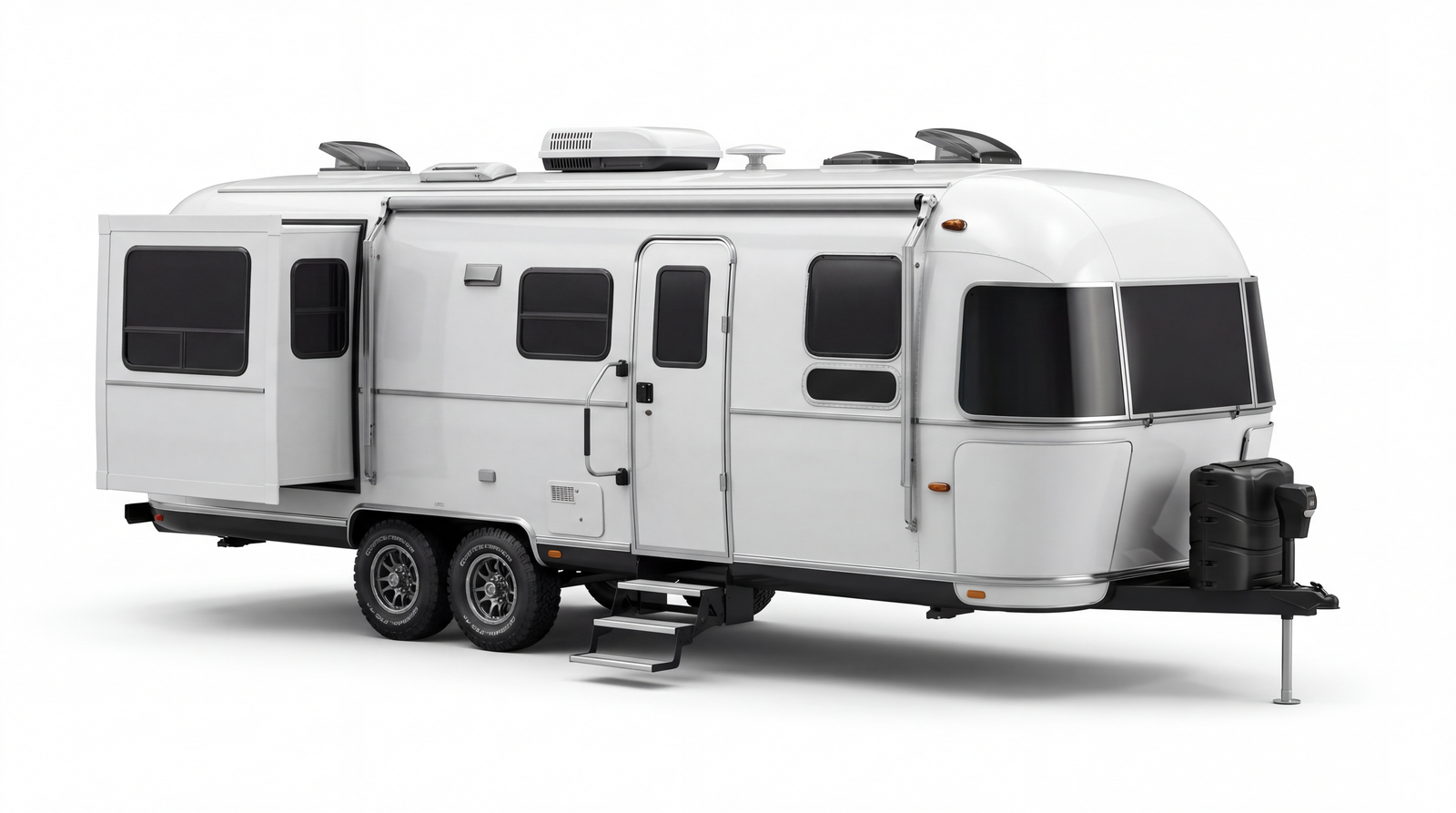
Tandem-axle trailers. Tow with a half-ton pickup with tow package or full-size V8 SUV. Sleep 4 to 6 with bunkhouse or rear-bed layouts. Dry bath (separate toilet and shower). Larger fridge (6 to 8 cubic feet), 3-burner cooktop, microwave, sometimes a stand-up shower. Often a single slide-out. Use case: families with 1 to 2 kids, frequent campers. Brand examples: Jayco Jay Flight, Forest River Salem, Crossroads Sunset Trail.
Larger under-30 (28 to 30 feet, 6,500 to 8,000 lbs dry)
Tandem-axle, often with one slide. Tow with a well-equipped half-ton or 3/4 ton pickup. Sleep 6 to 8 with bunkhouse or master bedroom layouts. Full bathroom, larger kitchens, sometimes outdoor kitchens. Use case: families of 4 to 6, longer trips, more extensive amenities. Brand examples: Jayco White Hawk, Forest River Vibe, Crossroads Hampton (lower trim).
Key Features for First-Time Buyers
Holding Tank Capacity
Fresh water tank (40 to 80 gallons), grey water tank (30 to 50 gallons), black water tank (25 to 40 gallons). Larger tanks mean longer stays without dumping. For full-hookup campgrounds, tank size matters less. For state park camping or boondocking, tank size determines how long you can stay.
Sleep Capacity vs Comfortable Sleep
Spec sheets often list sleep capacity counting every dinette and sofa fold-out. A trailer rated for 8 sleeps 4 comfortably. A trailer rated for 6 sleeps 4 comfortably. Plan based on actual beds, not sleep capacity.
Slide-Outs
Single-slide trailers add 50 to 80 square feet of floor space when extended. The trade-off: complexity, points of failure, weight, cost. For first-timers, single slide is fine. No-slide and double-slide trailers have their place but single-slide is the most common.
Awnings and Outdoor Living
Power awning is standard on most trailers above $25,000. Outdoor kitchens (with mini-fridge, sink, sometimes a grill) are a nice-to-have, not a must-have. Outdoor TV mounts are nice. Outdoor speakers are pointless because they\’re always too quiet to use.
Solar and Off-Grid Capability
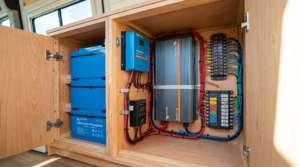
Most modern travel trailers are \”solar prep\” with a roof port for adding panels. Few come with panels installed. For boondocking, plan to add 200 to 400 watts of solar plus a battery upgrade ($1,500 to $3,500 aftermarket). For campground use, solar prep is fine.
Brand Context for First-Timers
Crossroads RV (Hampton, Sunset Trail, Volante). Strong fit-and-finish. Generous floor plans. Common in our 28 to 32 foot inventory. Higher-end interior appointments than entry-level brands.
Forest River. Largest US RV manufacturer with broad price points. Multiple sub-brands (R-Pod, Salem, Cherokee, Wildwood, Heritage Glen) covering compact to large. Excellent dealer network for parts and service nationwide.
Jayco. Family-owned manufacturer known for industry-leading 2-year structural warranty. Solid build. Common at the mid-price tier.
Real Costs Beyond the Purchase Price
The trailer itself is roughly half of total first-year RV cost.
- Hitch installation (weight-distribution + sway control): $400 to $800 if you don\’t already have one
- Brake controller (if your truck doesn\’t have it integrated): $150 to $400 installed
- Trailer registration and license plate: $50 to $300 depending on state
- Trailer insurance: $20 to $50/month
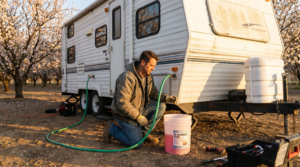
- Initial campground equipment (water hose, sewer hose, leveling blocks, chocks, surge protector): $300 to $600
- First-year campground fees: $500 to $3,000 depending on usage
Total first-year cost beyond purchase: $1,500 to $5,000. Plan for it.
First-Time Travel Trailer Buyer Questions
What size travel trailer is best for a beginner?
For first-time buyers, 24 to 28 feet is the sweet spot. Light enough for half-ton pickups, fits most state park campsites, sleeps 4 to 6 comfortably, and storage at home is manageable. Avoid 35+ foot trailers as your first RV.
Can I tow a 28-foot travel trailer with my Tahoe?
Most modern Tahoes (with V8 and tow package) tow 8,000 to 9,000 lbs. A 28-foot travel trailer typically weighs 5,500 to 7,500 lbs loaded, well within Tahoe range. Verify your specific year and configuration\’s tow rating in the owner\’s manual.
How much does a travel trailer weigh?
Compact (20-24 ft): 3,500 to 5,500 lbs dry. Mid-size (24-28 ft): 5,500 to 7,000 lbs dry. Larger (28-30 ft): 6,500 to 8,000 lbs dry. Always add 1,500 to 3,000 lbs for water, propane, gear, and food when calculating real-world towed weight.
Slide-outs or no slide-outs?
Single slide is the most common configuration and a good balance of space, complexity, and cost. No-slide trailers are simpler and lighter (good for tight campgrounds). Multiple slides add space but also weight, complexity, and points of failure. For first-timers, single slide is recommended.
What's the difference between dry weight and gross weight on a travel trailer?
Dry weight is the unloaded factory weight. Gross weight (loaded) includes water (40 to 80 gal fresh = 320 to 640 lbs), propane (60+ lbs full), batteries, gear, and people. Real-world gross weight is almost always 1,500 to 3,000 lbs higher than dry weight.
Is a travel trailer a good first RV?
Yes. Travel trailers are simpler than motorhomes (no engine maintenance), more affordable, and you can disconnect at the campsite and use your tow vehicle for daily driving. Bumper-pull travel trailers under 30 feet are the most accessible entry point to RV ownership.
Related Guides and Inventory
Ready to buy? Get a free quote within 24 hours, or call us at (360) 560-5472.