Looking for utility trailers for sale? You’ve found one of the largest online lineups in America, with free delivery to all 50 states. This guide walks you through every detail you need before you buy, from sizes and lift mechanisms to 2026 pricing and brand reputations.
Utility Trailers For Sale in 2026: What Smart Buyers Watch For
The trailer industry has shifted under buyers’ feet over the last three years. Anyone shopping utility trailers for sale in 2026 faces more transparent pricing, better delivery logistics, and bigger spec sheets than ever. The federal FMCSA CDL rules for towing have not changed (no CDL needed under 26,001 lbs combined GVWR), but how dealers package utility trailers for sale listings has. Free nationwide delivery, side-by-side spec comparisons, and out-the-door pricing are now the norm at any reputable dealer. Don’t accept anything less.
Brand selection matters too. The NHTSA tire safety standards govern how every trailer-rated tire performs at GVWR; brands that buy lower-rated tires to hit a price point are easy to spot once you know what to look for. Whether you’re a first-time buyer or your fifth purchase, finding the right utility trailers for sale comes down to two things: matching capacity to use and trusting the brand to back the build. This guide walks you through every variable that matters before you sign.
nn
Shopping for a utility trailer is harder than it should be. Sizes overlap, brand specs read like spreadsheets, and half the dealers near you stock four units and call it a selection. PrimeLoad runs 107 utility trailers in stock right now, and after 15 years of independent trailer sales out of Woodland, WA, we have learned exactly what buyers ask, what tricks the marketing copy plays, and what actually matters once a load is strapped down.
This guide walks every decision in plain English. Sizes from 4×6 up to 7×20, single axle versus tandem, steel versus aluminum, brand-by-brand strengths, real 2026 pricing, and how our free nationwide delivery drops a brand new trailer in your driveway in any of the 50 states. By the end you will know which utility trailer for sale fits your truck, your work, and your budget.
What Is a Utility Trailer
A utility trailer is an open deck trailer built to haul loads that do not need weather protection. Lawn mowers, ATVs, landscaping debris, lumber, motorcycles, gravel, dirt bikes, small tractors, household moves, and shop equipment all ride on utility trailers every day. The defining traits are an open top, low side rails (usually 12 to 24 inches), a flat deck of wood or mesh, and either a single or tandem axle underneath.
Three numbers define every utility trailer:
- Deck size: width by length, measured between the fenders and from the front rail to the gate.
- GVWR: Gross Vehicle Weight Rating, the maximum total weight (trailer + cargo) the trailer is rated to carry.
- Payload: GVWR minus the empty trailer weight. This is what you can actually load.
A 5×8 single axle from Carry On might weigh 700 lbs empty with a 2,990 GVWR, giving you about 2,290 lbs of usable payload. A 7×16 tandem from Big Tex weighs around 2,100 lbs empty with a 7,000 GVWR, leaving roughly 4,900 lbs of payload. Always shop the payload number, not the GVWR.
Want to dig deeper into weight ratings before you buy? Read our utility trailer weight capacity and GVWR guide.
Utility Trailer Sizes Explained
Sizes are listed width by length. A 6×12 means a 6 foot wide deck, 12 feet long. Here is how the common sizes line up against payload, axle setup, and best use:
- 4×6: Single axle, around 1,995 GVWR, payload near 1,400 lbs. Two push mowers, light yard waste, motorcycle on a chock. Tows behind anything with a 2 inch ball, even compact SUVs.
- 5×8: Single axle, 2,990 GVWR, payload around 2,300 lbs. Single rider mower, ATV plus a cooler, plywood sheets laid flat. The starter trailer for most homeowners.
- 5×10: Single axle, 2,990 GVWR, payload around 2,200 lbs. Two ATVs end to end, a UTV without accessories, mid-size landscape loads. Easy to store in a one car bay.
- 6×10: Single axle, 2,990 GVWR, payload around 2,100 lbs. Wider deck handles a zero-turn mower with bagger, side-by-side UTV, and most household moves.
- 6×12: Single axle 2,990 or tandem 7,000 GVWR. The most popular size in America. Holds a 60 inch zero-turn, two ATVs side by side on the diagonal, or a half pallet of pavers.
- 7×12: Single axle 2,990 or tandem 7,000 GVWR. Wider 7 foot deck fits a Ford F-150 hood worth of mulch (about 4 cubic yards heaped) and most lawn care fleets.
- 7×14: Tandem axle, 7,000 GVWR, payload around 5,000 lbs. Step up for landscapers running 60-72 inch zero turns plus blowers, line trimmers, and a fuel station.
- 7×16: Tandem axle, 7,000 to 9,990 GVWR. Two zero turns nose to tail, a compact tractor with a bucket, or a small skid steer.
- 7×18: Tandem axle, 9,990 GVWR. Commercial landscaping, mid-size Kubota tractors, and full equipment days.
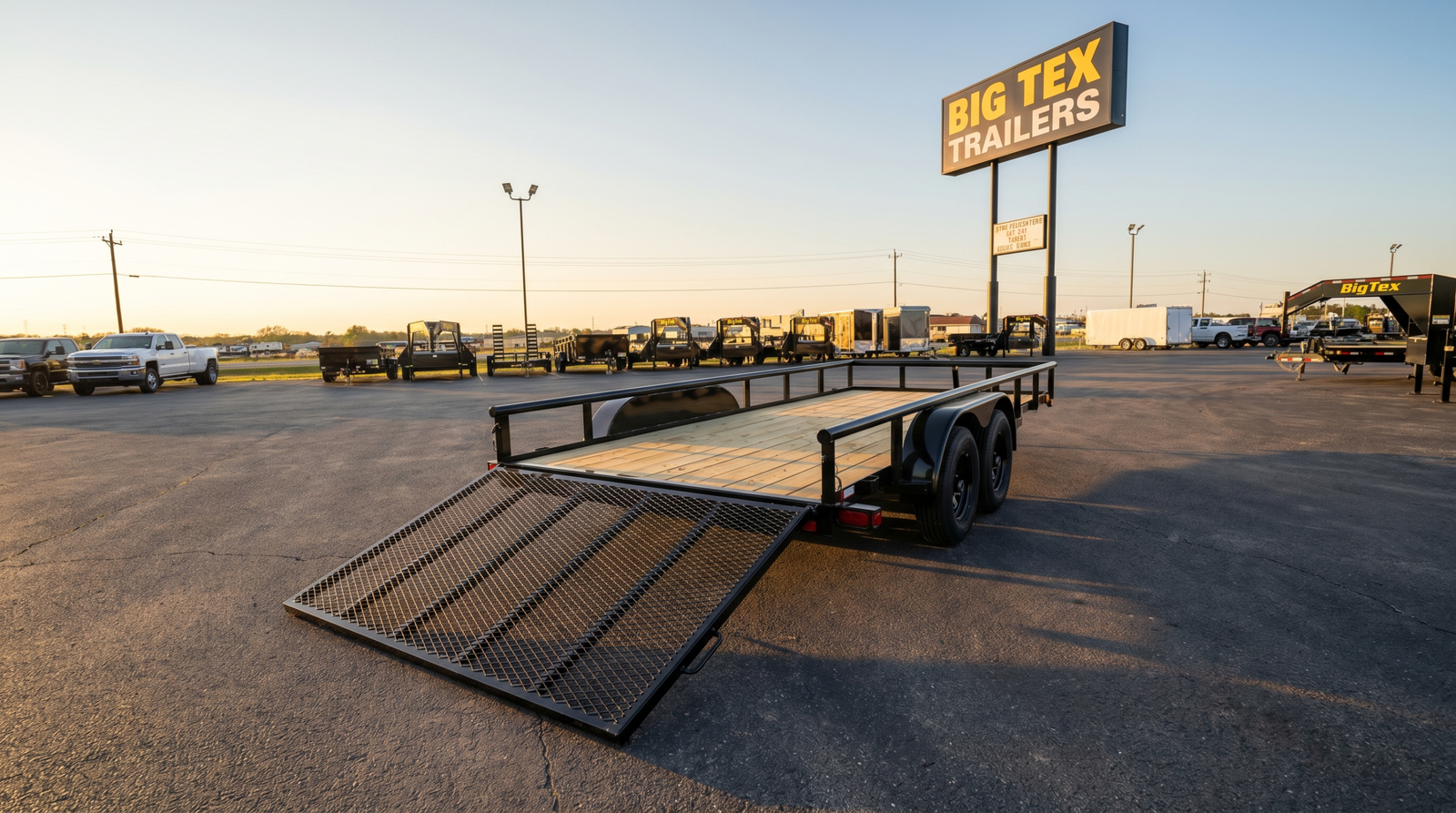
- 7×20: Tandem axle, 9,990 to 14,000 GVWR. Heavy use. Compact track loaders, mini excavators, two pallets of sod, full commercial cargo. The Big Tex 7×20 Landscape with Ramp Gate is the most requested size on our lot.
If you are torn between two sizes, go up. Trailers run cooler, ride better, and resell stronger when they are not maxed out every load.
Open Utility vs Landscape vs Heavy Duty
The category called “utility trailer” actually splits into three flavors. Picking the wrong one costs you money or leaves you swapping trailers in a year.
Open Utility (Standard)
Side rails of 12 to 15 inches, treated wood deck, flat tailgate or no gate at all. Best for hauling lumber, ATVs, motorcycles, and small loads where loose material is not a concern. Lighter empty weight means better tow mileage. A 5×10 standard utility from Carry On runs around $1,895 in 2026.
Landscape
Taller 18 to 24 inch mesh sides, mesh or solid ramp gate that folds flat for easy loading, removable rail uprights. Designed for lawn debris, mulch, mowers, and crew equipment that benefits from contained sides. The mesh sides keep grass clippings and leaves from blowing out on the highway. Almost every commercial landscaper buys this style. Big Tex 50LA and 60PI lines lead the segment, and our Big Tex 7×18 Landscape is a top seller for green industry crews.
Heavy Duty Utility
Tube main frame instead of channel iron, heavier 5,200 or 7,000 lb axles, dovetail tail (the rear 2-3 feet angles down to ease loading), and a 5 foot fold-up ramp gate. Heavy duty utility trailers cross over with equipment trailers and pull double duty for skid steers, mini excavators, and commercial mower fleets. Big Tex 70CH and the BWise UT series are the workhorses here.
Deck options matter too. Treated southern yellow pine is the standard, lasts 7-10 years, and is cheap to replace. Composite deck boards add 5 years of life and resist rot in wet climates. Steel mesh decks shed water and debris and are the choice for landscapers who haul wet sod. Aluminum extruded decks come on aluminum trailers from Sport Haven and ATC.
Single Axle vs Tandem Axle
This is the question buyers get wrong most often. The shop owner says “more axles equals better” and you end up paying for capacity you never use. Here is the honest math.
Single axle trailers carry one set of springs, two tires, and one set of bearings. Most are rated 2,990 or 3,500 GVWR. They are lighter, cheaper, easier to back up, simpler to maintain, and tow great on highway. The catch is that a flat tire on a single axle leaves you stranded on the shoulder, and any payload over about 2,800 lbs starts pushing the trailer past its rating.
Tandem axle trailers carry two sets of springs, four tires, and double the bearing maintenance. GVWRs run 7,000, 9,990, or 14,000. The benefits show up in three places: a tandem can limp home on three tires if one blows, payload roughly doubles, and the longer wheelbase tracks straighter at highway speed with heavy loads. The trade-offs are higher empty weight (200-400 lbs more), tighter turning circle, faster tire wear if you make tight pivots on pavement, and more drag on tow mileage.
Pick single axle if your loads stay under 2,500 lbs and your trailer length is 12 feet or shorter. Pick tandem if you regularly haul over 2,500 lbs, run trailers longer than 14 feet, tow on interstate highways, or carry equipment that you cannot afford to leave on the side of the road. Match the trailer to your truck with our trailer-to-tow-vehicle matching guide.
Materials: Steel vs Aluminum Utility
The two main frame materials behave very differently over a 10 year lifespan.
Steel utility trailers dominate the market. They are stronger pound-for-pound, cheaper to manufacture, easier to weld and repair, and accept any paint or powder coat finish. The downside is rust. Coastal users from Florida to the Pacific Northwest see surface rust appear in 3-5 years and structural rust in 8-12 if the trailer lives outside without coverage. Big Tex, Carry On, BWise, CAM Superline, Premier, and Mission all build steel utility trailers in volume.
Aluminum utility trailers from Sport Haven and ATC weigh 25 to 35 percent less than the equivalent steel unit. Lower empty weight means better tow mileage and more payload for the same GVWR. Aluminum will not rust, period, which makes it the obvious pick for salt air, snow belt road salt, and farms that wash mud off equipment weekly. The downsides are 30-50 percent higher purchase price, slightly more flex under heavy point loads, and harder field repair if you crack a weld.
The 10 year cost picture is closer than it looks once you factor in resale value, deck replacements, and rust repair. We broke down the numbers in our aluminum vs steel 10 year cost comparison. Short version: in dry climates steel wins on cost, in wet or salty climates aluminum often comes out ahead despite the higher sticker.
Best Utility Trailers by Use
Match the trailer to the job, not the other way around.
ATV and UTV Hauling
Two ATVs side by side need a 6 foot wide deck minimum. A 6×10 or 6×12 with a fold-up ramp gate handles two full size quads or a single side-by-side UTV. Tie-down D-rings recessed in the deck beat surface mounted hooks because they do not snag tires. Look for a 2,990 GVWR single axle for one machine, tandem 7,000 for two.
Lawn Care
For solo operators, a 6×12 single axle landscape trailer with mesh sides and a spring-assist ramp gate covers a 60 inch zero turn plus blowers and trimmers. Add a tool rack and a 2 gallon water cooler mount and you are working. Crews running multiple machines step up to a 7×14 or 7×16 tandem.
Hauling Tools and Lumber
A 5×10 or 6×10 standard utility with low 12 inch sides and a fold-down rear gate makes loading 8 foot studs and sheet goods painless. Steel mesh deck or treated wood both work fine. Skip the tall landscape sides because they get in the way when sliding lumber off the back.
Residential Moves
One bedroom moves fit a 5×10. Two bedroom moves call for a 6×12 or 7×12. A bi-fold or full size ramp gate plus removable side rails turns the trailer into a flatbed when you are sliding a couch on. Strap down with ratchet straps to flush mount D-rings and tarp the load.
Commercial Landscaping
Daily commercial use is brutal. Buy a tandem axle 7×16 or 7×18 landscape trailer with a 7,000 GVWR, removable mesh sides, mesh ramp gate, and brakes on both axles. Big Tex 70PI or BWise commercial models are built for this beating.
Hauling Small Equipment
Compact tractors with loaders, mini skid steers, and stand-on mowers fit on a 7×16 or 7×20 with a dovetail rear and a 5 foot fold-up ramp gate. The dovetail keeps the angle of approach gentle so low-clearance equipment loads without dragging. The Big Tex 7×20 Landscape is the most flexible single trailer for mixed equipment days.
Top Brands Compared
PrimeLoad sells eight brands. Each one earns its slot for a different reason.
Big Tex
Manufactured in Texas, sold through every state, Big Tex offers the broadest utility lineup in the industry. The 35SA and 45SS single axle lines start under $2,000. The 50LA, 60PI, and 70PI landscape lines cover the meat of the market. The 70CH and 14ET heavy duty lines push into equipment trailer territory. Resale value is the strongest in the industry. If you only know one brand, Big Tex is the safe answer.
Sport Haven
The aluminum specialist. Built in Indiana with bonded aluminum construction. Lighter empty weight, no rust, premium fit and finish. AUT and AUS series are the open utility lines. Expect to pay 30-40 percent more than the equivalent steel Big Tex, but plan on never replacing a deck or sanding a frame. Coastal buyers and snow belt buyers love them.
Carry On
The value play. Carry On builds in Georgia and prices their 4×6, 5×8, and 5×10 single axle utility trailers more aggressively than anyone else. Specs are honest, build quality is solid, and warranty support is straightforward. If you are buying your first trailer for occasional homeowner use, Carry On gives you the most trailer per dollar.
BWise
Pennsylvania-built commercial workhorse. BWise UT and UTI series use heavier tube frames, 7,000 lb torsion or spring axles, electric brakes on both axles, and finishing touches like aluminum tool boxes and beavertail rears. Landscapers and contractors who put 5,000 miles a year on a trailer pick BWise because the frame outlasts the truck pulling it.
The other four brands fill specific roles. CAM Superline competes with BWise on commercial duty. Premier and Mission build solid mid-tier steel and aluminum lines. ATC builds the premium aluminum trailers when budget is no object.
Key Features to Check
Once you have settled on size, axle count, and brand, these spec details separate a great trailer from a regret.
- Bed type: Treated wood is standard and easy to replace. Composite adds longevity. Steel mesh sheds water but rusts without paint touch-up. Aluminum extrusion comes on aluminum trailers and lasts 20+ years.
- Gate options: Fold-down tailgate works for sheet goods. Spring-assist ramp gate is the daily landscaper choice (one hand to lift). Bi-fold ramp gate splits the weight in half for easier solo operation. Hydraulic gates exist on larger trailers but add cost and maintenance.
- Tie-down points: Look for at least four flush-mount D-rings recessed in the deck. Surface mounted hooks tear out under load. Stake pockets along the rails accept removable side boards and ratchet strap anchors.
- Fender style: Diamond plate steel fenders take abuse and double as a step. Smooth painted fenders look cleaner but dent. Removable fenders cost more but make hauling oversized loads possible.
- Lights: LED lights are the industry standard in 2026. They draw less power, last 10x longer, and survive vibration better than incandescent. All-weather sealed wiring looms prevent corrosion shorts.
- Axle type: Spring axles are cheaper, easier to repair, and ride a touch firmer. Torsion axles ride softer, last longer, and seal out water but cost more to replace if damaged.
- Frame welding: Look at the welds. Continuous welds (no skips) on the main frame joints last longer than stitch welds. Powder coat over a phosphate primer beats spray paint over bare steel by 5-7 years of life in wet climates.
- Coupler size: 2 inch ball couplers fit most consumer trailers up to 3,500 GVWR. 2-5/16 inch couplers handle 7,000 to 14,000 GVWR. Match your tow vehicle ball before you drive home.
Utility Trailer Pricing in 2026
Trailer prices climbed in 2021-2023 with steel costs and have settled into a new normal. Here is what real buyers are paying in 2026, based on PrimeLoad’s actual sales data:
- 4×6 single axle steel: $1,495 to $1,895
- 5×8 single axle steel: $1,795 to $2,395
- 5×10 single axle steel: $1,995 to $2,795
- 6×10 single axle steel: $2,195 to $2,995
- 6×12 single axle steel: $2,395 to $3,295
- 6×12 tandem axle steel: $3,595 to $4,795
- 7×14 tandem landscape: $4,295 to $5,895
- 7×16 tandem landscape: $4,795 to $6,495
- 7×18 tandem landscape: $5,295 to $7,295
- 7×20 tandem landscape: $5,795 to $8,495
- Aluminum utility (any size): Add 30-45 percent over steel equivalent
Add-ons that change the bottom line: spare tire and mount ($95-$195), spring-assist gate upgrade ($150-$295), tool box ($195-$495), brakes on both axles ($295-$495 for tandem retrofits), upgraded LED lighting kit ($95-$195), composite deck ($395-$895), and dovetail upgrade ($295-$595).
Skip the financing fees and hidden “prep charges” some dealers add at the end. PrimeLoad quotes the delivered price up front, no surprises at signing.
Free Nationwide Delivery
This is the part most dealers do not talk about. PrimeLoad delivers every trailer to all 50 US states for free. Not a discounted rate, not free over a certain price, free.
Here is how it works. You browse our 107 in-stock utility trailers for sale, request a quote, and within one business day you get a delivered price to your driveway. We dispatch from Woodland, WA using contracted hot-shot carriers and our own delivery network. Most West Coast and Mountain West deliveries arrive in 3-7 days. Midwest takes 5-10 days. East Coast and Southeast runs 7-14 days. We notify you 24 hours before arrival, and the driver walks the trailer with you on delivery.
What you save: a typical commercial trailer transport from Washington to Florida runs $1,800-$2,400 on a hot-shot rate sheet. We cover that. The same trailer delivered from a regional dealer with “$3.50 per loaded mile” pricing would tack 1,500-2,500 dollars onto your invoice. Our nationwide delivery is the largest single reason out-of-state buyers pick us over local dealers with smaller selections.
Get a delivered quote at our free delivered quote page. We respond every business day inside one hour during normal hours.
How to Compare Utility Trailers For Sale Side-by-Side
Most buyers comparing utility trailers for sale get one or two spec lines wrong on their first pass.
Three numbers settle most decisions when you’re shopping utility trailers for sale: GVWR rating, frame gauge, and hydraulic pump brand. Spec sheets that bury these are a yellow flag.
Brand matters too. Reputable dealers list every utility trailer with full specs visible. We carry utility trailers for sale from every major manufacturer in our nationwide inventory.
Pricing on utility trailers for sale has stabilized in 2026 after the steel swings of the early 2020s. Whether you’re looking at entry-level utility trailer models or commercial-grade builds, the buying framework in this guide gives you a clean way to evaluate every option.
Ready to start? Browse utility trailers for sale on our inventory page to see every model with real photos, full specs, and our delivered out-the-door price.
Frequently Asked Questions
What tow rating do I need for a utility trailer?
Add the trailer’s GVWR to the weight of any cargo you plan to haul, then check that number against your truck’s published tow rating. A 6×12 single axle at 2,990 GVWR loaded to 2,500 lbs of cargo plus a 700 lb empty trailer equals 3,200 lbs of tow load. Almost any half-ton truck or mid-size SUV with a Class III hitch handles that. Tandem axle 7,000 GVWR trailers loaded near max need a half-ton truck minimum, and 9,990-14,000 GVWR units want a three-quarter ton.
Single axle or tandem axle for a homeowner?
If you tow under 50 miles per trip, haul under 2,500 lbs, and want easier backing and lower cost, single axle wins. Most homeowners are happy with a 5×10 or 6×12 single. If you tow longer distances on interstates or carry heavier loads regularly, the safety and stability of a tandem is worth the extra spend.
Steel or aluminum utility trailer?
Steel costs less, repairs easier, and works fine in dry climates. Aluminum costs more upfront, weighs less, never rusts, and pays back over 8-12 years in coastal or snow-belt climates. If your trailer will live outside year round in salt air or road salt country, aluminum is the smarter long-term buy.
Do I need insurance on a utility trailer?
State rules vary. Most states do not require separate trailer insurance because the tow vehicle’s liability policy extends to the trailer for liability claims. You will want comprehensive and collision coverage to insure the trailer itself against theft, fire, and damage. Add the trailer to your auto policy as a separate item. Comprehensive coverage on a $4,000 utility trailer typically runs $80-$150 a year.
How does a utility trailer hold its resale value?
Better than almost anything else with wheels. A well maintained Big Tex utility trailer holds 70-85 percent of its purchase price after 5 years. Aluminum trailers hold 80-90 percent. Compare that to a pickup truck losing 40-50 percent in the same window. Trailers are a rare appreciating-utility purchase.
What is the best utility trailer brand for landscaping?
For solo and small crew landscapers, the Big Tex 50LA or 60PI 6×12 to 7×14 lineup hits the value sweet spot. For larger commercial crews running daily, BWise UT series or CAM Superline 7×16 to 7×18 trailers handle the abuse. For salt air operators on coastal routes, Sport Haven aluminum landscape trailers eliminate rust headaches.
How long does delivery take?
From Woodland, WA we deliver West Coast in 3-7 days, Mountain West in 5-9 days, Midwest in 7-12 days, and East Coast or Southeast in 9-14 days. Free in all 50 states. We notify you 24 hours before the truck arrives.
Ready to Buy
You came here for one decision: which utility trailer is right for you. The answer almost always lands in this range. Homeowners with light hauling needs pick a 5×10 or 6×12 single axle steel trailer from Carry On or Big Tex for around $2,500. Landscapers and serious DIYers go for a 6×12 or 7×14 landscape trailer from Big Tex for $4,000 to $5,500. Commercial users buy a tandem axle 7×16, 7×18, or 7×20 from Big Tex or BWise in the $5,500 to $8,500 range. Coastal and salt-belt buyers add 30-45 percent and step up to Sport Haven or ATC aluminum.
PrimeLoad has all of these in stock right now, all eight brands, all sizes, with free delivery to your address in any of the 50 states. Browse the full lineup at our utility trailers for sale page, or request a free delivered quote and we will reply with a price and delivery window inside one business hour. Fifteen years of independent service, 107 utility trailers ready to ship, zero delivery fees. That is how we do it.