Looking for enclosed trailers for sale? You’ve found one of the largest online lineups in America, with free delivery to all 50 states. This guide walks you through every detail you need before you buy, from sizes and lift mechanisms to 2026 pricing and brand reputations.
Enclosed Trailers For Sale in 2026: What Smart Buyers Watch For
The trailer industry has shifted under buyers’ feet over the last three years. Anyone shopping enclosed trailers for sale in 2026 faces more transparent pricing, better delivery logistics, and bigger spec sheets than ever. The federal FMCSA CDL rules for towing have not changed (no CDL needed under 26,001 lbs combined GVWR), but how dealers package enclosed trailers for sale listings has. Free nationwide delivery, side-by-side spec comparisons, and out-the-door pricing are now the norm at any reputable dealer. Don’t accept anything less.
Brand selection matters too. The NHTSA tire safety standards govern how every trailer-rated tire performs at GVWR; brands that buy lower-rated tires to hit a price point are easy to spot once you know what to look for. Whether you’re a first-time buyer or your fifth purchase, finding the right enclosed trailers for sale comes down to two things: matching capacity to use and trusting the brand to back the build. This guide walks you through every variable that matters before you sign.
nn
Shopping for enclosed trailers for sale is one of those decisions where small details cost real money later. The wrong axle rating, the wrong width, the wrong door configuration, and suddenly you have a $9,000 trailer that does not fit your job.
After 15 years of selling cargo and car haulers out of Woodland, WA, and delivering them to driveways in all 50 states, the PrimeLoad team has learned exactly which specs matter and which ones are marketing fluff. This guide walks through every size, both major construction styles, the brands worth your money, real 2026 pricing, and the features that separate a 20-year trailer from a 5-year trailer. Whether you haul cars, run a landscape crew, race motocross, or run a mobile coffee business, you will leave this page knowing exactly what to buy.
What Is an Enclosed Trailer
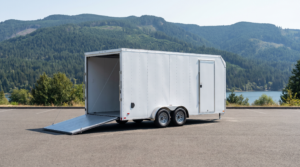
An enclosed trailer is a fully covered cargo box on a steel or aluminum frame, riding on one to three axles, towed behind a truck or SUV. Unlike open utility trailers, the cargo is sealed inside walls, a roof, and lockable doors. That single difference is why enclosed models are the standard choice for cars, tools, motorcycles, race equipment, and any cargo that cannot get wet, dusty, or stolen.
Single Axle vs Tandem Axle vs Triple Axle
Axle count is the first decision because it caps your payload and changes how the trailer tows.
- Single axle: One axle, typically rated 3,500 lbs. Found on 5×8 and 6×10 trailers. GVWR usually 2,990 lbs (so it stays under most state registration breakpoints). Light, easy to maneuver, fine for motorcycles, light cargo, and short trips. Tire failures can be more dramatic since you only have two tires holding the load.
- Tandem axle: Two axles, usually 3,500 lbs each (7,000 lbs combined) or 5,200 lbs each on heavier models. Standard on 6×12 and larger. Tows straight on the highway, handles a blowout safely, carries cars and heavy gear. This is what 80% of buyers should choose.
- Triple axle: Three axles, typically 5,200 or 7,000 lbs each. Reserved for 8.5×28+ car haulers, race trailers, and toy haulers carrying 14,000 lbs or more. They wear tires faster on tight turns but offer huge payload margin.
V-Nose vs Flat-Front
The front of the trailer is either a 24 to 30 inch pointed V-nose or a vertical flat wall. V-nose buys you roughly 10 to 14% more interior space, slightly better fuel economy at highway speeds, and easier towing in crosswinds. Flat-fronts are about $200 to $400 cheaper and offer flat front shelving for some commercial setups. For 2026, V-nose is the default on most quality builds. We break this down further in our V-Nose vs Flat-Front Cargo Trailer comparison.
Ramp Door vs Barn Doors
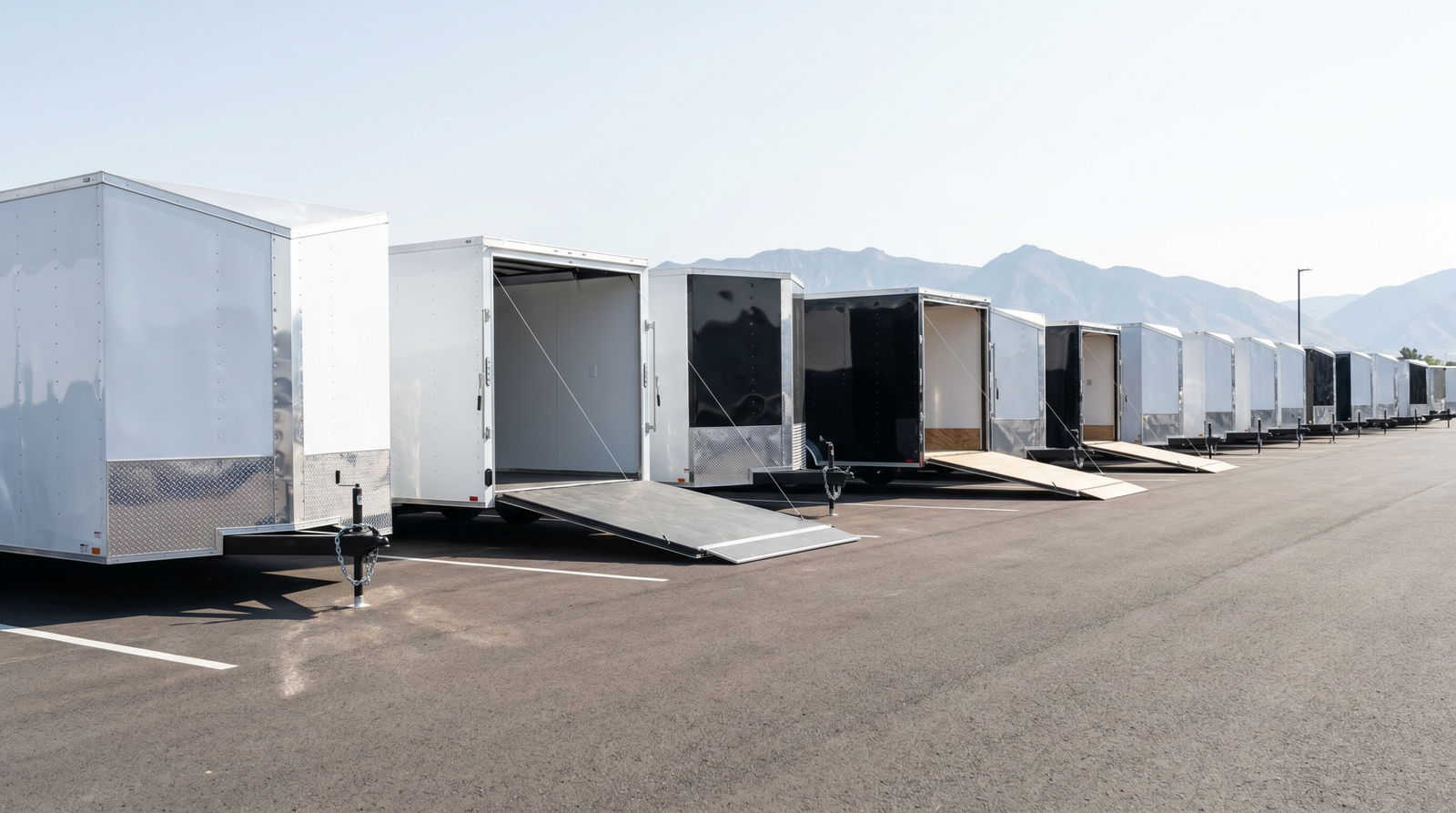
Rear access matters more than people think. A rear ramp door is a single hinged door that drops down to form a ramp, usually rated 2,500 to 4,000 lbs and built with a spring assist for one-person operation. It is the right choice for cars, motorcycles, mowers, and anything you roll in. Barn doors (also called double doors) are two hinged doors that swing open. They are lighter, sit lower, and let you back a forklift right up to floor height. Choose barn doors for pallet freight, mobile workshops, and businesses that load from the rear with a dock.
Enclosed Trailer Sizes Explained
Trailer width and length drive everything from the truck you need to the price you pay. Below is what each common size actually fits, with real interior dimensions (note: nominal box size is rounded; interior measures are typically 4 to 6 inches less in width and 8 to 12 inches less in length once walls and V-nose are accounted for).
| Nominal Size | Interior (W x L) | Typical GVWR | Best Use |
|---|---|---|---|
| 5×8 | 4’8″ x 7’9″ | 2,990 lbs | One motorcycle, camping gear, small moves |
| 6×10 | 5’8″ x 9’8″ | 2,990 lbs | Two motorcycles, ATV, light landscape |
| 6×12 | 5’8″ x 11’8″ | 2,990-7,000 lbs | Landscape crew, contractor tools, two-bedroom move |
| 7×14 | 6’8″ x 13’8″ | 7,000 lbs | Compact car, mobile workshop, band gear |
| 7×16 | 6’8″ x 15’8″ | 7,000 lbs | Mid-size sedan, full landscape rig, three-bedroom move |
| 8.5×16 | 8’2″ x 15’8″ | 7,000-9,990 lbs | Full-size truck, side-by-side UTV, mobile detailing |
| 8.5×20 | 8’2″ x 19’8″ | 9,990 lbs | Most cars and trucks, two motorcycles plus gear, food trailer |
| 8.5×24 | 8’2″ x 23’8″ | 9,990-14,000 lbs | Truck plus side-by-side, race team, larger food truck |
| 8.5×28 | 8’2″ x 27’8″ | 14,000 lbs | Toy hauler with living quarters, full race transporter |
The single most common buying mistake is going one size too small to save $800. You will spend that on a Tetris session every load. When in doubt, go up two feet in length. Browse our full enclosed trailer inventory to see what is available right now in each size.
Steel vs Aluminum Construction
This is the biggest cost lever on the entire trailer. The same 8.5×20 can be $11,000 in steel or $24,000 in aluminum. Knowing which one fits your situation saves real money or saves real heartache.
Steel Frame, Steel Skin
The traditional build. A 2×4 or 2×5 tube steel frame with 16-gauge tubing, 16-inch on-center crossmembers, and a galvanized or painted exterior skin. Brands like Homesteader, Diamond Cargo, Covered Wagon, and Haulmark dominate this category.
- Cost: Roughly 35 to 45% cheaper than aluminum equivalents.
- Weight: An 8.5×20 tandem steel trailer empty weighs around 3,200 to 3,800 lbs.
- Longevity: 15 to 20 years if stored dry and washed seasonally. Steel skin can dent and chip but is easy to repair.
- Salt-belt risk: Real. If you live anywhere from Pennsylvania to Minnesota where roads get salted, the underbody, frame, and welds will start surface rusting in 3 to 5 years. Annual undercoating extends life dramatically.
Aluminum Frame, Aluminum Skin
The premium build, dominated by ATC, Featherlite, and select Cargo Pro and Sport Haven models. Extruded aluminum tube frame, riveted or bonded aluminum skin, integrated thermal break.
- Cost: 40 to 80% premium over steel.
- Weight: The same 8.5×20 in aluminum is 2,400 to 2,900 lbs empty, roughly 800 to 1,000 lbs lighter.
- Longevity: 25 to 30+ years. Aluminum does not rust. It oxidizes to a stable surface and stops.
- Salt-belt advantage: Massive. Aluminum is the obvious answer for the Northeast, Midwest, and anywhere coastal.
- Towing benefit: Lighter trailer means more usable payload before hitting GVWR, plus 1 to 2 mpg better towing fuel economy.
Hybrid Builds
Some manufacturers like Car Mate and Cargo Pro offer steel frames with aluminum skin (or vice versa). These split the cost difference and offer some of the rust resistance of aluminum at 15 to 25% over steel pricing. A reasonable middle path for buyers in moderate climates.
Rule of thumb: if the trailer will tow under 8,000 miles a year and live in a barn, buy steel. If it will live outside, see road salt, or get used commercially every day, the aluminum premium pays back in 7 to 10 years through resale value alone.
Best Enclosed Trailers by Use Case
Car Hauler
For a single sedan or sports car, you want 8.5 wide minimum and 20 to 24 feet long with a 7,000 lb tandem axle setup. Look for a beavertail (the slight rear floor angle that prevents bumper scraping), a 4,000 lb-rated ramp door, and at least 8 D-rings recessed in the floor. Interior height of 76 to 84 inches matters if you ever haul a truck or lifted vehicle. The ATC 8.5×28 aluminum toy hauler is the high end of this category, built for haulers who want zero compromises.
Cargo and General Hauling
For moves, deliveries, or general loads, a 7×14 or 7×16 steel trailer hits the sweet spot. Flat floor, ramp door, side door for walk-in access, and 7,000 lbs of GVWR. The Homesteader 7×14 is a perfect example. Around $7,000 to $9,000 delivered, 20 years of service if you take care of it.
Landscaping
Landscape crews need a 6×12 or 7×14 with reinforced floor (3/4 inch plywood minimum), interior E-track on both walls for trimmer racks and blower mounts, two side doors if your crew loads from both sides, and a ramp door rated for a zero-turn mower (so 3,000 lbs minimum). Interior LED lighting and roof vents are not optional once you start working summer days.
Mobile Business
Coffee carts, mobile detail rigs, dog grooming, food trailers. You want 8.5 wide for counter space, finished interior walls (white vinyl or aluminum, not bare plywood), 50-amp electrical pre-wire, generator vent, and additional roof vents. The Tatinium 8.5×20 porch trailer is purpose-built for this kind of conversion with a fold-down porch deck.
Motorsport and Race
Race teams want 8.5×24 or 8.5×28, aluminum, with a 5,000 lb ramp, full cabinetry option, 30 to 50 amp electrical, escape door at the front, and a finished interior. Many teams add a winch plate and a tire rack. ATC and Cargo Pro dominate this segment.
Snowmobile and Toy Hauling
For a pair of sleds, a 7×14 or 7×16 with V-nose and a fuel door is enough. For three or four sleds plus gear, jump to 8.5×20. Heated floors are a real option from a few brands. Insulation packages help if you store the trailer outside in the winter.
Top Enclosed Trailer Brands Compared
ATC (Aluminum Trailer Company)
The premium aluminum specialist. Indiana-built, fully aluminum, lifetime structural warranty on the frame. ATC is what you buy when the trailer has to last 30 years and resale matters. Expect to pay $22,000 to $55,000 depending on size and options. The most common ATC sale at PrimeLoad is the 8.5×24 Quest for around $28,000 delivered.
Homesteader
Maryland-based, steel-frame value leader. Excellent build quality for the price, 5-year frame warranty, available in every common size. Homesteader is the answer for a buyer who wants 20 years of life without paying aluminum prices. Most 7×14 and 8.5×16 buyers end up here.
Car Mate
Pennsylvania-built, focused on commercial and contractor trailers. Heavier-duty steel construction than the value brands, more standard features (E-track, screwless exterior, upgraded axles), priced 15 to 25% above Homesteader. Worth it for daily commercial use.
Diamond Cargo
Georgia-built steel trailers, very competitive pricing, strong national presence. Customizable from the factory with hundreds of options. Good fit for buyers who want a specific configuration without paying premium-brand prices.
Haulmark
One of the oldest names in the industry, owned by Forest River. Wide model lineup from entry Transport to commercial Edge Pro to high-end Edge. A safe, well-supported brand with parts and dealer service available almost anywhere.
The Rest of the Lineup
PrimeLoad also carries Tatinium (specialty porch and toy hauler builds), Cargo Pro (aluminum value), Sport Haven (open and enclosed crossover), Covered Wagon (Indiana steel), and Formula (premium steel race trailers). Each has a niche, and we steer customers to the right brand based on the actual job.
Key Features to Look For
The brand badge matters less than the spec sheet. Here is what to verify on every quote.
Interior Height
Standard heights are 54 inches (low-profile, fits in most garages), 66 inches (older standard), 76 inches (modern standard, walk-around for most adults), and 84 inches (extra tall, fits trucks and lifted vehicles). Going from 76 to 84 inches usually adds $400 to $700 and is worth it if you ever haul anything taller than a sedan.
Tie-Downs
Recessed D-rings rated 5,000 lbs each are the standard for car and motorcycle haulers. Eight rings minimum on a car hauler. E-track (a horizontal slotted rail) on the walls is the right call for landscape and mobile business builds because you can mount and remove gear without drilling. The best builds combine both.
Ramp Door Rating
Cheap builds use a 2,000 lb ramp. That is fine for motorcycles. For cars, mowers, or UTVs, demand 3,000 to 4,000 lbs, with spring assist and a flap extension. Verify the spring assist is gas strut or torsion spring, not a thin coil that breaks in three years.
Axle Ratings and Brakes
Tandem 3,500 lb axles (Dexter or Lippert) are standard. For 8.5 wide trailers, 5,200 lb axles are common. Both axles should have electric brakes (4-wheel brakes), not just one axle. The cheapest builds skip brakes on the second axle. Always confirm 4-wheel brakes.
Lighting
LED exterior lighting is standard in 2026. Interior should have at least two 12-volt LED dome lights, a switch by each door, and a 110-volt outlet if you ever plug in a shop light or fan. Upgrade packages add an exterior porch light over the side door.
Ventilation
One roof vent (non-powered) is standard. For mobile business, motorsport, and any humid climate, add a 12-volt powered roof vent and at least two side wall vents. Otherwise condensation rusts your gear from the inside.
Side Door
A 32 or 36 inch side door with RV-style flush latch, screwless mount, and grab handle is standard. Confirm it sits forward of the wheel well so you have foot clearance. A door bar lock or paddle lock upgrade is cheap insurance.
Finished Interior
Bare plywood walls are the entry build. White luan finish (vinyl-coated plywood) is the upgrade most buyers should pay for at around $500 to $900. It cleans easier, looks professional, and resists moisture. Aluminum interior skin is the top tier and shows up on race and toy haulers.
Enclosed Trailer Pricing in 2026
Real numbers from current PrimeLoad inventory and recent deliveries, including freight and prep but not state tax or registration. Prices vary by build options.
| Size | Steel (Value) | Steel (Premium) | Aluminum |
|---|---|---|---|
| 5×8 | $3,800-$4,600 | n/a | $7,500-$9,000 |
| 6×12 | $5,200-$6,400 | $7,800-$9,200 | $11,500-$13,800 |
| 7×14 | $6,800-$8,400 | $9,800-$11,500 | $15,000-$18,500 |
| 7×16 | $7,500-$9,300 | $10,800-$12,500 | $17,000-$20,500 |
| 8.5×16 | $8,400-$10,200 | $11,800-$14,000 | $19,000-$23,000 |
| 8.5×20 | $9,800-$12,000 | $13,500-$16,500 | $22,000-$27,000 |
| 8.5×24 | $11,500-$14,200 | $15,800-$19,500 | $26,000-$32,500 |
| 8.5×28 | $13,500-$16,800 | $18,500-$23,000 | $30,000-$45,000+ |
If a quote you see anywhere is well below the value column, ask three questions. Are the axles rated 3,500 lbs or 2,200 lbs? Is the floor 3/4 inch or 5/8 inch plywood? Is the roof one-piece aluminum or seamed? Cheap trailers cut on those three places.
Free Nationwide Delivery
PrimeLoad delivers to all 50 states at no charge. Here is how it works in practice. You pick the trailer from inventory, lock it in with a deposit, and we schedule a delivery window (usually 7 to 21 days). A licensed transport driver tows your trailer from Woodland, WA to your driveway or job site. You inspect on arrival, sign off, and the title and registration paperwork follows by mail. No freight surprises, no broker upcharges, no “plus delivery” line item. The price you see is the price you pay. Get a free delivered quote on any trailer in the inventory.
Before delivery, we run our own pre-delivery inspection on every trailer. Wheel torque, brake function, light test, door alignment, and floor inspection. If you want to learn what to verify on arrival, our trailer inspection checklist walks through the same 22-point list our shop uses.
How to Compare Enclosed Trailers For Sale Side-by-Side
Most buyers comparing enclosed trailers for sale get one or two spec lines wrong on their first pass.
Three numbers settle most decisions when you’re shopping enclosed trailers for sale: GVWR rating, frame gauge, and hydraulic pump brand. Spec sheets that bury these are a yellow flag.
Brand matters too. Reputable dealers list every enclosed trailer with full specs visible. We carry enclosed trailers for sale from every major manufacturer in our nationwide inventory.
Pricing on enclosed trailers for sale has stabilized in 2026 after the steel swings of the early 2020s. Whether you’re looking at entry-level enclosed trailer models or commercial-grade builds, the buying framework in this guide gives you a clean way to evaluate every option.
Ready to start? Browse enclosed trailers for sale on our inventory page to see every model with real photos, full specs, and our delivered out-the-door price.
Frequently Asked Questions
What truck do I need to tow an enclosed trailer?
For 5×8 to 6×12 trailers under 5,000 lbs loaded, any half-ton truck or full-size SUV with a Class III hitch and a 5,000 lb tow rating works. For 7×14 to 8.5×20 trailers, you want a half-ton with the tow package or a 3/4-ton truck. For 8.5×24 and larger loaded over 10,000 lbs, you need a 3/4-ton diesel or 1-ton truck with weight-distributing hitch. Always check the GCWR (gross combined weight rating) on your door jamb, not just the tow rating.
Single axle or tandem axle, which should I choose?
Tandem, in almost every case. Single axle saves $400 to $700 and a few hundred pounds of curb weight, but you lose blowout safety, highway tracking stability, and total payload. The only good case for single axle is a 5×8 motorcycle hauler that lives in a garage and gets used 10 times a year.
Is V-nose worth the extra cost?
Yes. V-nose adds about 10 to 14% interior space, tracks better in crosswinds, and resells for more. The price difference is usually $200 to $400. The only reason to choose flat-front is a specific loading configuration that needs the front wall flat (some commercial shelving setups).
Do I need special insurance on an enclosed trailer?
Liability is usually covered by your tow vehicle policy while the trailer is hitched. Comprehensive and collision on the trailer itself, including theft and contents, requires a separate trailer policy or rider. Expect $150 to $400 a year for a $15,000 trailer with full coverage. Commercial use requires a commercial policy, which runs $400 to $900 a year. Always confirm in writing with your agent.
Do I need a CDL to tow an enclosed trailer?
For non-commercial personal use, no, as long as your combined GVWR (truck plus trailer) is under 26,001 lbs. Almost no enclosed trailer setup hits that without a heavy-duty truck and a 14,000+ lb trailer fully loaded. For commercial use, the CDL line is also at 26,001 lbs combined, with the trailer over 10,000 lbs GVWR. Most landscape and contractor 7×14 setups stay under that line. Race teams hauling in a 1-ton dually with an 8.5×28 sometimes need a CDL Class A. Check your state DMV for specifics.
How well do enclosed trailers hold their value?
Better than almost any other towable. A 5-year-old aluminum ATC trailer typically resells for 70 to 80% of original price. A 5-year-old steel Homesteader resells for 55 to 65%. Trailers that were stored inside, kept clean, and have good tires sell within a week on the used market. The ones with floor rust, faded skin, and bald tires sit for months at heavy discounts.
What maintenance does an enclosed trailer need?
Annual: repack wheel bearings or check sealed bearings, inspect brake magnets and shoes, check tire pressure and tread, test all lights, lubricate hinges and ramp springs, inspect floor for soft spots, check roof seams and reseal as needed. Every 3 to 5 years: inspect axles for bend, check frame welds, replace tires regardless of tread (trailer tires age out from UV exposure before they wear out). Skipping bearing service is the number one cause of roadside breakdowns.
How long does it take to ship a car in an enclosed trailer?
Cross-country (coast to coast) typically runs 7 to 14 days for enclosed transport. Regional moves are 2 to 5 days. We cover this fully in our enclosed car trailer shipping cost article with current 2026 rates.
Ready to Buy
PrimeLoad has 64 enclosed car trailers and 44 cargo trailers in stock right now, ready for free delivery to any of the 50 states. We are family-run, in business 15 years, and our team has actually loaded, towed, and delivered every brand on this page. Our job is simple. Match you to the right trailer the first time, deliver it free, and stand behind it for the long haul.
Two ways to start.
- Browse the lot: See live photos and prices in our enclosed trailer inventory.
- Get a quote: Tell us what you want to haul and your zip code. We will send a delivered out-the-door price within one business day. Get a free delivered quote.
Questions before you buy? Call the team in Woodland. We answer the phone, we know the inventory by VIN, and we will tell you straight if a different trailer fits better, even if it costs us a sale today.