Shipping a car in an enclosed trailer costs roughly twice what shipping in an open trailer costs. The premium buys weather protection, theft protection, and reduced road debris damage. For valuable vehicles (classic cars, restoration projects, race cars, exotic cars), the enclosed premium is usually worth it. For commodity vehicles (daily drivers, used cars), open transport is the standard cost-effective choice.
This guide gives you real cost numbers for both options, plus the math on when to ship vs when to buy your own enclosed trailer.
Commercial Enclosed Car Shipping Rates
Short routes (under 500 miles)
Open transport: $400 to $700 typical.
Enclosed transport: $700 to $1,400 typical.
Routes in this range usually move within 3 to 7 business days. Common examples: New York to Connecticut, Boston to Philadelphia, New York to Washington DC. Both open and enclosed carriers operate frequently in these corridors so pricing is competitive.
Mid-range routes (500 to 1,500 miles)
Open transport: $700 to $1,400 typical.
Enclosed transport: $1,400 to $2,500 typical.
Routes in this range take 5 to 10 business days. Common examples: the Northeast to Florida, Chicago to Texas, New York to Atlanta. Open carriers move regularly on these corridors; enclosed carriers schedule specifically and may add 2 to 3 days for pickup scheduling.
Long routes (1,500+ miles)
Open transport: $1,200 to $2,200 typical.
Enclosed transport: $2,500 to $4,500 typical.
Routes in this range take 7 to 14 business days. Common examples: East Coast to West Coast, Northeast to Southwest. Enclosed carriers run fewer routes; expect longer scheduling delays.
What Drives the Cost Difference
Carrier capacity and demand
Open auto transport carriers carry 7 to 10 vehicles per truck. Enclosed carriers carry 1 to 6 vehicles per truck (single-deck enclosed) or 2 to 4 vehicles (high-end multi-vehicle enclosed). The lower per-vehicle capacity directly drives higher per-vehicle cost.
Insurance coverage
Open carrier insurance typically covers up to $50,000 to $100,000 per vehicle. Enclosed carrier insurance covers $250,000 to $1 million+ per vehicle. The higher insurance premium passes through to the shipping cost.
Driver expertise
Enclosed transport drivers handle high-value vehicles (classics, exotics, race cars) and need higher experience and certification levels. Wages reflect this. Open transport drivers handle commodity vehicles where loading and tie-down skill demands are lower.
Route specificity
Open carriers fill trucks opportunistically along routes. Enclosed carriers often run specific routes for known customers or scheduled commercial work. Less route flexibility means less ability to consolidate loads, which raises per-vehicle cost.
When Enclosed Is Worth It
Valuable or rare vehicles ($30,000+ market value)
The cost difference between open ($1,000) and enclosed ($1,800) is $800 on a typical mid-range route. For a $40,000 classic car, that’s 2 percent of vehicle value, well worth the protection from weather damage, road salt, and stone chips.
Restoration projects
Cars partially disassembled for restoration are vulnerable to weather damage that open transport can’t prevent. Enclosed transport keeps the car in a controlled environment for the trip. Same logic for project cars with paint or trim issues that open exposure would worsen.
Race cars and track-day vehicles
Track-prepped vehicles (race cars, autocross cars) often have aerodynamic body panels, low ground clearance, and racing tires unsuitable for highway exposure. Enclosed transport prevents tire damage and aerodynamic component damage during transit.
Long routes through extreme weather
Cross-country shipping through winter storms or summer heat exposes vehicles to weather extremes for 7 to 14 days. Enclosed transport eliminates this exposure entirely.
Buying or selling at a long-distance auction
Vehicles purchased at auction are often shipped the same day. Enclosed transport for auction purchases protects from immediate weather exposure and any pre-existing condition damage.
When Open Is the Right Choice
Daily driver vehicles ($15,000 or less market value)
The $800 enclosed premium on a $12,000 used car is 7 percent of vehicle value. Open transport offers adequate protection for commodity vehicles. The premium doesn’t pay back unless the vehicle has specific exposure concerns.
Short routes in good weather
A 300-mile route in summer with no rain in the forecast doesn’t need enclosed protection. Open transport is fine for short, weather-controlled trips.
Vehicles in routine commuter condition
Used cars with normal wear and tear, daily-driver paint condition, and standard tires don’t need enclosed protection. Save the premium for valuable or vulnerable vehicles.
DIY Math: When Owning an Enclosed Trailer Pays Back
For frequent vehicle transport (multiple times per year, repeat collector buying, dealer-to-dealer transport, classic car show circuit), buying an enclosed car trailer can pay back vs hiring carriers.
Cost comparison example
Customer A: Classic car collector, transports 6 to 10 vehicles per year between the Northeast, Florida, and Texas (mid-range to long routes).
- Hiring enclosed transport: 8 vehicles x $2,200 average = $17,600/year
- Owning a 7×18 enclosed car trailer: $14,000 trailer + $1,000 fuel/year + $400 maintenance = $15,400 first year, $1,400/year ongoing
Year 1: roughly break-even. Year 2 onward: $16,200/year savings vs hiring.
Plus the trailer holds value (8-year resale around $7,000) and offers schedule flexibility (move vehicles when you need to, not when carriers can fit you in).
When DIY doesn’t pay back
Light use (1 to 3 vehicles per year) doesn’t justify trailer ownership. The fixed costs (insurance, registration, storage, maintenance) eat the savings vs hiring transport on demand.
Long-route only use (cross-country) doesn’t pay back as quickly because driving the trailer 2,500+ miles round trip costs $400 to $700 in fuel plus 5+ days of driver time. Per-trip cost approaches commercial enclosed pricing.
If You Buy an Enclosed Car Trailer
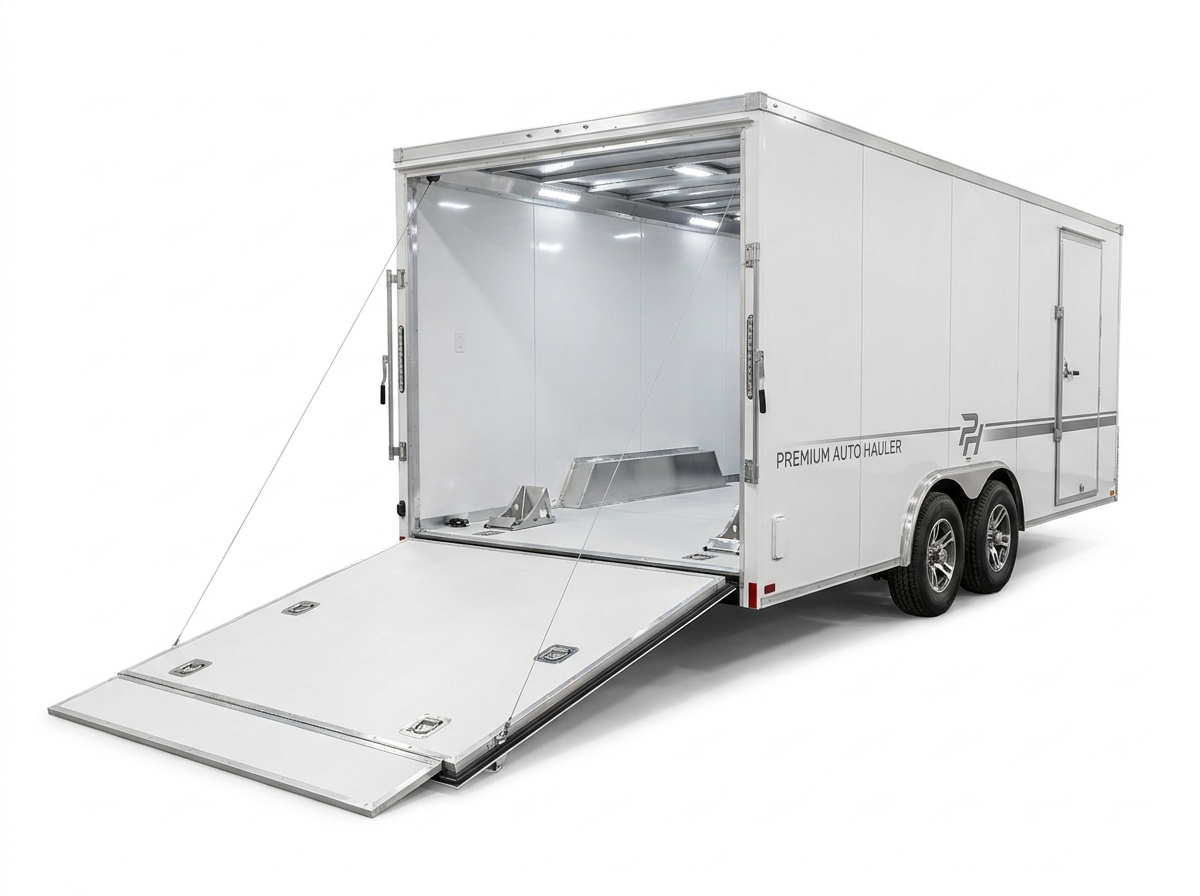
Single-vehicle enclosed haulers run $14,000 to $25,000 new. Two-vehicle (28-foot) enclosed haulers run $25,000 to $45,000.
Key features:
- Wood deck (better for tire and paint protection vs steel)
- Tilt-deck or low-angle ramps (essential for low-clearance vehicles)
- Recessed D-ring tie-downs (avoid scratching the vehicle when walking around it)
- Side door (32 to 36 inch) for walk-in access without dropping rear ramps
- Aluminum exterior (longer service life, better resale than steel-skin)
- Interior lighting (LED package for evening loading)
- 110V shore power inlet (for interior lights and battery charger when stored)
Enclosed Car Shipping Questions
How much does it cost to ship a car cross-country?
Open transport: $1,200 to $2,200 for cross-country routes. Enclosed transport: $2,500 to $4,500. Cost varies by exact distance, vehicle size, route specificity, and seasonal demand. Get 3 to 5 quotes from different carriers for the same route.
Is enclosed transport worth the extra cost?
For vehicles valued $30,000+, restoration projects, race cars, and routes through extreme weather: yes. For commodity daily drivers under $15,000 market value, the $800 to $2,000 premium typically doesn’t pay back. Match transport type to vehicle value and condition.
What's included in enclosed transport insurance?
Most enclosed carriers cover $250,000 to $1 million per vehicle vs $50,000 to $100,000 for open carriers. Coverage typically includes weather damage, theft, transit accidents, and loading/unloading damage. Always request the carrier’s certificate of insurance and verify coverage limits before booking.
How long does enclosed car shipping take?
Short routes (under 500 miles): 3 to 7 business days. Mid-range (500 to 1,500 miles): 5 to 10 business days. Long routes (1,500+ miles): 7 to 14 business days. Enclosed carriers run fewer routes than open carriers, so add 2 to 3 days for pickup scheduling.
Can I save money by hiring open transport for a classic car?
Possible, but risky. Open transport exposes the car to weather, road salt, and stone chips for the entire trip. For valuable classics, the $800 to $2,000 enclosed premium prevents potentially $5,000+ in detail and paint repair from open exposure. Math usually favors enclosed for valuable vehicles.
When should I buy my own enclosed car trailer instead of hiring transport?
For 6 or more vehicle transports per year, owning your own trailer typically pays back vs hiring within 18 to 24 months. For light use (1 to 3 vehicles/year), hiring on demand is more cost-effective.
Related Guides and Inventory
Ready to buy? Get a free quote within 24 hours, or call us at (360) 560-5472.