The dump trailer is the single most productive tool a landscaping business can buy after the truck and the mower. The right size pays back in months through reduced labor (no hand-loading or hand-unloading), reduced disposal trips (one big load vs three small loads), and reduced equipment damage (no shoveling out of pickup beds). The wrong size either limits your business or sits underutilized.
This guide gives you the right answer for residential, commercial, and municipal landscape work, with real numbers on capacity, ROI, and which features matter.
Dump Trailer Size by Business Type
Residential landscaper (1 to 2 person crew, 50 to 150 properties/season)
Recommended size: 6×10 to 7×14, 7,000 to 10,000 lb GVWR.
This crew handles weekly mowing, mulching, leaf cleanup, and small spring/fall projects. Per-trip dump load is typically 2,000 to 4,000 lbs (grass clippings + small branches + fall leaves). A 7×12 dump trailer with 10,000 lb GVWR carries 6,500+ lbs of cargo, plenty of headroom for a full day of pickups before disposal.
Hoist type: standard scissor hoist works fine. Telescopic hoist is unnecessary at this scale.
Tow vehicle: half-ton pickup with tow package handles this size class easily.
Annual investment: $5,500 to $8,500. Payback: 10 to 16 months from labor savings (one person operating a dump trailer replaces two people with shovels and rakes).
Commercial landscape contractor (3 to 6 person crew, larger commercial properties)
Recommended size: 7×14 to 7×16, 12,000 to 14,000 lb GVWR.
This crew handles commercial property maintenance, larger residential developments, and seasonal projects (mulch installs, leaf cleanup, snow removal contracting). Per-trip dump load is 4,000 to 8,000 lbs (commercial fall leaves, mulch, gravel, demo waste).
Hoist type: telescopic hoist preferred for full ejection of dense materials (gravel, soil, wet leaves). Scissor hoist can struggle to fully eject heavy concentrated loads.
Tow vehicle: 3/4 ton pickup minimum, 1 ton preferred for daily commercial use.
Annual investment: $9,500 to $14,000. Payback: 8 to 14 months from reduced disposal trip count and labor.
Municipal or commercial maintenance (large crew, daily heavy use)
Recommended size: 7×16 to 8×20, 14,000 to 16,000 lb GVWR or gooseneck.
For high-volume daily commercial use (city contracts, large commercial properties, regional landscape contractors), gooseneck dump trailers offer better stability and easier maneuvering on tight job sites. Per-trip dump load can hit 10,000+ lbs.
Hoist type: telescopic hoist standard. Some buyers spec hydraulic dump tarp covers for fines (mulch, soil) that blow off in transit.
Tow vehicle: 1 ton dually with HD tow package or gooseneck setup.
Annual investment: $14,000 to $22,000. Payback: 10 to 16 months for active commercial users.
Hoist Types Explained
Scissor hoist (most common, lower cost)
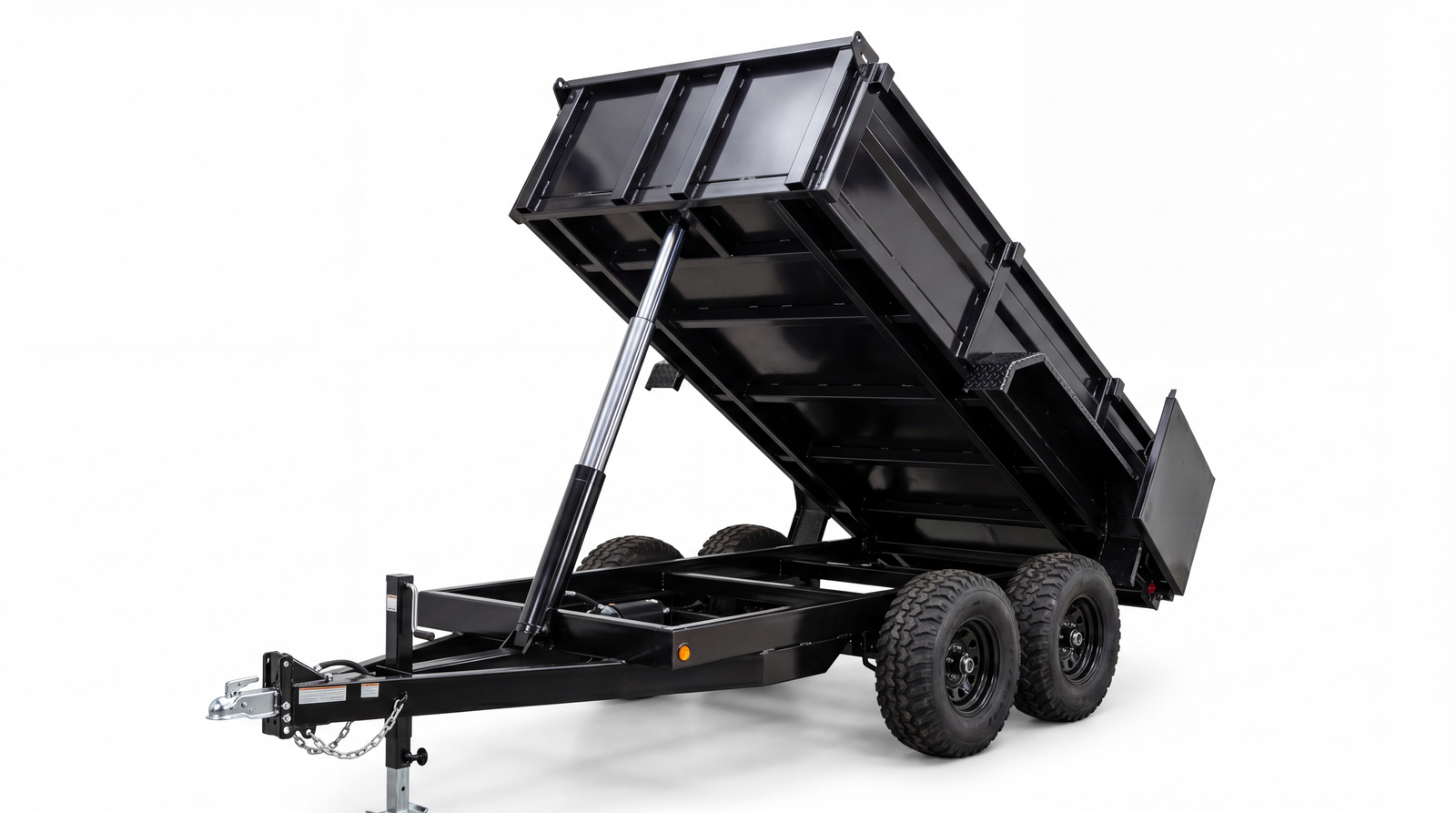
Single hydraulic cylinder mounted in the center of the trailer, scissoring the bed up and back. Works well for general landscape waste (leaves, branches, light mulch). Limitation: doesn’t fully eject heavy concentrated loads (gravel, wet soil, dense materials) without manual assistance.
Cost: standard on most dump trailers in the 7K to 10K GVWR range. No upgrade cost.
Telescopic hoist (better for heavy/dense loads)
Multi-stage hydraulic cylinder that extends fully vertical, lifting the bed to a steeper dump angle. Fully ejects gravel, soil, and dense materials without operator assistance.
Cost: typically $400 to $1,200 upgrade over scissor hoist on the same trailer model.
Hydraulic dump tarp covers
Powered tarp that opens and closes via hydraulic ram. Required by some commercial contracts (waste hauling, gravel transport). Optional but useful for residential landscapers hauling fines.
Cost: $800 to $2,500 add-on.
Real ROI Example: Pacific Northwest Residential Landscaper
A Vancouver, WA-area landscaper with a 2-person crew bought a 7×14 dump trailer (10,000 lb GVWR, scissor hoist) in March 2024 for $7,200. Before the dump trailer:
- Fall cleanup time per property: 2.5 hours (rake, bag, haul bags to truck)
- Disposal trips per week: 3 to 4 (each trip 45 minutes round-trip plus dump fees)
- Labor cost per fall season (12 weeks, 60 properties): $8,400
- Disposal fees: $850/season
After the dump trailer:
- Fall cleanup time per property: 1.5 hours (blow into trailer, drive to next property)
- Disposal trips per week: 1 (one big trip per week)
- Labor cost per fall season: $5,000 (40 percent reduction)
- Disposal fees: $700/season (smaller fee per trip but fewer trips)
Annual savings: $3,550. Trailer paid for itself in 24 months. Year 3 onward is pure profit margin recovery.
Features That Matter
Side height (deep vs shallow)
Deep-side dump trailers (24 to 36 inch side height) carry more volume per trip. Critical for hauling leaves, mulch, and other low-density materials. A 24-inch side dump holds about 15 cubic yards of leaves; a 36-inch side dump holds 22+ cubic yards.
For mulch and leaf hauling, prioritize side height over deck length. A 6×10 deep-side trailer often hauls more leaf volume than a 7×14 shallow-side trailer.
Tarp system
Manual tarps are standard. Hydraulic tarps add convenience for daily commercial use. Open-top dump trailers without tarps are illegal for hauling on public roads in most states (loose material can blow out and create road hazards).
Spreader gate / barn doors
Standard configuration is a single rear barn door that swings open for full-bed dumping. Spreader gate option (small adjustable opening at the bottom) lets you spread gravel, mulch, or salt as you drive forward without fully dumping. Useful for residential gravel install or commercial salt spreading.
Dual cylinder vs single cylinder hoists
Dual cylinder hoists distribute load across two hydraulic rams, providing more even lifting on heavy loads. Standard on most dump trailers above 12,000 lb GVWR. Single cylinder hoists are sufficient for sub-10K GVWR trailers in landscape use.
Common Sizing Mistakes
Buying too small initially. The 5×8 to 6×10 dump trailer class (5,000 to 7,000 lb GVWR) sounds adequate for residential landscape but is undersized for commercial routes. Most buyers who start in this class upgrade within 2 to 3 years as their business grows.
Buying too large for tow vehicle. A 14,000 lb GVWR dump trailer requires a 3/4 ton or 1 ton truck for legal operation at full load. Half-ton pickup buyers should stay in the 10,000 lb GVWR class to avoid overloading the tow vehicle.
Ignoring side height. Two trailers with the same length but different side heights have dramatically different leaf-hauling capacity. Match side height to your typical material density.
Skipping the telescopic hoist on heavy applications. Scissor hoists struggle with gravel, wet soil, and other dense materials. If your business hauls these regularly, the telescopic hoist upgrade pays back through reduced unloading time.
Landscape Dump Trailer Questions
What size dump trailer do I need for a residential landscape business?
For a 1 to 2 person crew servicing 50 to 150 residential properties per season, a 6×10 to 7×14 dump trailer with 7,000 to 10,000 lb GVWR is the sweet spot. Tows easily behind a half-ton pickup. Standard scissor hoist is sufficient for typical residential landscape waste.
Scissor hoist or telescopic hoist?
Scissor hoist works for general landscape waste (leaves, branches, light mulch). Telescopic hoist is needed for heavy/dense materials (gravel, wet soil, demolition waste). For commercial contractors hauling these regularly, telescopic upgrade pays back through faster unloading.
How much weight can a 7×14 dump trailer haul?
A 7×14 dump trailer with 10,000 lb GVWR holds 6,500 to 7,500 lbs of cargo. With 14,000 lb GVWR, capacity rises to 9,500 to 11,000 lbs. Always check the trailer’s VIN sticker for the exact GVWR; cargo capacity equals GVWR minus the trailer’s curb weight.
Can my F-150 pull a dump trailer?
Yes, with a properly sized dump trailer (10,000 lb GVWR or smaller). A modern F-150 with the tow package handles 8,000 to 10,000 lbs comfortably. For 12,000+ lb GVWR dump trailers, you need a 3/4 ton or larger pickup with a brake controller and weight-distribution hitch.
How long does a dump trailer take to pay for itself?
For active landscape businesses, dump trailers typically pay back in 10 to 16 months through labor savings (one person operating the dump trailer replaces two people with shovels) and reduced disposal trip count. After year 2, the trailer is pure profit margin recovery.
Do I need a tarp on my dump trailer?
Yes. Most US states require dump trailers to have tarps when hauling on public roads (loose material blowing out creates road hazards and is illegal in most jurisdictions). Manual tarps are standard equipment; hydraulic tarp upgrades cost $800 to $2,500 for daily commercial users.
Related Guides and Inventory
Ready to buy? Get a free quote within 24 hours, or call us at (360) 560-5472.