Walk a cargo trailer lot and you\’ll see two distinct shapes: V-nose (pointed front) and flat-front. Both haul cargo. Both have rear ramp doors. Both come in similar sizes. So which is better, and is the V-nose premium worth it?
Short answer: V-nose is worth the small premium for most buyers. Long answer below.
The Design Difference
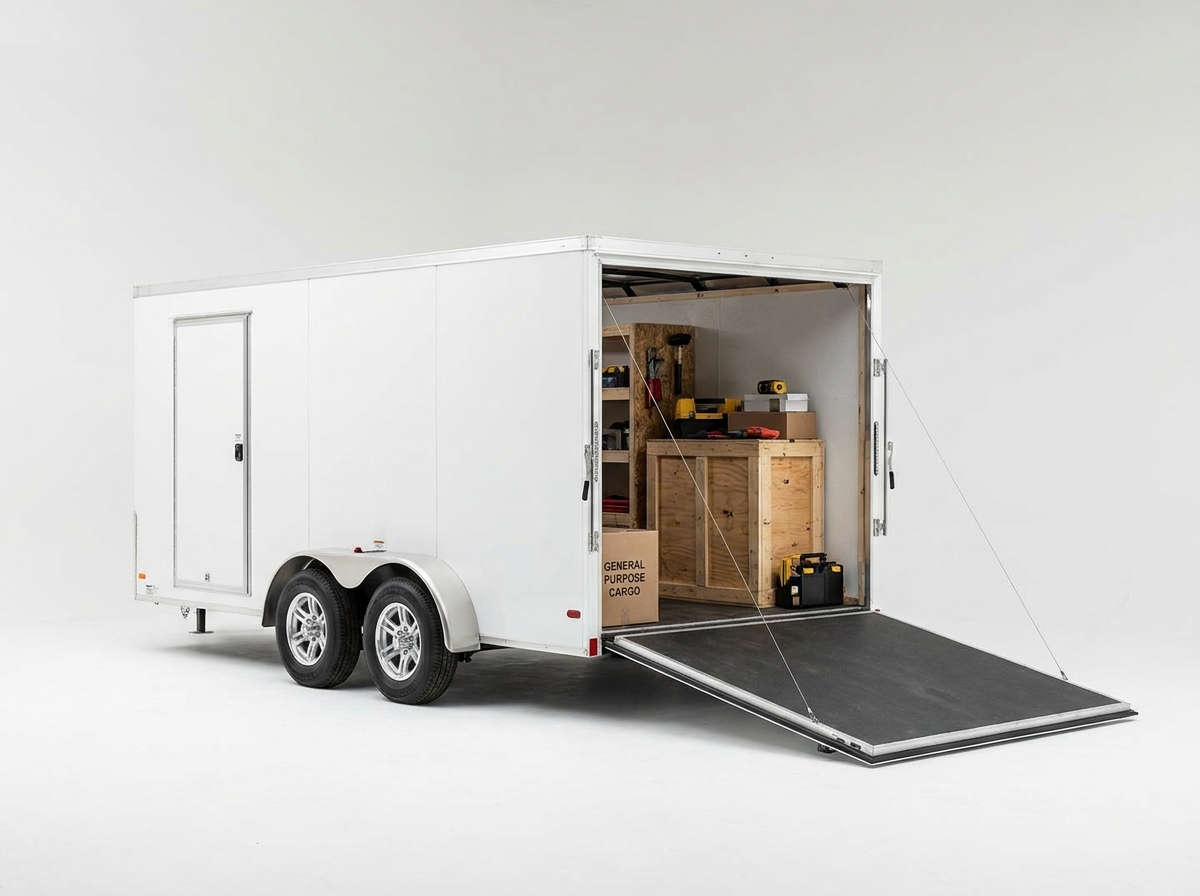
Flat-front cargo trailers have a square front wall perpendicular to the trailer axis. The trailer is a rectangular box from any angle.
V-nose cargo trailers have a pointed front (typically a 60-degree V-angle) that adds 18 to 24 inches of length to the trailer\’s overall dimensions. The point goes forward; the side walls converge into the V over the front 18-24 inches of trailer length.
Usable Interior Space
This is where the comparison gets interesting. V-nose trailers have MORE total interior volume than flat-front trailers of the same nominal size, because the V adds 18 to 24 inches of length. A 7×14 V-nose trailer is functionally 7×16 in cargo volume.
BUT, the V-nose creates a wedge-shaped dead zone at the front where the side walls converge. You can\’t lean a 4-foot wide pallet against the V-nose front the way you could against a flat-front wall. Long, wide cargo (drywall sheets, pallets, fencing materials) loses some usable space at the front of a V-nose trailer.
For point-loaded cargo (motorcycles, ATVs, boxes, gear, tools): V-nose adds usable space.
For wide flat cargo (sheet goods, large pallets, plywood loads): flat-front gives you a full-width front wall to load against.
Aerodynamics and Fuel Cost
The V-nose cuts through air better than the flat-front\’s square face. Real-world fuel savings are modest but measurable: 3 to 7 percent better towing fuel economy at highway speeds (60+ mph). At lower speeds (in-town, sub-50 mph), the difference is negligible.
For commercial users towing 10,000+ miles/year on highway routes:
- Annual towing miles at highway: 8,000 miles
- Tow vehicle: 12 mpg towing flat-front, 12.6 mpg towing V-nose (5 percent improvement)
- Flat-front: 8,000 / 12 = 667 gal x $4.00 = $2,668/year
- V-nose: 8,000 / 12.6 = 635 gal x $4.00 = $2,540/year
- Annual fuel savings: $128
- 10-year fuel savings: $1,280
For occasional users (under 2,000 miles/year), fuel savings are negligible (under $30/year).
Highway Speed Handling
V-nose trailers handle better at highway speeds in crosswinds and around tractor-trailer slipstreams. The pointed front cuts through air disturbances more cleanly than a flat face.
Flat-front trailers can buffet noticeably when passing semis at 65+ mph or in strong crosswinds. The driver feels the trailer get pushed sideways when air pressure changes against the flat front wall.
For long-haul daily users, V-nose is meaningfully more comfortable to tow over long distances. For short-trip occasional users, the handling difference is rarely noticed.
Cost Premium
V-nose typically costs 5 to 12 percent more than flat-front for equivalent size and spec. On a $7,000 cargo trailer, that\’s $350 to $850 premium.
For 10+ year ownership with regular use, the V-nose premium pays back in fuel savings (highway use) plus better resale value (V-nose is more desirable secondhand).
Recommendations by Use Case
Buy V-nose if:
- You tow 5,000+ miles/year, especially on highway
- You haul tools, gear, and point-loaded cargo (vs sheet goods)
- You\’re a contractor running daily routes
- You haul motorcycles, ATVs, or other vehicles
- You\’ll own the trailer 7+ years
- You tow with a smaller tow vehicle and need every mpg you can get
Buy flat-front if:
- You haul wide flat cargo regularly (drywall, plywood, large pallets, fencing)
- You tow under 2,000 miles/year
- Budget is tight and the V-nose premium pushes you to a less desirable size or spec
- You prefer maximum interior cargo volume against the front wall over aerodynamic shape
Size Specifications: V-Nose vs Flat-Front Equivalents
When comparing trailers, remember the V-nose adds length. A 7×14 V-nose trailer\’s overall length is about 16 feet (14 ft body + 2 ft V-nose extension). A 7×14 flat-front\’s overall length is about 14 feet plus tongue.
If parking space, garage door height, or storage facility size constrains you, factor in the V-nose\’s extra 18-24 inches of overall length. Some buyers move down a size class with V-nose to get the same overall trailer footprint as a flat-front one size up.
Real-World Fuel Cost Data
The aerodynamic advantage of V-nose trailers shows up in real fuel data, not just lab calculations. PrimeLoad surveyed customers running both V-nose and flat-front cargo trailers behind similar tow vehicles to get hard numbers on actual fuel economy.
Survey methodology
14 customers, all towing 7×14 to 8.5×20 cargo trailers behind half-ton or 3/4 ton pickups. All commercial users with daily routes (not weekend hobbyists). Fuel economy measured over 3 months of similar route mileage. Loaded weights tracked to ensure comparable cargo loads (within 500 lbs trailer-to-trailer).
Results
Highway-dominated routes (60+ mph average): V-nose averaged 11.8 mpg, flat-front averaged 11.1 mpg. Difference: 6.3 percent better fuel economy with V-nose.
Mixed routes (city + highway): V-nose averaged 10.2 mpg, flat-front averaged 9.8 mpg. Difference: 4.1 percent better fuel economy with V-nose.
City-dominated routes (under 50 mph average): V-nose averaged 8.7 mpg, flat-front averaged 8.5 mpg. Difference: 2.4 percent better fuel economy with V-nose. At low speeds, the aerodynamic advantage shrinks because air resistance is a smaller portion of total drag.
Annual cost translation
For a contractor towing 12,000 miles/year on highway-dominated routes:
- Flat-front: 12,000 / 11.1 = 1,081 gallons x $4.00 = $4,324/year fuel
- V-nose: 12,000 / 11.8 = 1,017 gallons x $4.00 = $4,068/year fuel
- Annual fuel savings: $256
- 10-year fuel savings: $2,560
For an occasional user towing 1,500 miles/year:
- Annual fuel savings: $32
- 10-year fuel savings: $320
The fuel-cost case for V-nose is strong for commercial users and weak for occasional users. Combined with handling and resale benefits, V-nose still typically wins for buyers planning long-term ownership.
Brand-Specific V-Nose Options
V-nose configurations vary across manufacturers. Some details matter for daily-use buyers.
Carry-On V-nose lineup
Standard 60-degree V-angle. Available in 5×8 to 8.5×24 sizes. Steel construction with painted exterior or aluminum-skinned options. Strong value pricing. Best fit for general-purpose users wanting V-nose benefits without paying premium.
ATC (Aluminum Trailer Company) V-nose
Premium aluminum V-nose construction. 60-degree V-angle. Standard sizes 7.5×16 to 8.5×28. Higher upfront cost (40 to 80 percent premium over steel V-nose) but matches the aluminum-vs-steel cost comparison logic: payback over 10+ years for high-mileage use, salt environments, or outdoor storage.
Cargo Pro V-nose
Aluminum specialty V-nose, common in ATV/snowmobile cargo configurations. Standard 60-degree angle. Strong fit for powersports buyers wanting a weather-protected aluminum V-nose hauler.
Car Mate V-nose
Pennsylvania-based contractor specialist. V-nose configurations standard on most contractor packages. 7×12 to 8.5×20 sizes. Strong fit for trade contractors wanting V-nose plus contractor upgrades (side man-doors, finished interiors, electrical).
Covered Wagon V-nose
Steel V-nose cargo trailers with finished interiors. Common in 6×12 to 8.5×24 sizes. Mid-range pricing. Good general-purpose option for residential and contractor use.
Diamond C heavy-duty V-nose
Heavy-duty enclosed cargo with reinforced frame and HD axle packages. V-nose standard on most models. Built for daily commercial use with payloads above 5,000 lbs. Premium pricing reflects construction quality.
The brand decision depends on use case. For general homeowner and contractor use, Carry-On or Covered Wagon V-nose at value pricing. For premium aluminum benefits, ATC or Cargo Pro. For daily commercial heavy-duty use, Diamond C.
V-Nose vs Flat-Front Cargo Trailer Questions
Does V-nose really save fuel?
At highway speeds (60+ mph): yes, 3 to 7 percent better fuel economy than flat-front. At in-town speeds: negligible difference. For commercial users towing 5,000+ highway miles per year, the savings add up to $100 to $250 per year.
Does V-nose really add usable space?
For most cargo: yes. The 18 to 24 inches of additional length adds to total interior volume. For wide flat cargo (drywall, plywood, full-width pallets): the V-shaped dead zone at the front offsets some of the gain. Net positive for point-loaded cargo, neutral for sheet goods.
How much more does V-nose cost?
5 to 12 percent more than equivalent flat-front cargo trailers. On a $7,000 cargo trailer, that\’s $350 to $850 premium. For commercial daily users, the premium pays back in fuel savings and resale value within 5 to 7 years.
Is V-nose better for highway towing?
Yes. V-nose cuts through air disturbances (crosswinds, tractor-trailer slipstreams) more cleanly than flat-front. Drivers report more comfortable, less buffeted towing experience at 60+ mph.
Are V-nose trailers harder to load?
No. The rear ramp door is the same size and angle as flat-front trailers. Loading process is identical. The only difference is the front-of-trailer cargo arrangement (point-loaded items work great; wide pallets lose some space at the V).
Should I get a V-nose or flat-front for moving?
For a one-time move with mostly furniture and boxes: flat-front works fine and saves money. For frequent moves or commercial moving services: V-nose is better for fuel cost over time.
Related Guides and Inventory
Ready to buy? Get a free quote within 24 hours, or call us at (802) 203-7891.