
One of the most important decisions you’ll make as a trailer owner is whether to go with a gooseneck or bumper pull configuration. Get it right and your setup handles beautifully. Get it wrong and you’re fighting your trailer on every highway mile. Here’s everything you need to know.
What Is a Bumper Pull Trailer?
A bumper pull trailer (also called a conventional or tag-along trailer) connects to a standard ball hitch mounted at the rear of your truck. It’s the most common trailer configuration in the US and works with virtually any pickup truck or SUV equipped with a hitch.
Advantages:
- Works with any hitch-equipped vehicle
- Lower upfront cost
- Easier to hook and unhook
- No special truck bed required
Limitations:
- Maximum payload typically 14,000-16,000 lbs GVWR
- Less stable at high speeds with heavy loads
- More sway in crosswinds compared to gooseneck
What Is a Gooseneck Trailer?
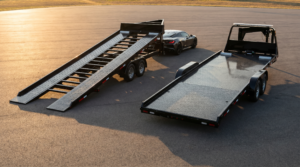
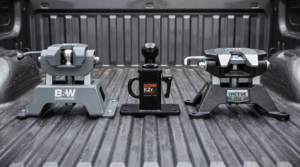
A gooseneck trailer connects via a ball hitch mounted in the bed of your pickup truck, directly over the rear axle. This placement transfers tongue weight more efficiently and allows for significantly higher payload ratings.
Advantages:
- Higher payload capacity, commonly 20,000-40,000+ lbs GVWR
- Superior stability at highway speeds
- Less sway, better control with heavy loads
- Better weight distribution over the truck’s axles
Limitations:
- Requires a gooseneck hitch in the truck bed (dedicated installation)
- Takes up truck bed space
- Higher cost than bumper pull equivalents
- Not ideal for lighter, everyday loads
Which Do Hotshot Drivers Use?
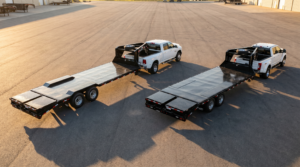
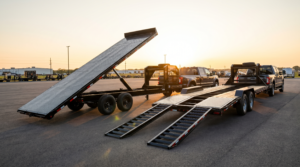
The hotshot trucking industry runs almost exclusively on gooseneck trailers, specifically gooseneck flatbeds in the 40-53 foot range. The payload capacity and stability advantages are non-negotiable when you’re hauling heavy freight for profit. Most non-CDL hotshot operators run a 1-ton dually with a gooseneck rated up to 25,900 lbs GVWR to stay under CDL thresholds.
Which Is Better for Contractors?
It depends on what you’re hauling:
- Light equipment (skid steer, mini excavator, compact tractors): Either works, but a heavy-duty bumper pull handles these fine.
- Full-size excavators, large dozers, multiple pieces of iron: Gooseneck is the only safe choice.
- Mixed use (some heavy days, some light days): A gooseneck gives you more flexibility as your workload grows.
The Tow Vehicle Question
Gooseneck trailers require a 3/4-ton or 1-ton truck minimum, no exceptions. Running a gooseneck behind a half-ton truck is dangerous and will void your vehicle warranty. Bumper pull trailers can be handled by properly equipped half-tons for lighter loads, but heavy bumper pull setups still need 3/4-ton power.
PrimeLoad Trailers Carries Both
Whether you’re just starting out with a bumper pull or ready to step up to a gooseneck for serious commercial hauling, we have the inventory to match your needs. Our team will help you spec the right trailer for your truck and your load, every time.
Browse gooseneck and bumper pull trailers or call (360) 560-0285.
Related Guides and Inventory
Ready to buy? Get a free quote within 24 hours, or call us at (360) 560-0285.