Loading a skid steer onto an equipment trailer the wrong way is the fastest way to wreck your deck, your ramps, and possibly the loader itself. Bent ramps, gouged decking, broken tie-down rails, and worse — all from skipping the basic technique. This guide walks through how to load a skid steer the right way every time, from ramp angle math through tie-down patterns, and ranks the gear that prevents the most common damage modes.
Why How You Load a Skid Steer Matters
A loaded skid steer is 6,000–12,000 lbs concentrated on four points (or two tracks). Drive it onto the deck wrong and you focus all that weight onto a single ramp section, deck plank, or tie-down rail. The result is a gouged deck plank in the best case, a snapped ramp or bent tie-down post in the worst.
For broader buyer guidance on the trailer itself, see our equipment trailers buyer’s guide.
Step-by-Step: How to Load a Skid Steer
Step 1: Park on Level Ground
Loading on a slope shifts the loader’s center of gravity unpredictably. Park the trailer on a flat surface, set the parking brake, chock the wheels.
Step 2: Position Ramps
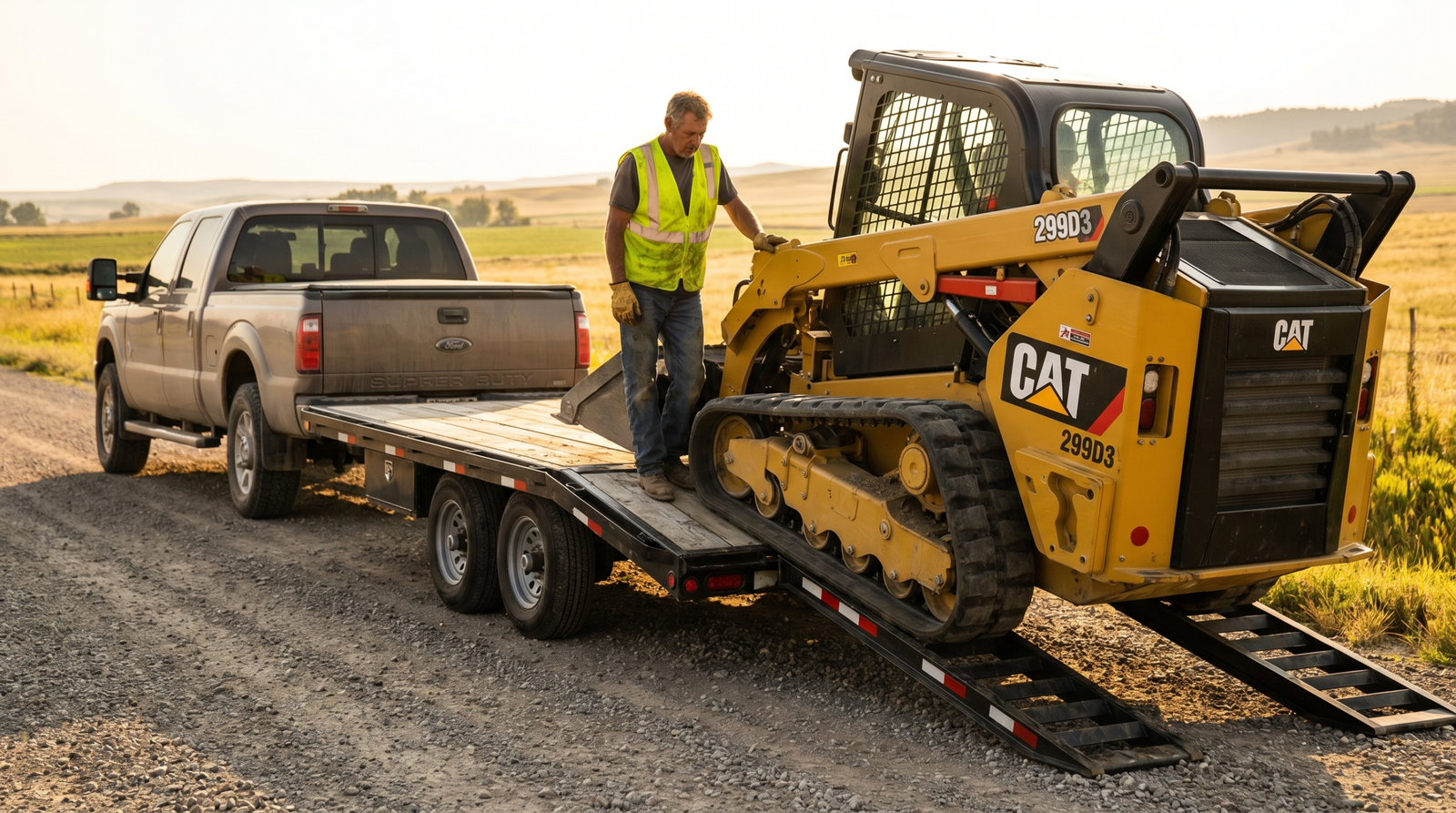
Slide-in ramps should sit fully into the receivers with the safety pins seated. Hydraulic ramps lock at full-down. Either way, ramp angle should be 12–15 degrees — steeper than 18 degrees and the loader can high-center on the deck edge.
Step 3: Approach Slowly and Squarely
Approach the ramps perpendicular to the trailer, dead center between them. Crooked entry binds one ramp and overloads it. Slow forward speed (idle creep) until the front wheels or tracks make full contact with the ramps.
Step 4: Center the Loader on the Deck
Drive forward until the rear wheels/tracks clear the ramps and sit on the deck. The loader’s center of gravity should be 12–18 inches forward of the trailer’s axle group — this gets you proper tongue weight (10–15 percent of total).
Step 5: Lower the Bucket and Engage the Parking Brake
Lower the bucket flat onto the deck. Set the parking brake. Shut the engine off. Both these steps must happen before tying down — the bucket on the deck adds friction that prevents lateral shift during transport.
Step 6: Tie Down at Four Points Minimum
Use four 5/16-inch grade-70 transport chains rated for 4,700 lbs working load each. Run one chain from each loader corner (lift arm chain points or designated tie-down lugs) to opposing corner D-rings on the trailer. Tighten with ratcheting binders.
Common Mistakes That Damage the Deck
Mistake 1: Loading at high RPM. Skid steer drive lugs at full RPM tear up wood decks fast. Always load at idle.
Mistake 2: Using straps instead of chains. Nylon straps stretch under load. Chains hold position. Use chains for loaders over 5,000 lbs.
Mistake 3: Pivot turns on the deck. Spinning the loader on the deck tears wood and scratches steel. Drive in a straight line.
Mistake 4: Skipping the rear wheel chocks. Without chocks, the trailer can roll while loading. Chock both rear wheels before the loader touches the ramps.
Right Trailer for Skid Steer Loading
A 7×20 equipment trailer with 14K GVWR and slide-in ramps handles most compact and mid-size skid steers. For tracked machines or larger loaders (Bobcat T770, CAT 299D3), step up to a 8.5×22+ deckover or a tilt-deck that lays flat for a 0-degree approach. Our equipment trailer guide covers the right size for every loader class.
Tie-Down Reference Table
| Loader Weight | Chain Spec | Tie-Down Points | Ramp Angle Max |
|---|---|---|---|
| Up to 5,000 lbs | 3/8″ Grade 70 (6,600 WLL) | 4 points | 15° |
| 5,000–8,000 lbs | 5/16″ Grade 70 (4,700 WLL) × 4 | 4 points | 14° |
| 8,000–12,000 lbs | 3/8″ Grade 70 × 4 | 4 points | 12° |
| 12,000+ lbs (compact track) | 1/2″ Grade 70 × 4 | 4–6 points + tilt deck | 10° (tilt only) |
Outbound References
For load-securement compliance, the federal FMCSA 49 CFR 393.130 standard requires a minimum of four tie-downs and proper aggregate working load. For OSHA-compliant ramps and loading practices, see OSHA 1926 standards on ramp grades and load handling.
Common Questions
Wood deck or steel deck for skid steers?
Wood for steady use — less slip, easier on tracks. Steel deck for occasional use or extreme conditions. Apitong tropical hardwood is the premium pick.
Should I drive forward or backward up the ramps?
Backward is safer. The loader’s center of gravity is over the rear wheels, so backing up keeps the heavy end low during the climb.
Tilt-deck or ramps for a heavy loader?
Tilt-deck for tracked machines and skids over 10K lbs. The flat-to-deck angle reduces stress on the chassis. See our tilt vs ramp comparison post.
How tight should the chains be?
Tight enough that the chain is straight and the loader’s suspension is partially compressed. Over-tight bends loader frames; under-tight lets the load shift.
Ready to Buy?
Browse equipment trailers for sale to find the right deck and ramp setup. See our equipment trailer pillar guide for sizing and brand picks.
Request a free delivered quote with your loader spec and we’ll send out-the-door pricing same business day.
Skid Steer Loading Pre-Trip and Post-Trip Inspection
A 60-second walk-around before every trip catches the issues that ground a job before it starts. Ten checkpoints to make a habit:
- Tongue weight visually correct — trailer level or slightly nose-down, not nose-up
- Loader bucket lowered all the way to the deck
- Parking brake set on the loader; transmission in neutral
- All four (or six) chains seated tight at attachment points
- Chains routed away from hot exhaust components
- Ramp pins seated and visible
- No loose tools or attachments on the deck
- Tarp (if used) tucked and secured
- All trailer lights working with brakes engaged
- Tire pressures match the door-jamb spec on tow vehicle and trailer
Choosing the Right Trailer Size for Your Skid Steer
Match deck length and GVWR to your machine. A 7×16 14K trailer fits any standard-frame compact skid steer up to 8,500 lbs operational weight. A 7×20 14K–16K is the sweet spot for mid-frame skid steers (Bobcat S650, CAT 262D3) up to 10,000 lbs. For full-size or compact track loaders over 11,000 lbs, you need an 8.5×22+ deckover with proper axles. Our equipment trailer pillar guide has the full sizing matrix.
Don’t forget the truck. A loaded equipment trailer at 14,000 lbs combined gross weight requires at least an F-250 or 2500-class truck for safe towing margin. Our tow vehicle guide covers the math.
Recommended Tie-Down Gear
Cheap chains break under shock loads. Spend on grade-70 transport chain (yellow chromate finish) and HD ratcheting binders rated for the working load. Mac’s, Ancra, and Kinedyne are the brands that hold up. Avoid harbor-freight chains for any equipment over 5,000 lbs.
Where How To Load A Skid Steer Fits in Your 2026 Buying Plan
If you’re comparing every option for how to load a skid steer, three resources help. The federal FMCSA cargo securement standards (49 CFR 393.100) apply on every public road. The NHTSA towing safety guide covers tow-vehicle setup. And our parent buyer’s guide covers sizing, brands, and 2026 pricing for the broader category.
Pricing on how to load a skid steer has stabilized in 2026 after the steel-cost swings of the early 2020s. Whether you’re buying first-time or replacing a unit, how to load a skid steer decisions still come down to use case, brand, and delivered out-the-door price. PrimeLoad’s position is to make the comparison transparent.
Browse How To Load A Skid Steer inventory to see every option with full specs and delivered pricing. Free delivery to all 50 states from PrimeLoad Trailers.