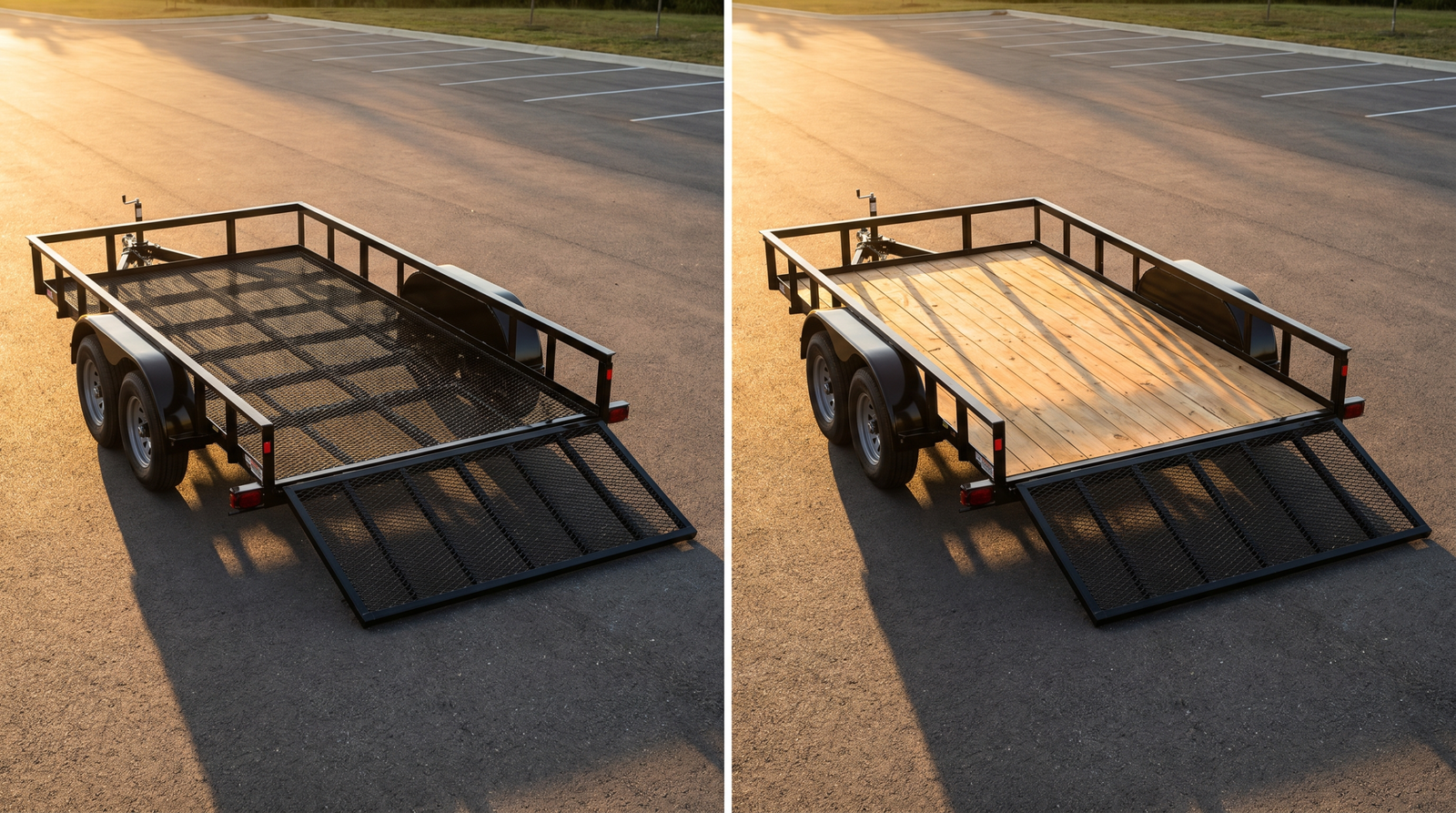
Trying to choose between steel mesh vs wood deck on your next utility trailer? The deck is the most-used surface on a trailer, and the wrong material kills the trailer’s usefulness for your specific work. Steel mesh decks last forever and shed water but punish wheeled equipment. Wood decks are quiet, easy to repair, and gentle on tires — but rot in 5–10 years if you don’t maintain them. This guide breaks down steel mesh vs wood deck for every common use case, ranks brands, and explains the hybrid options most buyers don’t know about.
Why Deck Choice Matters
The deck takes 95 percent of the wear and tear on a utility trailer. Loaded equipment, dropped tools, abrasive aggregates, weather exposure — the deck handles all of it. A trailer with the right deck for the work lasts 15–20 years. A trailer with the wrong deck either rots out or gets replaced because nothing fits on it. The steel mesh vs wood deck choice is one of the highest-impact spec decisions you’ll make.
For broader utility-trailer buying advice, see our utility trailers buyer’s guide.
Steel Mesh Deck: Pros and Cons
A steel mesh deck (sometimes called expanded metal) is welded steel grating with diamond-shaped openings. The mesh structure offers serious advantages for specific use cases.
Steel Mesh Pros
- Lasts forever: 25–30+ year service life with minimal maintenance.
- Sheds water and debris: rain, snow, mud falls right through. No standing water rots the deck.
- Visibility through the deck: useful when loading equipment with axle alignment requirements.
- Lighter than equivalent wood: 50–100 lbs lighter on a 6×12 trailer, which adds payload.
Steel Mesh Cons
- Rough on tires and wheels: the diamond pattern catches and chews tire sidewalls, especially under hard braking or sharp turns.
- Catches small items: screws, nails, small parts fall through and are lost.
- Cold in winter: picks up cold faster than wood, ice forms underneath in freezing rain.
- Loud: equipment sliding on mesh is significantly louder than on wood.
- Hard to walk on: in work boots it’s fine; in soft-soled shoes the mesh fatigues your feet fast.
Steel mesh deck is best for: aggregates, gravel, dirt hauling, snow plow trucks, and equipment that doesn’t have soft tires.
Wood Deck: Pros and Cons
A wood deck on a utility trailer is typically pressure-treated southern yellow pine planks (5/4 thickness, 6–8 inch wide) screwed to steel cross-members. Premium decks use Apitong tropical hardwood for additional durability.
Wood Deck Pros
- Easy on tires: the smooth, flat surface protects tire sidewalls and rubber compounds.
- Easy to repair: a damaged plank is unscrewed and replaced in 10 minutes for $15.
- Quiet: dramatically reduces noise from equipment, tools, and load shifting.
- Warm in winter: doesn’t conduct cold like steel.
- Easy to walk on: reduces fatigue when working from the deck.
- Easy to nail or screw items down: attach work surfaces, blocks, dunnage.
Wood Deck Cons
- Rots in 5–12 years: wood swells, splits, and rots even when treated. Pressure-treated pine averages 6–8 years before significant deterioration.
- Holds water: a wet wood deck stays wet for days, accelerating rot.
- Can splinter: aged wood deck surfaces grow splinters that catch on tires and skin.
- Heavier: a wood deck adds 75–150 lbs vs an equivalent steel mesh deck on a 6×12.
- Annual maintenance: needs sealing or staining every 1–2 years to maximize life.
Wood deck is best for: lawn and garden equipment, vehicles, motorcycles, ATVs, lumber, and anything that benefits from a smooth surface.
Steel Mesh vs Wood Deck: Side-by-Side
| Factor | Steel Mesh | Wood Deck |
|---|---|---|
| Service life | 25–30+ years | 5–12 years |
| Maintenance | None | Re-seal every 1–2 years |
| Repair cost | Welder needed ($200+) | $15 per plank, DIY |
| Equipment friendly | No — chews tires | Yes |
| Aggregate friendly | Yes — sheds debris | No — holds debris |
| Weight delta on 6×12 | Baseline | +75 to +150 lbs |
| Cost premium | +$300–$600 over wood (when offered) | Baseline |
| Noise | Loud | Quiet |
Hybrid Options Most Buyers Miss
The steel mesh vs wood deck question isn’t always either-or. Three hybrid setups solve common problems.
Apitong (Tropical Hardwood) Deck
Apitong is a dense tropical hardwood that lasts 12–20 years — nearly double pressure-treated pine. Cost premium is $400–$800 on most trailer sizes. Used on heavy-duty contractor trailers and any wood deck that gets serious abuse.
Wood Floor + Mesh Sides
Some manufacturers offer a flat wood deck with mesh-sided rail extensions. The wood handles equipment; the mesh sides let water and debris drain when hauling aggregates. Common on high-side landscape utility trailers.
Steel Plate Deck
Smooth steel plate (1/8-inch or 3/16-inch) is heavier than mesh, more expensive than wood, but combines the best of both — smooth surface like wood, no rot like steel. Used on high-end equipment haulers. Cost premium: $500–$1,200 over wood.
Brand Picks for Each Deck Type
Steel mesh deck: Big Tex 70CH series, Diamond C UDX, Iron Bull mesh utility — all use heavy 12-gauge expanded metal welded to crossmembers on 12-inch centers.
Wood deck: CAM Superline 6×12, BWise 7×14, Lamar 7×16 — use pressure-treated 5/4 boards screwed (not nailed) to crossmembers. Bolt-down decking is preferable for repair access.
Apitong: Premier and Diamond C offer Apitong as an upgrade on equipment trailers. Big Tex offers it on the LX and XH series.
Maintenance Tips for Each
Steel Mesh Maintenance
Touch up paint chips with rust-converting primer, especially after winter use in salt-belt states. Once a year, wire-brush any rust spots and re-paint with rust-converter primer plus an enamel topcoat. Total maintenance time per year: 1–2 hours.
Wood Deck Maintenance
Apply Thompson’s WaterSeal or equivalent every 12–18 months. Replace planks at first sign of soft spots or significant splitting. Tighten deck screws annually — wood swelling and shrinking loosens fasteners.
Outbound References
For pressure-treated wood durability standards, the American Wood Protection Association standards classify treatment levels. For trailer-deck load ratings under federal cargo rules, the FMCSA Title 49 CFR requires the deck support the rated load.
Common Questions About Steel Mesh vs Wood Deck
Can I retrofit a wood deck onto a mesh trailer?
Yes, by bolting a wood deck on top of the mesh. Many landscapers do this exactly to get the durability of mesh below and the smooth surface of wood on top. Cost: $200–$400 in lumber and hardware.
Which deck holds value better at resale?
Steel mesh — buyers see no replacement work needed. A trailer with a 7-year-old wood deck (about to need replacing) discounts $300–$700 vs a trailer with a fresh deck.
How loud is steel mesh during transit?
About 5–8 dB louder than wood when loaded. Not unbearable, but enough to notice over a long highway run.
Do tires actually wear faster on mesh?
Trailer tires are unaffected (they’re stationary on the deck). The trailer’s deck tires are what wear faster. We’re talking about wheels you load — a forklift or wheelbarrow run repeatedly across mesh wears tire compounds 15–25 percent faster.
What’s the right deck for hauling a riding mower?
Wood. Riding mower tires are soft compound and don’t tolerate mesh well. Tractor or zero-turn mower tires are even softer.
Ready to Buy?
The steel mesh vs wood deck decision comes down to what you’ll actually haul. Aggregates and dirt = mesh. Equipment, vehicles, and sensitive cargo = wood. Apitong if budget allows.
Browse utility trailers for sale filtered by deck type. Cross-check sizing in our best utility trailer for F-150 and tarp picks in our tarping guide.
Request a free delivered quote with the deck type you want and we’ll send out-the-door pricing same business day.