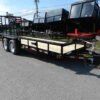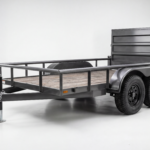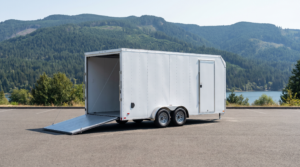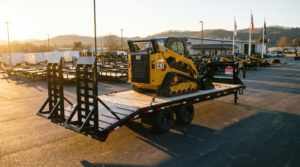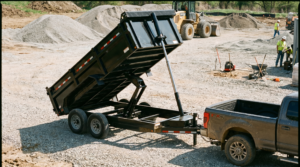

The single most expensive trailer mistake we see at PrimeLoad is buyers picking a trailer based on what they want to haul without first checking what their truck can actually tow. The result: blown transmissions, bent frames, voided warranties, and roadside breakdowns. Matching the trailer to the tow vehicle is the first step, not an afterthought.
This guide walks you through every number that matters and every decision you need to make before you spec a trailer.
Start With Your Tow Vehicle\’s Real Tow Rating
Open your owner\’s manual and find the tow rating for your specific configuration. The dealer brochure number, the marketing website number, and the actual rating in your manual are often different. The owner\’s manual is the only source that matters for warranty and legal purposes.
Your tow rating depends on six factors:
- Engine and transmission. A 5.3L V8 with the 6-speed automatic tows differently than a 6.2L V8 with the 10-speed.
- Rear axle ratio. A 3.42 axle pulls less than a 3.73 or 4.10. The window sticker shows this number.
- Cab and bed configuration. Crew cab long bed weighs more than regular cab short bed, which reduces available payload.
- 2WD vs 4WD. 4WD trucks weigh 200 to 400 lbs more, reducing payload accordingly.
- Tow package. The factory tow package adds heavier brakes, wiring, transmission cooler, and integrated brake controller. Without it, your max tow rating drops 20 to 40 percent.
- Cab passengers and cargo. Every pound in the truck reduces what you can tow safely.
GVWR vs Payload vs Tongue Weight
Three different numbers control whether your trailer setup is legal and safe:
GVWR (Gross Vehicle Weight Rating)
The maximum weight the trailer is allowed to carry, including its own weight plus cargo. A 7,000 lb GVWR trailer cannot legally be loaded above 7,000 lbs total. This number is on the trailer\’s VIN sticker and is set by the manufacturer based on the axle rating, frame strength, and tire capacity.
Cargo Capacity (Payload)
GVWR minus the trailer\’s curb weight. A 7,000 lb GVWR trailer with a 2,500 lb curb weight has 4,500 lbs of cargo capacity. This is what you actually have available for your load. Always check the cargo capacity number before assuming you can fit your gear.
Tongue Weight
The downward force the trailer exerts on your truck\’s hitch. For bumper-pull trailers, tongue weight should be 10 to 15 percent of the trailer\’s loaded weight. A 5,000 lb loaded trailer should have 500 to 750 lbs of tongue weight. Too little tongue weight causes sway. Too much overloads the rear axle.
For gooseneck and fifth-wheel trailers, the equivalent metric is \”kingpin weight\” or \”pin weight,\” targeting 20 to 25 percent of loaded trailer weight. This sits over the rear axle of the truck so it stresses the frame differently than bumper-pull tongue weight.
Hitch Types Explained
Bumper-pull (receiver hitch). The most common setup. The trailer connects to a 2-inch or 2-5/16 inch ball mounted in a Class III, IV, or V receiver behind the rear bumper. Class III handles up to 8,000 lbs, Class IV up to 12,000 lbs, Class V up to 20,000 lbs. Most pickups come with Class III or IV from the factory tow package.
Weight-distribution hitch (WDH). Adds spring bars that distribute trailer tongue weight forward to the front axle of the tow vehicle, leveling the truck and improving handling. Recommended for trailers above 5,000 lbs or any trailer where the loaded tongue weight exceeds 500 lbs. WDH does not increase your tow rating, but it makes towing at the upper end of your rating safer.
Gooseneck. Hitch ball mounted in the bed of a pickup truck, between the wheel wells, over the rear axle. Tows heavier loads with better stability than bumper-pull because the load sits over the truck\’s frame. Requires a 3/4 ton or 1 ton pickup with bed-mounted hitch installation ($400 to $1,200 installed).
Fifth-wheel. Similar to gooseneck (also bed-mounted) but uses a kingpin and saddle instead of a ball. Better articulation for tight turns. Common on RV trailers; less common on commercial cargo and equipment trailers.
Trailer Brake Systems
Most US states require trailer brakes on any trailer with GVWR over 3,000 lbs. Every state requires brakes above 4,500 lbs. Two systems dominate:
Electric brakes. The standard for utility, equipment, and cargo trailers. Activates from the tow vehicle\’s brake controller. Requires the truck to have an integrated or aftermarket brake controller installed (most modern factory tow packages include this).
Electric over hydraulic (EOH). Used on dump trailers and heavy-duty equipment trailers. Combines electric activation with hydraulic disc or drum brakes for better stopping power on heavier loads.
Surge brakes. Older boat trailers and some specialty trailers use surge brakes that activate based on tongue compression during deceleration. Less common on new trailers.
Real-World Weight Math
Here\’s how to calculate whether your truck can handle a specific trailer:
- Start with your truck\’s tow rating from the owner\’s manual. Example: 9,300 lbs for a 2024 F-150 5.0L 4×4 SuperCrew with the Max Trailer Tow package.
- Subtract passengers. Driver + passenger + 2 kids = ~600 lbs.
- Subtract cargo in the truck. Tools, gear, fuel cans = ~250 lbs.
- The remaining number is your usable trailer towing capacity. In this example: 9,300 – 600 – 250 = 8,450 lbs.
- Compare to the trailer\’s loaded weight, not its dry weight. A trailer that weighs 4,500 lbs empty often weighs 6,500 to 7,500 lbs loaded with cargo, fuel, and gear.
Stay 10 to 15 percent below your max rating for safety margin. Maxing out tow capacity stresses the transmission, brakes, and cooling system. Trucks rated to tow 9,300 lbs are happiest pulling 7,500 to 8,000 lbs.
Common Mistakes That Cost Money
Trusting the dry weight on the trailer brochure. Dry weight is the unloaded factory weight. Real-world towed weight is almost always 1,500 to 3,000 lbs higher once you add water (RV trailers), fuel, gear, and cargo. Always assume the trailer will weigh significantly more than the dry weight.
Ignoring tongue weight. A trailer that\’s within your tow rating can still overload your rear axle if the tongue weight is too high. Check your truck\’s rear gross axle weight rating (GAWR) and ensure tongue weight + truck cargo + passenger weight doesn\’t exceed it.
Skipping the weight-distribution hitch. Above 5,000 lbs, a WDH improves handling, braking, and reduces wear on your truck\’s rear suspension. The $300 to $600 cost pays back in extended truck service life.
Towing without trailer brakes. Even if your state allows it on lighter trailers, towing without trailer brakes shortens stopping distance, accelerates wear on truck brakes, and creates unsafe handling at highway speeds.
Decision Framework: Pick the Right Trailer for Your Truck
If your truck tows 5,000 to 7,500 lbs (most half-ton pickups, midsize trucks, and full-size SUVs):
- Utility, landscape, and small enclosed cargo trailers up to 5,000 lbs GVWR work without weight-distribution.
- Above 5,000 lbs GVWR, add a WDH and electric brake controller.
- Avoid gooseneck and fifth-wheel trailers (frame strength typically insufficient).
If your truck tows 9,000 to 12,000 lbs (well-equipped half-tons, light 3/4 tons):
- Equipment trailers up to 10,000 lbs GVWR.
- Mid-size enclosed cargo (7×14 to 8.5×20).
- Heavier dump trailers (10,000 to 12,000 lbs GVWR).
- Light gooseneck if your truck has bed-mount capability.
If your truck tows 14,000+ lbs (3/4 ton with HD package, 1 ton single rear wheel):
- Heavy equipment trailers (14,000 to 16,000 lbs GVWR).
- Gooseneck dump and equipment trailers.
- Heavy commercial cargo.
If your truck tows 18,000+ lbs (1 ton dually):
- Heavy gooseneck (16,000 to 25,000 lbs GVWR).
- Multi-axle commercial trailers.
- Fifth-wheel destination trailers.
Tow Vehicle Matching Questions
Can I trust the tow rating on the dealer brochure?
No. Always check the owner\’s manual for your exact configuration. The brochure number is the maximum rating for the best-equipped version of that truck. Your specific cab type, axle ratio, drivetrain, and tow package determine your actual rating, which can be 1,000 to 4,000 lbs lower than the brochure peak number.
What's the difference between dry weight and gross weight?
Dry weight is the trailer\’s unloaded factory weight. Gross weight (loaded) includes cargo, fuel, water (for RVs), gear, and people. Real-world gross weight is almost always 1,500 to 3,000 lbs higher than dry weight. Always plan based on loaded weight.
Do I need a weight-distribution hitch?
Recommended for any trailer above 5,000 lbs loaded weight or any trailer with tongue weight above 500 lbs. A WDH levels the truck, distributes weight to the front axle, and improves braking and handling. The $300 to $600 cost extends truck service life and improves safety.
How much trailer can a half-ton truck really tow?
Most modern half-ton pickups (Ford F-150, Chevy Silverado 1500, Ram 1500, Toyota Tundra) tow 7,500 to 11,000 lbs depending on engine, axle ratio, and tow package. Always verify in your specific truck\’s owner\’s manual. Stay 10 to 15 percent below max rating for safety margin.
Do I need trailer brakes?
Required by most US states on any trailer over 3,000 lbs GVWR. Required by all states above 4,500 lbs GVWR. Even if your state allows brakeless towing on lighter trailers, electric brakes shorten stopping distance, reduce truck brake wear, and improve safety at highway speeds. Worth the $200 to $500 install cost on any trailer you tow regularly.
Can a Tahoe or Suburban tow a travel trailer?
Yes. Modern full-size SUVs (Tahoe, Suburban, Expedition, Sequoia) tow 7,500 to 9,500 lbs depending on configuration. Travel trailers under 5,500 lbs dry weight (which means 7,000 to 8,000 lbs loaded) work well with these SUVs. Verify your specific vehicle\’s tow rating before shopping.
Related Guides and Inventory
Ready to buy? Get a free quote within 24 hours, or call us at (802) 203-7891.