Looking for dump trailers for sale? You’ve found one of the largest online lineups in America, with free delivery to all 50 states. This guide walks you through every detail you need before you buy, from sizes and lift mechanisms to 2026 pricing and brand reputations.
Dump Trailers For Sale in 2026: What Smart Buyers Watch For
The trailer industry has shifted under buyers’ feet over the last three years. Anyone shopping dump trailers for sale in 2026 faces more transparent pricing, better delivery logistics, and bigger spec sheets than ever. The federal FMCSA CDL rules for towing have not changed (no CDL needed under 26,001 lbs combined GVWR), but how dealers package dump trailers for sale listings has. Free nationwide delivery, side-by-side spec comparisons, and out-the-door pricing are now the norm at any reputable dealer. Don’t accept anything less.
Brand selection matters too. The NHTSA tire safety standards govern how every trailer-rated tire performs at GVWR; brands that buy lower-rated tires to hit a price point are easy to spot once you know what to look for. Whether you’re a first-time buyer or your fifth purchase, finding the right dump trailers for sale comes down to two things: matching capacity to use and trusting the brand to back the build. This guide walks you through every variable that matters before you sign.
nn
A dump trailer is one of the few pieces of equipment that pays for itself. Hire one landscaper for a season, haul one demolition load, or skip one dumpster rental, and the math starts working in your favor. The trouble is that buying the wrong one costs you twice.
Wrong size, wrong lift, wrong brand for your use case, and you end up either renting on top of owning or replacing the trailer two years in. This guide is built for the person actually writing the check. We cover how the dump mechanism works, what GVWR really means in pounds you can haul, which sizes fit which jobs, what brands to trust, and what 2026 pricing looks like. Whether you are a landscaper buying your first 6×12, a contractor sizing up to a deckover gooseneck, or a homeowner cleaning out a property, you will leave knowing exactly what to browse in dump trailer inventory and why.
What Is a Dump Trailer (And How the Dump Mechanism Actually Works)
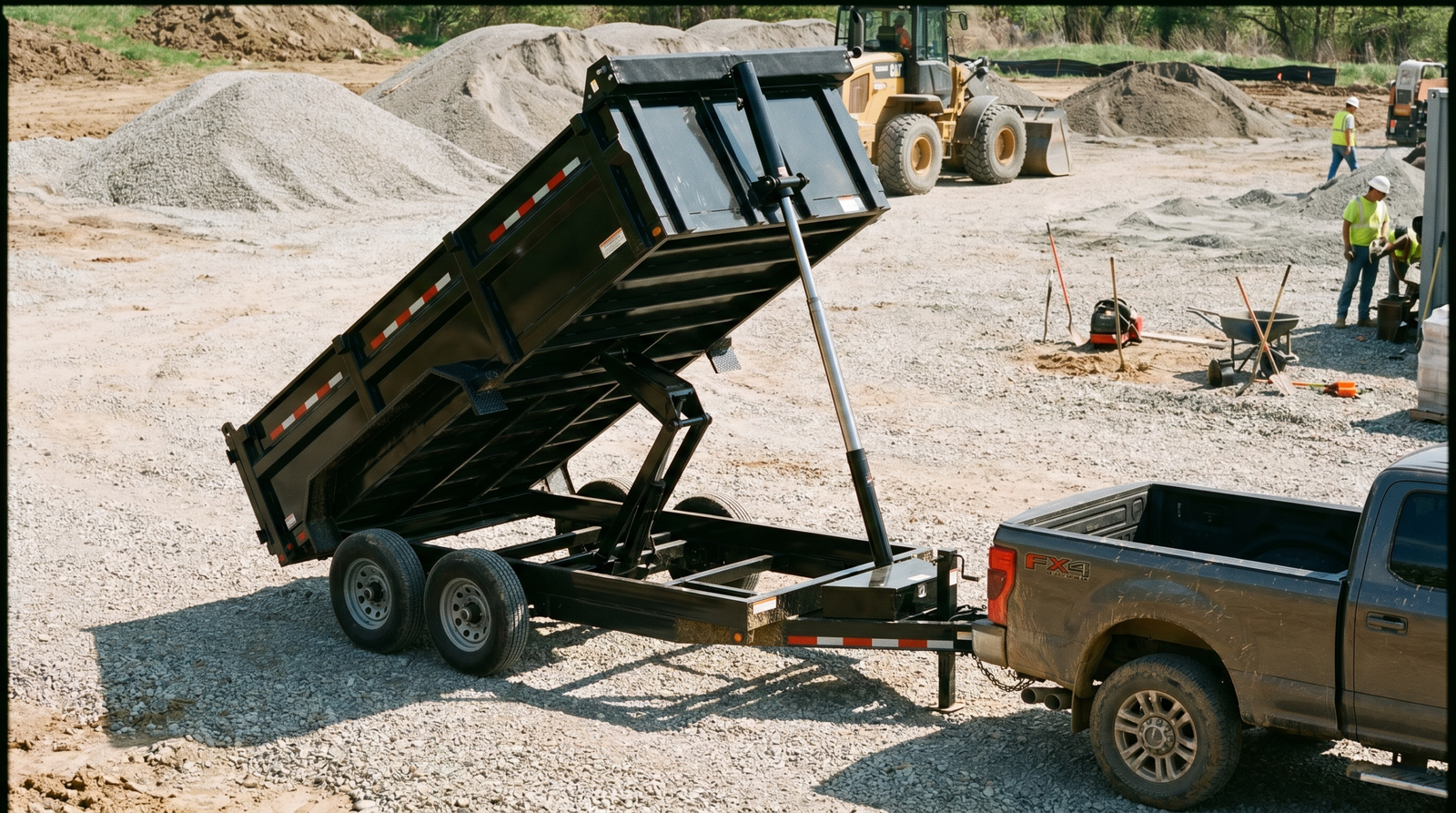
A dump trailer is a towable open-box trailer with a hydraulically powered bed that tilts to unload. It hitches to a bumper pull or gooseneck on your truck, runs off a 12-volt battery and pump that you charge through your truck or shore power, and dumps cargo by raising the front of the bed at an angle (typically 40 to 50 degrees) so gravity does the rest. No CDL is required for any standard dump trailer under 26,001 lbs combined gross vehicle weight, and the trailer itself does most of the work.
Three mechanical systems do the lifting. Each one moves the same bed, but they apply force differently and that affects price, durability, lift angle, and how the trailer handles uneven loads.
Hydraulic Single Ram (Direct Push)
One hydraulic cylinder mounted under the front of the bed pushes straight up. It is the simplest design, the cheapest to build, and the easiest to repair. Single rams are common on small 5×8 and 5×10 dump trailers where loads are light and the geometry stays manageable. The downside: mechanical advantage is weakest at the start of the lift, exactly when the bed is full and heaviest.
Scissor Hoist
A scissor hoist uses an X-shaped linkage with a hydraulic cylinder pushing the scissor open. As the cylinder extends, the scissor mechanism multiplies force at the bottom of the lift, which is the moment you need it most. Scissor hoists handle heavy, off-balance loads (rip-rap, wet concrete, root balls) better than any other style. They also distribute lift force across a wider footprint, which reduces frame fatigue. This is the workhorse design on most 12K and 14K dump trailers.
Telescopic Cylinder
A telescopic cylinder is a single ram with multiple stages that extend in sequence like an old radio antenna. It mounts at the front of the bed and produces the highest dump angle of any style, often 50+ degrees, which matters when you are dumping wet clay, mulch, or anything sticky. Telescopic lifts are fast, clean, and reduce frame stress because the lift point sits forward of the load. They cost more to manufacture and more to rebuild if a seal blows.
Dual Ram
Two cylinders, one on each side of the bed, lift in tandem. Dual ram setups were popular on older heavy-duty dumps but have largely been replaced by scissor and telescopic designs. The reason: if one cylinder gets ahead of the other, the bed twists. Twisted beds bend frames, and bent frames are not warranty repairs. You will still see dual ram on some import trailers and a few legacy models. We generally do not recommend it.
Dump Trailer Sizes Explained
Size is where most buyers get it wrong. The dimension on the listing (5×8, 7×14, etc.) is bed length and width in feet. What actually matters is the combination of bed size, side height, and GVWR, because that combination determines how many cubic yards you can legally and safely haul.
Small (5×8 to 5×10)
Single-axle, 7,000 lb GVWR, roughly 2 to 2.5 cubic yards. These are the homeowner and light landscaping trailers. Empty weight runs around 1,800 to 2,200 lbs, leaving you 4,800 to 5,200 lbs of payload, which is enough for one yard of wet topsoil or a half-cord of firewood. The CAM Superline 5×8 is a good example of the category. Towable behind a half-ton, easy to maneuver, light enough that you do not need trailer brakes on every state’s roads (though you should have them).
Mid-Size (6×12 and 7×12)
Tandem-axle, 12,000 to 14,000 lb GVWR, roughly 4 to 5 cubic yards with standard 24-inch sides. This is the size most working landscapers and small contractors buy. A 7×12 with a 14K GVWR weighing about 3,800 lbs empty hauls just over 10,000 lbs of payload. That is two yards of gravel, a ride-on mower plus a string trimmer crew, or a full demo load from a bathroom remodel. If you are running one truck and one trailer, this is usually the right size.
Large (7×14 and 7×16)
Tandem-axle, 14,000 to 16,000 lb GVWR, 5 to 7 cubic yards. The 7×14 is the most popular dump trailer sold in America, and for good reason. It hauls a full pallet of pavers, a skid steer (with the right ramps), or three yards of mulch in a single trip. Step up to a 7×16 like the BWise 7×12 High Side sibling line and you gain the bed length to carry longer items like 12-foot landscape timbers or a full pallet of sod.
Heavy / Deckover and Gooseneck (14K+ to 30K)
This is where the trailers stop being utility and start being equipment. Deckover dumps eliminate the wheel wells inside the bed, so the load floor is flat and full width (usually 82 inches wide). The BWise 7×16 Deckover with fold-down sides is built for hauling skid steers, mini excavators, and pallets of brick. Gooseneck dumps push GVWR up to 25,000 or 30,000 lbs and require a one-ton truck and a gooseneck hitch in the bed. These are commercial-grade machines for excavation contractors, demolition crews, and farms moving serious tonnage.
| Size Class | Typical GVWR | Empty Weight | Payload | Cubic Yards |
|---|---|---|---|---|
| 5×8 / 5×10 | 7,000 lbs | 1,800-2,200 lbs | 4,800-5,200 lbs | 2-2.5 |
| 6×12 / 7×12 | 12,000-14,000 lbs | 3,400-3,900 lbs | 8,500-10,100 lbs | 4-5 |
| 7×14 / 7×16 | 14,000-16,000 lbs | 4,200-4,800 lbs | 9,500-11,200 lbs | 5-7 |
| Deckover / Gooseneck | 16,000-30,000 lbs | 5,500-7,500 lbs | 10,500-22,500 lbs | 7-12 |
GVWR and Payload: What These Numbers Mean in the Real World
Two numbers on the spec sheet matter more than anything else: GVWR and empty weight. GVWR (Gross Vehicle Weight Rating) is the maximum the trailer is engineered and legally rated to weigh when fully loaded. Empty weight is what the trailer scales at with no cargo. Subtract empty from GVWR and you get payload capacity, the actual weight of stuff you can put in the bed.
Worked example. A 14K GVWR dump trailer weighing 4,500 lbs empty has 9,500 lbs of payload. That sounds like a lot. Then you check what you actually haul:
- Dry topsoil: 2,000 lbs per cubic yard, so about 4.75 yards fits the payload. The bed only holds 5 yards anyway. Fine.
- Wet topsoil: 2,400 to 3,000 lbs per yard. Now you can only legally haul 3 to 3.5 yards even though the bed holds 5. Fill it past that and you are over GVWR.
- Gravel (3/4 minus): 2,800 lbs per yard. Same problem. Three yards is your limit.
- Wet concrete debris: 4,000 lbs per yard. You hit GVWR before the bed is half full.
The lesson: heavy materials hit weight limits long before they hit volume limits. If you haul wet aggregate or demolition waste, you want a 16K GVWR or larger. If you haul mulch, brush, and dry leaves, a 12K is plenty. For more on this calculation, our complete GVWR guide walks through the math for any trailer class.
Best Dump Trailers by Use Case
Landscaping
Most landscaping crews need a 6×12 or 7×12 with 14K GVWR, 24-inch sides, a tarp kit, and a barn-door or spreader gate. Barn doors let you dump full piles. Spreader gates let you dribble gravel down a driveway as you drive. The BWise 7×12 High Side with barn doors is a classic landscaper rig. For a deeper dive on right-sizing for green industry work, see our guide to the best dump trailer size for a landscaping business.
Construction and Demolition
Construction crews want 7×14 or 7×16 trailers with 14K to 16K GVWR, scissor lift, 24- to 36-inch sides, and a slide-in ramp pack so they can roll a skid steer or compact track loader on. Steel floors should be 10 gauge or thicker because dropping concrete chunks on 12-gauge floor will warp it. Look for D-rings welded inside the bed for tying down equipment.
Farming and Ranch Work
Farmers usually go big and go gooseneck. A 14- or 16-foot deckover or a gooseneck dump in the 21K to 25K range hauls fence posts, hay, manure, feed, and gravel without making three trips. Fold-down sides are non-negotiable on a farm trailer because most loads are oversized or awkward.
Residential Cleanup and DIY
For homeowners doing a roof tear-off, a deck demolition, or a multi-weekend yard project, a 6×10 or 6×12 with 10K to 12K GVWR is the sweet spot. Light enough to tow with a half-ton, big enough to skip the dumpster rental. A CAM Superline 5×8 is the entry point if you are tight on storage or driveway space.
Commercial Waste and Junk Hauling
Junk removal businesses run high-side trailers (36 to 48 inch sides) on 14K or 16K frames, because junk is volume-heavy not weight-heavy. The taller the sides, the more cubic yards you carry per trip and the more revenue per route.
Top Dump Trailer Brands Compared
Brand matters because the welds, axles, hydraulic pump, and powder coat are what separate a trailer that lasts 15 years from one that lasts 4. Here are the brands worth your money.
Big Tex
The 800-pound gorilla of the trailer industry. Big Tex makes dump trailers across every category from 5×10 utility to 30K gooseneck. Strengths: massive parts and dealer network, predictable build quality, strong resale. Ideal for: buyers who plan to sell or trade in, fleet operators who need consistent specs across multiple units.
BWise
Pennsylvania-built, premium spec, family-owned. BWise dump trailers come standard with features that are upcharges on cheaper brands: 10-gauge floors, hot-dipped components, deep-cycle marine batteries, and powder coat that holds up. Ideal for: contractors who use the trailer hard every day and want it to outlast two trucks.
CAM Superline
The middle of the market done right. CAM hits a sweet spot of price and quality with strong attention to fit and finish. Their 5×8 and 5×10 single-axle dumps are some of the best small trailers you can buy. Ideal for: serious DIYers, small landscapers, and anyone who wants commercial features without commercial pricing.
Premier
Premier builds heavy. Their dumps are overbuilt, often spec’d one frame size up from competitors at the same GVWR. The trade-off is empty weight (you lose a few hundred pounds of payload) but you gain a trailer that simply will not flex or warp. Ideal for: buyers who haul rocks, asphalt, and concrete daily.
Diamond C
Texas-built, telescopic cylinders standard on most models, and an exceptional powder coat process. Diamond C runs a 6-step coating system that holds up to road salt and abrasion better than most. Ideal for: buyers in northern climates, anyone hauling acidic loads (manure, salt, fertilizer).
We also stock CAM, Big Tex, BWise, Premier, Diamond C, and several others including Mission, Trailstar, Lamar, Horizon, N&N, Raw Maxx, and Covered Wagon, so you can compare side by side without driving lot to lot.
What to Look For When Buying a Dump Trailer
Once you know the size and brand, the spec sheet still has a dozen line items that determine whether the trailer is a good buy or a money pit. Here is what to check, in order of importance.
Tongue Weight and Coupler Rating
Tongue weight is the downward force the trailer applies to your hitch. It should run 10 to 15 percent of total loaded trailer weight. A 14,000 lb loaded trailer puts roughly 1,400 to 2,100 lbs on the hitch. Make sure your truck’s tongue weight rating, hitch class, and ball size match. A 2-5/16 inch ball is standard on anything 14K and up. A 2-inch ball is rated to about 8,000 lbs and is fine on 7K trailers only.
Axle Configuration
Two 7K axles equal a 14K GVWR. Two 8K axles give 16K GVWR. Triple axles or 10K axles push you into 21K and 25K territory. Look at brake type. Electric drum brakes are standard. Electric-over-hydraulic disc is an upgrade worth paying for if you tow in mountains or heavy traffic, because they shed heat better and stop shorter.
Ramps
If you ever plan to load equipment, you need ramps. Slide-in rear ramps are the most common and store inside the bed. HD ramps for skid steers should be at least 5 feet long and rated for 6,000 to 10,000 lbs each. Some trailers offer fold-up ramps that double as a tailgate. Useful, but check the rating.
Side Height and Configuration
Standard sides run 24 inches. High sides go to 36 or 48 inches. Fold-down sides drop flat for loading wide loads. Removable side extensions add 12 inches when you need them and store away when you do not. Choose based on what you actually haul, not what looks good on the lot.
Tarp Kit
A roller-style tarp kit is required by law in many states for any open dump load. Even where it is not required, you save fines and keep debris off other drivers’ windshields. Manual roll-up kits start around $300. Electric kits run $600 to $900. Buy it with the trailer; it is more expensive to retrofit.
Battery and Charger
The hydraulic pump runs off a 12-volt deep-cycle battery. A cheap lawn-mower battery dies in a season. A marine deep-cycle battery lasts three to five years. Check whether the trailer comes with a battery charger built into the tongue box. If not, plan to add one. You can charge through a 7-pin connector while towing, but you cannot rely on that alone if you dump 5+ times a day.
Hydraulic Pump Quality
The pump is the heart of the trailer. Bucher, KTI, and Monarch are the three brands worth trusting. Off-brand pumps from cheap import trailers fail in 12 to 24 months. A name-brand pump runs 8 to 10 years with proper maintenance.
Frame and Floor Gauge
Floor steel should be 10 gauge minimum on anything 12K or higher. Frame should be a 6-inch I-beam or channel on tandem axle dumps. Cross members spaced 12 inches on center are stronger than 16 inches on center. Look underneath the trailer before you buy, every time. If the dealer will not let you, walk away.
Before any final decision, run through our full trailer inspection checklist. It catches the things most buyers miss until the warranty has run out.
Dump Trailer Pricing in 2026
Pricing has stabilized in 2026 after the steel and component swings of the early 2020s. Here is what you can expect to pay, delivered, for a quality new dump trailer at current market.
| Size / Class | Typical 2026 Price Range | What’s Included |
|---|---|---|
| 5×8 / 5×10 single axle, 7K | $5,800 – $7,800 | Single ram or scissor, 18-24 inch sides, barn doors, manual tarp prep |
| 6×10 / 6×12 tandem, 10K-12K | $8,200 – $11,500 | Scissor lift, 24 inch sides, ramps, tarp kit, battery |
| 7×12 / 7×14 tandem, 14K | $10,800 – $14,500 | Scissor or telescopic, 24-36 inch sides, slide-in ramps, tarp, charger |
| 7×16 high side / deckover, 14K-16K | $13,500 – $18,500 | Telescopic, fold-down sides, HD ramps, full tarp kit, deep-cycle battery |
| Gooseneck deckover, 21K-30K | $19,500 – $32,000 | Telescopic, gooseneck hitch, dual jacks, HD axles, electric brakes all wheels |
What drives price differences within a size class? Three things, in order: lift type (telescopic costs more than scissor, scissor costs more than single ram), brand (BWise and Premier sit at the top, mid-tier brands sit 10 to 20 percent lower), and options. Common upgrades and their typical cost: electric tarp kit ($600), spare tire and mount ($250), upgraded battery and onboard charger ($350), HD slide-in ramps ($400), 36-inch sides ($500), spreader gate ($300), and disc brakes ($800 to $1,200 per axle).
Used dump trailers run 50 to 70 percent of new for trailers under 5 years old. Older than that and you are buying someone else’s wear. Plenty of buyers come in for a used trailer and leave with a new one because the price gap, after factoring in tires, battery, and pump rebuild on the used unit, is smaller than expected.
Free Nationwide Delivery: How It Works
Every dump trailer in our inventory ships free to all 50 states. No driving across the country, no paying a hot-shot service. We hitch it to a delivery truck and bring it to your driveway, your job site, or your shop.
Transit times depend on distance. West Coast deliveries typically arrive within 5 to 8 business days. Mountain and Midwest states run 8 to 12 days. East Coast and Gulf states are usually 10 to 15 days. We send tracking and an ETA window before the truck rolls. You sign for the trailer, do a walk-around with the driver, and start working.
To see what your delivered price looks like with options spec’d, get a free delivered quote and we email it back the same business day.
How to Compare Dump Trailers For Sale Side-by-Side
Most buyers comparing dump trailers for sale get one or two spec lines wrong on their first pass.
Three numbers settle most decisions when you’re shopping dump trailers for sale: GVWR rating, frame gauge, and hydraulic pump brand. Spec sheets that bury these are a yellow flag.
Brand matters too. Reputable dealers list every dump trailer with full specs visible. We carry dump trailers for sale from every major manufacturer in our nationwide inventory.
Pricing on dump trailers for sale has stabilized in 2026 after the steel swings of the early 2020s. Whether you’re looking at entry-level dump trailer models or commercial-grade builds, the buying framework in this guide gives you a clean way to evaluate every option.
Ready to start? Browse dump trailers for sale on our inventory page to see every model with real photos, full specs, and our delivered out-the-door price.
Frequently Asked Questions
Do I need a CDL to tow a dump trailer?
Not for any standard dump trailer at or under 26,001 lbs combined gross vehicle weight. That covers every bumper-pull dump trailer and most goosenecks. A non-commercial Class A endorsement is required in some states for combinations over 26,001 lbs, which mostly affects gooseneck buyers towing with a 1-ton truck.
What is the best dump trailer brand?
There is no single best brand. There is the best brand for your use case. BWise and Premier lead for daily commercial use. CAM Superline is the value play for serious users on a budget. Big Tex wins on resale and dealer network. Diamond C wins for buyers in salt-belt and acidic-load applications.
Hydraulic vs scissor lift, which is better?
Both are hydraulic. The real comparison is single ram vs scissor vs telescopic. For loads under 6,000 lbs, single ram is fine. For 6,000 to 12,000 lbs, scissor is the workhorse. For wet or sticky loads, or anything over 12,000 lbs, telescopic gives you better dump angle and less frame stress.
How much tongue weight should a dump trailer have?
10 to 15 percent of fully loaded trailer weight. A 14,000 lb loaded trailer should put 1,400 to 2,100 lbs on the hitch. Too little and the trailer fishtails. Too much and you overload the rear axle of the tow vehicle.
What is the resale value of a dump trailer?
Strong. A well-maintained 5-year-old dump from a major brand typically sells for 60 to 70 percent of its original price. Stay with named brands, keep the tarp kit and ramps, do annual greasing, and you preserve value better than almost any other piece of equipment you own.
What maintenance does a dump trailer need?
Three things, on schedule: grease all pivot points and the hoist hinge every 10 dump cycles or monthly, whichever comes first. Check hydraulic fluid level every 6 months and change it every 2 years. Charge the battery after every use and replace the deep-cycle battery every 3 to 5 years. Add tire pressure checks before every load and you have done 90 percent of what the trailer needs.
What kind of warranty comes with a new dump trailer?
Most major brands offer a 1-year bumper-to-bumper warranty plus extended coverage on specific components. BWise and Premier extend frame warranties to 5 or 6 years. Hydraulic pumps from Bucher and KTI carry their own 2-year warranties separate from the trailer. We send the warranty paperwork in your delivery packet and walk you through what is covered.
Ready to Buy?
You now know more about dump trailers than 95 percent of the people who walk onto a lot. Here is the next step.
Browse the inventory. Filter by size, GVWR, brand, and lift type on our dump trailer inventory page. Every listing shows real photos, full specs, and our delivered price.
Get a delivered quote. Tell us your zip code and the trailer you are eyeing, and we send a delivered out-the-door price within one business day. Request a free delivered quote and we handle the rest.
15 years of independent trailer dealing, free delivery to all 50 states, and a lineup that includes Big Tex, BWise, CAM Superline, Premier, Diamond C, and a dozen more. Whatever you haul, there is a dump trailer built to handle it.