Looking for equipment trailers for sale? You’ve found one of the largest online lineups in America, with free delivery to all 50 states. This guide walks you through every detail you need before you buy, from sizes and lift mechanisms to 2026 pricing and brand reputations.
Equipment Trailers For Sale in 2026: What Smart Buyers Watch For
The trailer industry has shifted under buyers’ feet over the last three years. Anyone shopping equipment trailers for sale in 2026 faces more transparent pricing, better delivery logistics, and bigger spec sheets than ever. The federal FMCSA CDL rules for towing have not changed (no CDL needed under 26,001 lbs combined GVWR), but how dealers package equipment trailers for sale listings has. Free nationwide delivery, side-by-side spec comparisons, and out-the-door pricing are now the norm at any reputable dealer. Don’t accept anything less.
Brand selection matters too. The NHTSA tire safety standards govern how every trailer-rated tire performs at GVWR; brands that buy lower-rated tires to hit a price point are easy to spot once you know what to look for. Whether you’re a first-time buyer or your fifth purchase, finding the right equipment trailers for sale comes down to two things: matching capacity to use and trusting the brand to back the build. This guide walks you through every variable that matters before you sign.
nn
If you are shopping equipment trailers for sale and you want a trailer that survives ten years of skid steers, mini excavators, and mud, this is the guide that does the work for you. We sell roughly 69 equipment trailers at any given time at PrimeLoad in Woodland, Washington, and we ship them with free nationwide delivery to all 50 states.
Fifteen years of selling these decks taught us where buyers waste money and where they save it. This post walks through every size, every GVWR class, the real difference between a hydraulic tilt and a stationary deck with ramps, and the brands that hold up on a job site versus the ones that bend a crossmember the first time you load a CTL. By the end you will know which trailer fits your machine, your tow rig, and your wallet, and you will know what to ask before you sign anything.
What Is an Equipment Trailer (and What It Is Not)
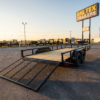
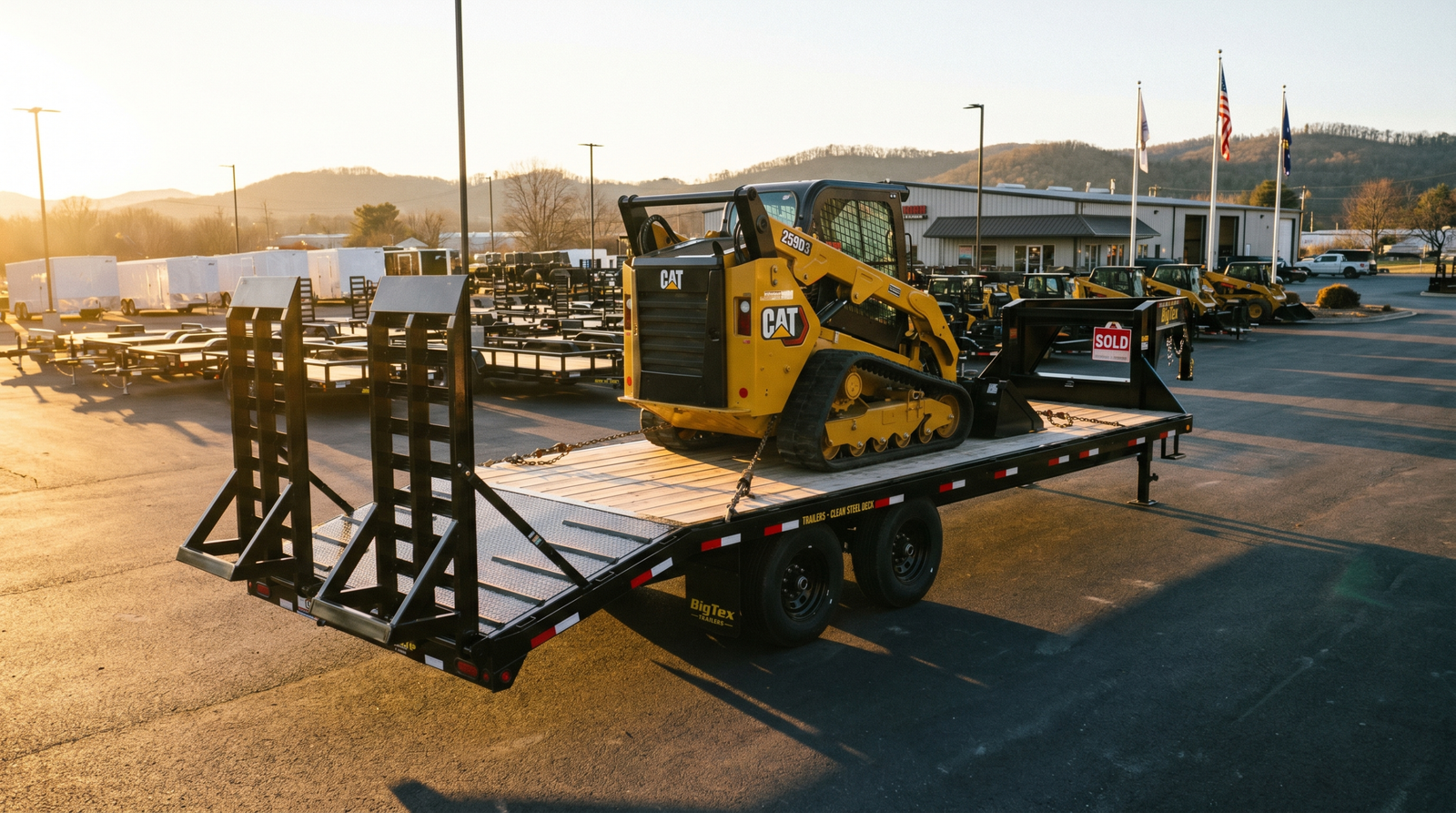
An equipment trailer is a deck trailer purpose-built to haul rolling and tracked equipment. Think skid steers, compact track loaders, mini excavators, scissor lifts, ZTR mowers, compact tractors, telehandlers, rollers, and small dozers. The deck is low, the frame is thick, the ramps or tilt section are engineered for point loads, and the tie-down geometry is set up for chains and binders rather than ratchet straps over plywood.
That sounds obvious until you compare it to the other deck trailers buyers confuse it with. A car hauler has a similar deck length but lighter frames, no dovetail meant for tracks, and tie-downs aimed at lower automotive weight. A utility trailer is too light for a 9,000 lb skid steer and the ramps will fold the first time you try. A flatbed deckover is wider (usually 102 inches) and rides higher, which is great for pallets and lumber but adds eight to twelve inches to your loading angle when you push a low-clearance machine up the ramp. A gooseneck flatbed is a heavier cousin meant for long, distributed loads.
The defining feature of an equipment trailer is the combination of a 14,000 to 24,000 lb GVWR, an 82 inch deck width that fits between the fenders, and a loading geometry built around heavy machines rather than long cargo. If you are hauling equipment, that combination matters more than any other spec on the sticker.
Equipment Trailer Sizes Explained
Deck length is the first decision and the one most buyers get wrong. They size for the machine they own today and outgrow it inside two years. Here is how the common lengths actually behave on the road and on the job.
- 7×14: The smallest practical equipment deck. Fits a small skid steer like a Bobcat S70 or a stand-on track loader, plus a few attachments. Light tow vehicles can pull it. Pricing typically runs $7,500 to $10,500.
- 7×16: The everyday landscape and small contractor size. Holds a compact track loader with a bucket, or a ZTR mower plus a walk-behind, or a small Kubota with an implement. This is our highest volume size at PrimeLoad. Expect $8,500 to $12,500.
- 7×18: The sweet spot for full size skid steers and mini excavators. An 18 foot deck swallows a Bobcat T76 or a Kubota SVL75 with a bucket attached and still leaves a foot for chains. Most run 14K GVWR. Pricing is usually $9,500 to $14,000.
- 7×20: Our most popular heavy-duty length. Holds a CTL plus an attachment, a small skid steer plus a mini ex, or a compact tractor with implements. Almost always 14K or 16K GVWR. Plan on $10,500 to $16,500.
- 7×22: Where construction crews live. Two pieces of equipment, longer dovetails, and frames built for point loads at any deck position. Expect $12,000 to $18,500.
- 7×24: The longest standard bumper-pull. If you regularly haul a mini excavator with a bucket on the dovetail and a skid steer up front, this is the right deck. Pricing ranges $13,500 to $21,000 depending on tilt or ramp.
For lengths beyond 24 feet you usually move to a gooseneck or a deckover. Bumper-pull decks past 24 feet flex, the tongue weight gets ugly on a half-ton, and you lose maneuverability in tight job sites.
GVWR Classes Explained
GVWR (Gross Vehicle Weight Rating) is the trailer’s loaded ceiling, including the trailer itself. It is the single most important spec you will read on a sticker. Buy too small and you destroy axles and brakes. Buy too big and you pay for capacity you never use and tow heavy empty.
- 10K GVWR (two 5,200 lb axles): Light skid steer territory. ZTR mowers, walk-behind machines, a Bobcat S70, a small Kubota subcompact tractor, lawn care fleets. Trailer typically weighs 2,500 lbs, so payload is around 7,500 lbs.
- 14K GVWR (two 7,000 lb axles): The volume class. Full size skid steers, compact track loaders up to roughly 9,500 lbs operating weight, mini excavators in the 8,000 lb class, compact tractors, scissor lifts. Trailer weight runs 3,000 to 3,800 lbs, so payload sits near 10,500 lbs.
- 16K GVWR (two 8,000 lb axles): Where heavier CTLs live. A Bobcat T86, a Kubota SVL97, a 12,000 lb mini excavator with a thumb. The bump from 14K to 16K usually adds $1,200 to $2,000 to the price but doubles the cushion you have on a heavy machine.
- 20K and 24K GVWR (two 10K or three 7K axles): Heavy industrial. Telehandlers, larger excavators, dual rolling stock, paving equipment. These trailers often have hydraulic disc brakes, 17.5 inch tires, and air-ride or torsion suspensions.
Our rule on the lot: pick a GVWR that gives you 15 percent of headroom above your heaviest machine plus its heaviest attachment plus a half tank of fuel. Loading to 95 percent every day is how you cook hubs.
If you want a deeper read on weight ratings, our GVWR guide walks through how to read axle stickers and what cargo capacity actually means.
Tilt vs Stationary Deck (the Real Trade-Off)
Tilt or ramps is the second-biggest decision after size, and the answer depends on what you load and how often.
Full Hydraulic Tilt
The whole deck pivots on a center hinge. Hit a button or pull a lever and the back drops to ground level. Loading angle is shallow, often six to nine degrees, which matters when you are pushing a low-ground-clearance skid steer or a sports car onto the deck. No ramps to lift, no parts to lose. Hydraulic tilts add roughly $2,500 to $4,500 over a comparable stationary deck. Best for buyers loading two to ten times a day, dealers moving equipment in and out, and rental fleets where speed matters.
Our BWise 7×20 hydraulic tilt is a good example. It loads a CTL by yourself in under two minutes.
Partial Tilt (Stationary Front, Tilting Rear)
The front 8 to 10 feet stays flat for a generator, fuel cube, or attachment, while the rear section tilts. You get fast loading and fixed cargo space. Costs sit between full tilt and stationary, usually $1,500 to $3,000 over a ramp deck.
Stationary Deck With Ramps
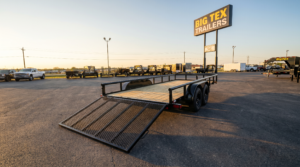
The classic dovetail and ramp setup. Cheaper, simpler, fewer hydraulic parts to fail, and easier to load long items that overhang. The downsides: ramps are heavy (most weigh 80 to 130 lbs each), the loading angle is steeper at 12 to 16 degrees, and you have to be on flat ground or the ramps misalign. If you load tracked equipment, ramps still win because tracks can grip a ramp better than a polished tilt deck on a wet morning.
Cost and Maintenance
Tilt trailers have a power unit, hydraulic cylinder, hoses, and a battery. Plan on replacing the battery every two to three years and rebuilding the power unit at year seven or eight. Ramp trailers have springs and grease zerks. Both are reliable when maintained, but the tilt costs more to keep alive.
Ramp Options Compared
If you go stationary, the ramp style determines how easy your day is.
- Slide-In Ramps: Tubes mounted under the deck. Pull them out, drop them, load, slide them back. Light to medium duty, usually rated to 7,000 lbs. Common on 10K trailers. Pros: light weight, no swing radius. Cons: they pull dirt and gravel into the receivers.
- Fold-Up (Stand-Up) Ramps: Hinged at the rear, fold vertical when not in use. The dominant style on 14K and 16K trailers. Pros: deck-width loading, supports up to 12,000 lbs per ramp pair. Cons: heavy, awkward to deploy alone, can get bent if you back into something.
- Ladder-Style (Knee) Ramps: Spring-assisted, often called flip-knee or cleated ramps. The favorite for tracked equipment because cleats give grip. Our Carry On 7×16 with ladder ramps is a perfect example. The spring assist means a single person can flip them up.
- Hydraulic Dovetail (Mega Ramp / Power Tail): The dovetail itself folds down to ground level on a hydraulic cylinder. No ramps to lift, but the deck is stationary and full length. Adds $2,000 to $3,500. The best of both worlds for loading long stuff plus heavy stuff.
Best Equipment Trailers by Use Case
Landscape Contractor
You move a ZTR, a walk-behind, blowers, and a string trimmer rack every day. A 7×16 with a 14K GVWR and ladder ramps is the right tool. You want a heavy-duty front toolbox, a removable side rail, and treated pine flooring. Total spend: $9,500 to $11,500.
General Construction
You haul a CTL plus attachments and the occasional mini ex. Pick a 7×20 at 14K or 16K, full hydraulic tilt or partial tilt, electric brakes on both axles, oak deck if you run tracks. Total spend: $13,500 to $17,500.
Equipment Dealer or Rental Fleet
Speed wins. Hydraulic tilts pay for themselves in saved minutes per load. Go 7×22 or 7×24 at 16K with a wireless remote, hydraulic disc brakes, and a spare tire. Total spend: $17,000 to $22,000.
Farm Operations
You move a compact tractor with a bush hog, a small skid steer, hay equipment, or a side-by-side. A 7×18 at 14K with stand-up ramps and a wood deck handles 90 percent of farm hauls. Total spend: $10,500 to $13,500.
Heavy Industrial / Step Deck
If you are running paving equipment, telehandlers, or larger excavators behind a semi, you are in step deck territory. Our 2026 Fontaine 48ft step deck is the answer. Different class, different audience, but worth knowing it exists.
Top Equipment Trailer Brands Compared
We sell eight brands and we sell them because each one does something specific better than the others. Here is the honest breakdown.
- Big Tex: The broadest commercial lineup. Strong dealer network, parts everywhere, predictable build quality. Their 14ET and 16ET equipment lines are the volume sellers in the country. Best for buyers who want a reliable workhorse without paying premium pricing.
- BWise: Heavy-duty Pennsylvania-built trailers. Their low-profile hydraulic tilts (the LPT and ULT lines) are what we sell to operators who load all day. The frames are thicker than most competitors at the same GVWR.
- Carry On: Florida-built, value-priced, and surprisingly tough for the money. Great for landscape and farm buyers who want a good deck under $11,000. The 7×16 with ladder ramps is a top seller for us.
- CAM Superline: Commercial-grade construction with a 5-year frame warranty on most models. Heavier than equivalent Big Tex by 100 to 250 lbs, which translates to longer life under abuse.
- Diamond C: Premium tier. Engineered Beam Technology frames, powder coat paint, torsion axle options, and the best fit and finish in the industry. Costs 15 to 25 percent more than mainstream brands. Worth it if you keep trailers ten-plus years.
- Lamar: Texas-built, oilfield-grade frames. Their 14K and 16K equipment trailers are favorites for buyers who want construction-grade specs at a sensible price.
- Fontaine: Semi-grade step decks and platforms. Different class than bumper-pull equipment trailers, but the brand to know if you run a tractor.
- Horizon: Northwest-built and a strong fit for buyers who want a regional brand with PNW-specific corrosion treatment.
Key Features to Check Before You Buy
The frame and the running gear separate a five-year trailer from a fifteen-year trailer. Here is the checklist we walk customers through on the lot.
- Frame thickness: Look for 6 inch I-beam or 8 inch channel main rails on a 14K trailer. Anything thinner and the deck sags under point loads after a couple of years.
- Crossmember spacing: 16 inches on center is the standard for heavy-duty equipment trailers. 24 inch spacing flexes and cracks decking faster.
- Axle brakes: Electric drum brakes are the volume choice and work great if you adjust them. Electric over hydraulic disc brakes are the upgrade for heavy 16K and 20K trailers, especially if you tow long distances or in mountains. Hydraulic disc stops shorter and fades less, but it adds $800 to $1,500 to the price.
- Tongue jack: 12,000 lb drop-foot jacks are the minimum on 14K trailers. Spring-return is fine. A power jack is a nice upgrade and runs about $250 to $400.
- Deck material: Pressure-treated southern yellow pine is the standard. Oak is the upgrade for tracked equipment because it does not chunk under cleats. Steel diamond plate is the premium and lasts forever but adds 600 to 900 lbs and $1,200 to $2,000.
- Tie-down points: Look for D-rings welded into the frame, not bolted to the deck. Eight rings minimum on a 16 to 20 foot deck, with extra stake pockets along the rails for chain anchors.
- Breakaway brake system: Required by federal law on any trailer with brakes. Make sure the battery is fresh and the cable is sized correctly.
- Spare tire mount: Often optional. Always order it. A blown tire on a loaded trailer in the middle of nowhere is the worst service call you can make.
- LED lighting: All sealed, all DOT compliant, all wired to a 7-way RV plug. Cheap incandescent lights fail in the first year.
- Suspension type: Leaf spring is the standard and is fine. Torsion axles ride better, last longer, and add $400 to $700 per axle.
Equipment Trailer Pricing in 2026
Pricing has stabilized after the 2022 to 2024 steel volatility. Here is what real out-the-door pricing looks like at PrimeLoad in 2026, including title and prep but before delivery (which is free):
- 7×14 10K stationary with ramps: $7,500 to $9,500
- 7×16 14K stationary with ramps: $8,800 to $11,800
- 7×18 14K stationary with ramps: $9,800 to $13,500
- 7×20 14K stationary with ramps: $10,500 to $14,500
- 7×20 14K hydraulic tilt: $13,500 to $17,000
- 7×22 16K stationary with ramps: $12,500 to $16,500
- 7×22 16K hydraulic tilt: $15,500 to $19,500
- 7×24 20K stationary deckover: $14,500 to $19,500
- 7×24 20K hydraulic tilt: $17,500 to $22,500
- Gooseneck premium: add $2,500 to $4,500 to comparable bumper-pull
Premium brands (Diamond C, BWise heavy-duty) sit at the upper end. Value brands (Carry On, base Big Tex) sit at the lower end. CAM Superline and Lamar trade in the middle.
Free Nationwide Delivery: How It Works
Every trailer we sell ships with free delivery to all 50 states. That is not a promotion, that is the standard offer. Here is the process:
- Pick the trailer on our website or call us. We confirm specs, options, and out-the-door pricing.
- You sign the paperwork by email and pay (financing or cash, your choice).
- We schedule delivery within 7 to 21 days depending on your state. West Coast deliveries usually run 7 to 10 days. East Coast is 10 to 21.
- A licensed transporter pulls your trailer with a Class 8 truck and drops it at your address, your job site, or a meeting point you pick.
- You inspect, sign, and start hauling.
If you would rather pick up in Woodland, Washington, we love that too. The lot is open six days a week and we will walk you through every option in person.
If you tow with a gooseneck rig and you do not have a hitch yet, our gooseneck hitch installation guide covers what it costs and what to expect.
How to Compare Equipment Trailers For Sale Side-by-Side
Most buyers comparing equipment trailers for sale get one or two spec lines wrong on their first pass.
Three numbers settle most decisions when you’re shopping equipment trailers for sale: GVWR rating, frame gauge, and hydraulic pump brand. Spec sheets that bury these are a yellow flag.
Brand matters too. Reputable dealers list every equipment trailer with full specs visible. We carry equipment trailers for sale from every major manufacturer in our nationwide inventory.
Pricing on equipment trailers for sale has stabilized in 2026 after the steel swings of the early 2020s. Whether you’re looking at entry-level equipment trailer models or commercial-grade builds, the buying framework in this guide gives you a clean way to evaluate every option.
Ready to start? Browse equipment trailers for sale on our inventory page to see every model with real photos, full specs, and our delivered out-the-door price.
Frequently Asked Questions
Do I need a CDL to tow an equipment trailer?
For non-commercial use, federal rules say no CDL is required if your combined GVWR (truck plus trailer) is under 26,001 lbs. For commercial use, the line moves. A 16K equipment trailer behind a 14,000 lb GVWR truck pushes you over 26,001 combined and into Class A territory if used commercially. Check your state DOT site or call us, we walk through it daily.
Tilt vs ramp: which is better for me?
If you load equipment more than three times a day, buy a tilt. The time savings pay for the upgrade in eighteen months. If you load two or three times a week, ramps are cheaper, simpler, and last longer with less maintenance. Track equipment users often prefer cleated ramps for grip.
What size equipment trailer do I need for a skid steer?
Most full-size skid steers (Bobcat S650, S76, T76, Kubota SVL75) load comfortably on a 7×18 or 7×20 with a 14K GVWR. Add a bucket and an attachment and you want the 7×20. Our skid steer trailer sizing guide walks through every machine class.
14K vs 16K GVWR: what is the real difference?
14K uses two 7,000 lb axles. 16K uses two 8,000 lb axles, larger brakes, and usually a slightly heavier frame. The price difference is $1,200 to $2,000. If your heaviest load is under 10,000 lbs, 14K is plenty. If you ever haul a 12,000 lb mini ex with a thumb and a bucket, go 16K.
Hydraulic vs electric brakes: which should I pick?
Electric drum is the volume choice and works great for trailers under 16K. It adjusts automatically on most modern axles and stops 14,000 lbs in normal conditions just fine. Electric over hydraulic disc is the upgrade for heavy 16K and 20K trailers, mountain towing, or anyone who wants shorter stops in rain. Disc brakes do not fade after a long downhill.
How do equipment trailers hold their value?
Better than almost any vehicle on the market. A well-maintained 14K equipment trailer typically retains 60 to 75 percent of purchase price after five years. Premium brands (Diamond C, BWise) hold value the best. Avoid bargain trailers from unknown manufacturers, the resale market is brutal on those.
Can I finance an equipment trailer?
Yes. We work with lenders who do 36, 48, 60, and 72 month terms with rates starting around 7.9 percent for qualified buyers. Down payment is typically 10 to 20 percent. We can pre-qualify you in about ten minutes by phone.
Ready to Pick the Right Equipment Trailer?
We have around 69 equipment trailers in stock right now in Woodland, Washington, ready to ship to all 50 states with free delivery. Whether you need a 7×14 for a small skid steer, a 7×20 hydraulic tilt for a CTL, or a 7×24 for a serious construction haul, we will help you spec the right deck the first time.
Browse our full inventory in the equipment trailers category, or pick from a few of our top sellers below:
- Carry On 7×16 Equipment Trailer with Ladder Ramps for landscape and small contractor work.
- BWise 7×20 Low Profile Hydraulic Tilt for daily heavy loaders.
- 2026 Fontaine 48ft Step Deck for semi-grade hauls.
Want pricing on a specific build? Hit our quote form and we will get back to you the same day, usually within an hour during business hours. Family-run, fifteen years on the lot, and we still answer the phone.