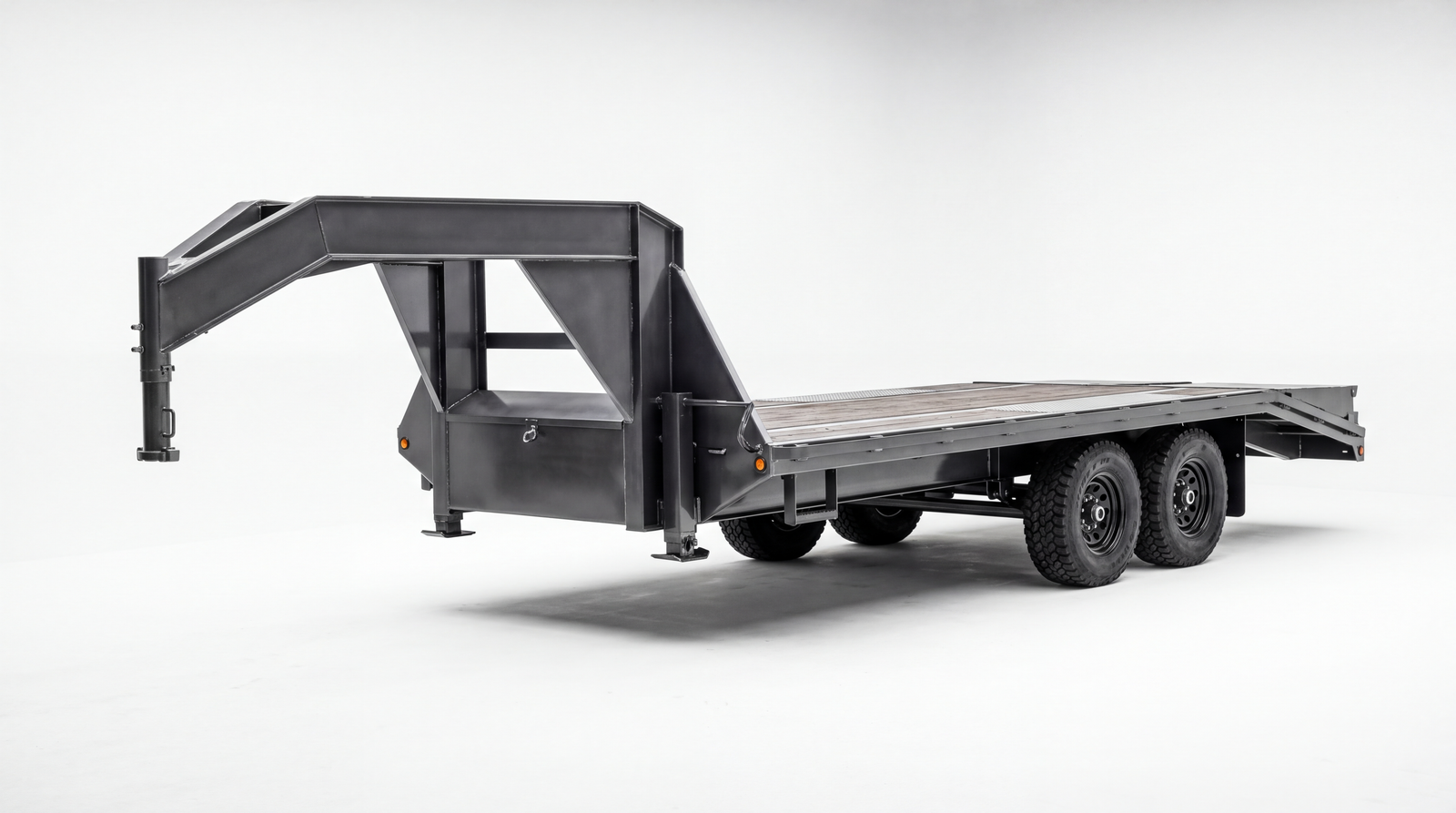
Gooseneck hitch installation is the gateway to towing serious payload. Bumper-pull trailers max out around 14,000 lbs GVWR; gooseneck trailers tow 18,000 to 25,000+ lbs comfortably. The hitch installation itself is straightforward, but cost and complexity vary based on the truck, the installer, and the brand of hitch you choose.
This guide covers real installation costs, the step-by-step process, brand comparisons, and DIY vs professional considerations.
Installation Cost Breakdown
Professional installation at a truck shop
Hitch hardware: $400 to $800 (B&W Companion or Curt OEM-style under-bed hitch, including ball, chains, breakaway switch).
Labor: $200 to $400 (4 to 6 hours of shop time).
Wiring (if not already in place for trailer brakes): $100 to $200.
Total professional installation: $700 to $1,400 typical.
DIY installation
Hardware: same $400 to $800.
Labor: 6 to 10 hours of your time on a Saturday.
Tools needed: socket wrench set, drill (for one or two holes through the bed), torque wrench, jack and stands. Most DIY mechanics have all the tools.
DIY total: $400 to $800 plus your time. Saves $200 to $400 vs professional.
Dealer installation at trailer purchase
Many trailer dealers offer hitch installation as a package deal at trailer purchase. Cost is typically similar to or slightly less than independent shop pricing because the dealer absorbs some labor in the trailer purchase margin.
Hitch Brand Comparison
B&W Companion (most popular, OEM-quality)
Cost: $750 to $850 hardware. The Companion is the gold standard for under-bed gooseneck hitches. Removable ball stows under the bed when not in use, leaving a flush-mounted bed surface for daily truck use. Strong frame integration with no interference with bed accessories. 25,000 lb tow rating standard.
Compatible trucks: most modern 3/4 ton and 1 ton pickups (Ford F-250/350, Chevy/GMC 2500/3500, Ram 2500/3500). B&W publishes truck-specific compatibility charts.
Curt OEM-style under-bed
Cost: $500 to $700 hardware. Strong value option with similar functionality to B&W Companion at lower price point. Removable ball, flush-mount surface. 25,000 lb tow rating typical.
Trade-off: build quality is solid but not B&W premium. Some installers prefer B&W for daily commercial use; Curt is excellent for occasional or light commercial use.
Curt OEM puck system (factory-equipped trucks)
Some 3/4 ton and 1 ton pickups (Ford Super Duty 2017+, Chevy/GMC HD 2020+, Ram HD 2014+) come from the factory with gooseneck and fifth-wheel pre-installation pucks in the bed. With this OEM puck system, gooseneck hitch installation is a 30-minute drop-in operation requiring minimal labor.
Cost: $200 to $400 for the drop-in ball mount and safety chain hardware. No labor needed beyond physically inserting the hitch.
Reese Gooseneck
Cost: $400 to $600 hardware. Older-style gooseneck hitch with above-bed ball mount. Less popular than under-bed options for most modern installations because the ball mount remains visible in the bed at all times. Still common on older trucks or buyers wanting simpler installation.
Installation Process Step-by-Step
This is the typical process for an under-bed B&W or Curt hitch on a non-OEM-puck-equipped truck:
Step 1: Prep the truck
Park on level ground. Remove the spare tire and any bed accessories (toolbox, bed cover) that block frame access. Block the wheels.
Step 2: Remove the bed (most installations)
Most under-bed gooseneck hitch installations require removing the bed for frame access. This is a 4 to 6 bolt operation (typical pickup beds are bolted to the frame at 4 to 6 points). With two people, bed removal takes 30 to 45 minutes. Some hitches (B&W Companion variants) are designed for installation through bed access holes without removing the bed; these add 30 to 60 minutes of labor but skip the bed removal step.
Step 3: Position the under-bed crossmember
The hitch consists of a crossmember that bolts to the truck\’s frame rails between the rear axle and the cab. Position it according to the manufacturer\’s template (specific position depends on truck model and bed length).
Step 4: Bolt the crossmember to the frame
Use the provided hardware (typically Grade 8 bolts and nuts). Torque to manufacturer\’s spec (usually 100 to 130 ft-lbs depending on bolt size). Hitch instructions include a torque table.
Step 5: Drill the bed (one or two holes for the ball)
The ball mounts through the bed with a rubber gasket sealing the hole. Drill through the bed at the manufacturer\’s template position (typically a 4-inch hole saw cut). Some hitches require a second smaller hole for the safety chain attachment.
Step 6: Re-install the bed
Bolt the bed back to the frame at the original mount points. Torque to original spec.
Step 7: Install ball and safety chain hardware
Drop the ball through the bed hole into the under-bed crossmember. Lock or pin per manufacturer\’s instructions. Attach safety chain hardware to the under-bed mount.
Step 8: Wire the breakaway switch
Run a wire from the truck\’s 12V system (typically the 7-pin trailer connector) to a small breakaway switch mount near the hitch. The switch activates the trailer\’s brakes if the trailer separates from the truck. Required by federal regulation on commercial use; recommended for all use.
Step 9: Test and torque check
Connect a gooseneck trailer (lightly loaded) and verify proper hitch engagement. Drive 50 to 100 miles, then re-torque all bolts to spec (initial torque-down often loosens slightly as components seat).
DIY vs Professional
Choose DIY if:
- You\’re mechanically experienced (you change your own oil, you\’ve done suspension work, you have a torque wrench)
- You have a level workspace with good lighting (concrete garage or driveway)
- You have help for the bed-removal step
- You\’re comfortable drilling through the bed
- You want to save $200 to $400 in labor
Choose professional if:
- You don\’t have a torque wrench or basic mechanical experience
- You\’re uncomfortable drilling through your truck bed
- The truck is leased and modifications need professional documentation
- You have time constraints and prefer to drop the truck off
- You want a warranty on the installation work
Post-Installation: What Changes
After gooseneck installation, your truck has the same daily drivability. The under-bed hitch is invisible during regular driving. The ball is removable and stows under the bed when not in use, leaving the bed surface clean.
For commercial use, the hitch installation should be reflected on your insurance policy. Notify your insurance carrier of the modification; most policies don\’t require additional premium but want documentation of the modification.
For lease vehicles, gooseneck installation may violate lease terms. Verify with your leasing company before installation; some require professional installation only and full documentation.
Gooseneck Hitch Installation Questions
How much does it cost to install a gooseneck hitch?
Professional installation: $700 to $1,400 (hardware + labor). DIY installation: $400 to $800 (hardware only, plus your time). OEM puck-equipped trucks: $200 to $400 for drop-in installation.
Can I install a gooseneck hitch myself?
Yes, if you have basic mechanical experience, a torque wrench, and a helper for bed removal. Total DIY time: 6 to 10 hours. Saves $200 to $400 vs professional installation.
How long does professional gooseneck installation take?
Most shops complete the installation in one business day (4 to 6 hours of actual labor). Drop your truck off in the morning, pick it up in the afternoon.
B&W Companion or Curt gooseneck hitch?
B&W Companion ($750 to $850) is the gold standard for daily commercial use. Curt OEM-style ($500 to $700) is excellent value for occasional or light commercial use. Both are removable, flush-mount, and 25,000 lb tow rated. Choose B&W if you tow daily; choose Curt if you tow occasionally or want to save money.
Do I need a special truck for a gooseneck hitch?
You need a 3/4 ton or 1 ton pickup with adequate frame strength. Half-ton trucks generally don\’t have the frame for gooseneck installation. Verify compatibility with the hitch manufacturer before purchase. Modern 3/4 ton and 1 ton pickups (Ford F-250/350, Chevy/GMC 2500/3500, Ram 2500/3500) are compatible with mainstream hitches.
Does the bed have to be removed for installation?
Most under-bed gooseneck hitches require bed removal for frame access. Some B&W Companion variants are designed for installation through bed access holes without removing the bed. OEM-puck-equipped trucks skip this entirely.
Related Guides and Inventory
Ready to buy? Get a free quote within 24 hours, or call us at (360) 560-5472.