Need to know how to tarp a utility trailer load properly? A poorly tarped load is illegal, dangerous, and embarrassing — it leaks debris, blows tarp corners on the highway, and dumps your gear all over the road behind you. This guide walks step-by-step through how to tarp a utility trailer load for any cargo type, ranks the best tarps and tie-downs, and explains the federal cargo-securement rules every driver has to follow.
Why Knowing How to Tarp a Utility Trailer Matters
Federal FMCSA 49 CFR 393.100 rules require any load that can leak, blow, or fall to be contained on every public road. State laws layer on top with fines from $50 to $5,000 for an unsecured or escaping load. A properly tarped load isn’t optional gear — it’s legal compliance.
Beyond legal: a clean tarp keeps mulch dry, prevents gravel from chipping the cars behind you, and tells customers and DOT inspectors that you operate professionally.
For broader buying advice on the trailer itself, our utility trailers buyer’s guide covers sizing and brand selection.
How to Tarp a Utility Trailer Load: Step-by-Step
Step 1: Pick the Right Tarp Size
Add 24 inches to your trailer width and 24 inches to your length. A 6×12 trailer needs an 8×14 tarp minimum to give 12 inches of overlap on every side for tucking and tying. For mounded loads (mulch, gravel above the rails), add another 12 inches.
Step 2: Pick Tarp Type
Mesh tarp for breathable loads (mulch, leaves, brush, grass clippings) — lighter, water sheds through, less wind catch. Solid vinyl tarp for fine loads (sand, sawdust, drywall debris) — heavier, fully waterproof, traps everything.
Step 3: Load Distribution
Load heavy items first, low and forward. Cargo should sit below the trailer rails, not piled high. The center of gravity must be ahead of the trailer axle (about 60 percent forward, 40 percent rear) to maintain proper tongue weight.
Step 4: Lay the Tarp
Open the tarp full size next to the trailer. Climb on the trailer (or have a helper hand it up) and unfold over the load. Center it so equal slack hangs over each side. Don’t bunch corners.
Step 5: Tuck the Edges
Tuck loose tarp under the load along all four sides, especially the front and back. The wind catches any flapping edge and rips the tarp at 65 mph. Tucking creates a tight seal.
Step 6: Secure with Bungees or Straps
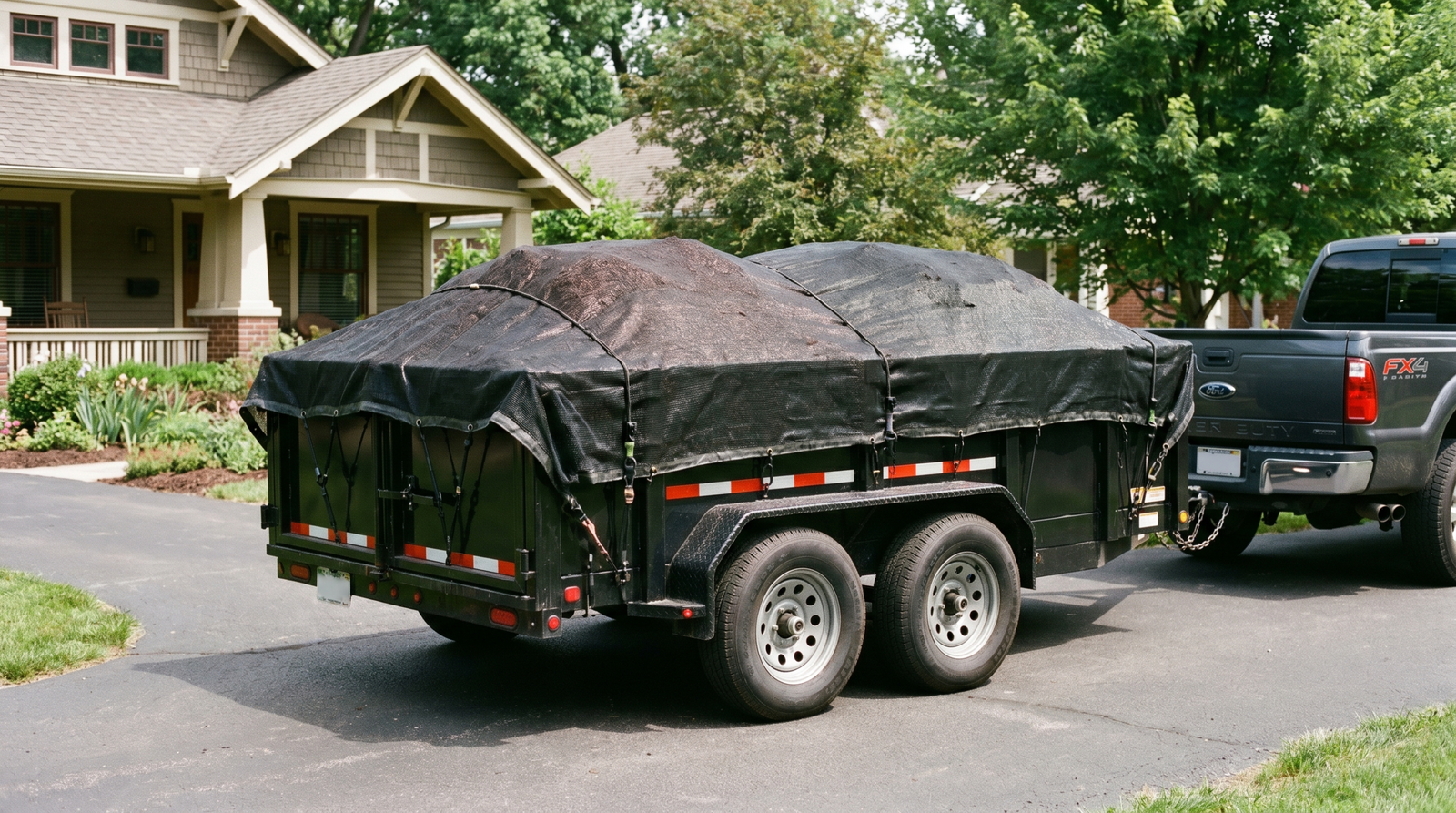
Run rubber bungees through the grommets and hook to the trailer’s tie-down points. Use 6–8 connection points minimum on a 12-foot trailer; 10–12 on a 16-foot. Cross-pattern the bungees so failure of one doesn’t release the whole tarp. Ratchet straps work too — stronger than bungees, slower to install.
Tarp and Tie-Down Brand Picks
Three brands cover the working market.
Boen Tarps — commercial-grade vinyl mesh and solid tarps. The 12-mil vinyl with grommets every 18 inches is the workhorse for landscaping crews. $80–$220 depending on size.
Kotap — economy mesh tarps for occasional users. Won’t last as long as Boen but the price is right. $30–$80.
Erickson Manufacturing — best ratchet straps in the price range. 1-inch straps rated 500 lbs working load (1,500 lbs break) handle most loads.
Common Mistakes
Mistake 1: Tarp Too Small
An undersized tarp leaves load exposed at the corners, and corners are where tarps blow open. Always size up.
Mistake 2: Bungees Through the Tarp Fabric, Not Grommets
Skipping grommets and hooking bungees into the tarp fabric tears the tarp in one trip. Always run hooks through grommets.
Mistake 3: Skipping the Front Tie
The front edge is the most aerodynamic stress point. Without a tight tie at the trailer’s front, wind lifts the tarp into the air at highway speed. Use 2 ties across the front minimum.
Mistake 4: Ratchet Straps Over Mulch
Ratchets over a soft load compress unevenly and let the tarp loosen mid-trip. Use bungees on soft loads (mulch, leaves) and ratchets on hard loads (lumber, gravel below rails).
Reference Table: Cargo Type to Tarp Method
| Cargo | Tarp Type | Tie Method | Tie Points |
|---|---|---|---|
| Mulch / leaves / brush | Mesh, oversized | Bungees through grommets | 8–10 |
| Gravel / topsoil | Solid vinyl, oversized | Bungees, tucked corners | 10–12 |
| Lumber / pallets | Solid vinyl | Ratchet straps over flat top | 4–6 |
| Demolition debris | Solid heavy vinyl | Ratchet + bungee mix | 10–12 |
| Lawn equipment | Solid vinyl over equipment | Ratchets through equipment + bungees on tarp | 6–8 |
How to Tarp a Utility Trailer Load Without a Helper
Solo tarping is a skill. Three techniques to make it easier.
Pre-fold technique: fold the tarp accordion-style so it lies flat across the load, then unroll across the cargo from one end. No climbing required.
Stake-pocket throw line: tie a 30-foot rope to one corner. Throw the rope over the load to the opposite side, walk around, pull the tarp across.
Inverted-roll technique: with a roll-style tarp, mount one end to the trailer and unroll across as you walk down the side.
Maintenance to Make Tarps Last
A quality tarp lasts 4–7 years with care. Three habits help:
Dry before storage. A wet tarp folded for storage grows mildew, which weakens fibers. Lay it out to dry before folding.
UV protection. Store tarps in shade or under cover. Direct sun is the #1 cause of tarp degradation — even a UV-treated tarp loses strength after 18 months of constant sun exposure.
Repair small holes early. A 1-inch tear becomes a 24-inch tear at highway speed. Use a tarp repair kit ($15–$25) to patch small holes within a week of finding them.
Outbound References
For specific state tarping laws, the Pulltarps state-by-state regulations white paper is the most complete guide. For securement standards, the federal FMCSA 49 CFR 393.100 is the authoritative source.
Common Questions About How to Tarp a Utility Trailer Load
Do I need a tarp if my load is below the rails?
It depends on the cargo. Loose dirt, mulch, or gravel below the rails can still escape over uneven roads or in wind. Most jurisdictions still require a tarp. When in doubt, tarp it.
What’s the highway-speed limit for tarped loads?
No specific federal limit, but a properly tarped load handles 65–70 mph fine. Above 70, even a perfect tarp lifts and flaps. Slow down for highway transit when fully loaded.
Are mesh tarps legal under DOT rules?
Yes, for most aggregate and bulk loads. The rule is “contained” — mesh contains the load while letting water drain. Solid vinyl is required only for fine particulate (ash, dust, etc).
How many tie-down points minimum?
FMCSA rules require enough tie-downs to provide securement equal to 50 percent of the load weight. In practice, that’s 1 tie-down per 10 feet of cargo plus 1 extra. For a 12-foot trailer load, 4 tie-downs minimum, 6–8 best practice.
Should I use a roll-style tarp kit?
For frequent tarping (3+ times a week), yes — see our dump trailer tarp kits comparison. For occasional use, a manual tarp + bungees is cheaper and just as effective.
Ready to Buy?
Knowing how to tarp a utility trailer load properly is the difference between a working trailer and a roadside hazard. Tarp every load, every time.
Browse utility trailers for sale to find the right deck size for your work, and pair with our best utility trailer for F-150 guide if you’re towing with a half-ton.
Request a free delivered quote with your trailer specs and we’ll send out-the-door pricing same business day.
Where How To Tarp A Utility Trailer Fits in Your 2026 Buying Plan
If you’re comparing every option for how to tarp a utility trailer, three resources help. The federal FMCSA cargo securement standards (49 CFR 393.100) apply on every public road. The NHTSA towing safety guide covers tow-vehicle setup. And our parent buyer’s guide covers sizing, brands, and 2026 pricing for the broader category.
Pricing on how to tarp a utility trailer has stabilized in 2026 after the steel-cost swings of the early 2020s. Whether you’re buying first-time or replacing a unit, how to tarp a utility trailer decisions still come down to use case, brand, and delivered out-the-door price. PrimeLoad’s position is to make the comparison transparent.
Browse How To Tarp A Utility Trailer inventory to see every option with full specs and delivered pricing. Free delivery to all 50 states from PrimeLoad Trailers.