A 30-minute trailer inspection before purchase prevents 90 percent of post-purchase regrets. Hidden frame damage, near-end-of-life tires, failing brakes, water-damaged floors, and bad ground wires aren\’t obvious from photos or a casual walk-around. They are obvious to anyone who knows what to look for.
This checklist works for new and used trailers. New trailers should pass every check; if a new trailer fails, request a different unit. Used trailers will fail some checks; the question is whether the failure is a deal-breaker or a normal wear item to factor into your offer.
Frame Inspection (10 minutes, most important)
Tongue and coupler area
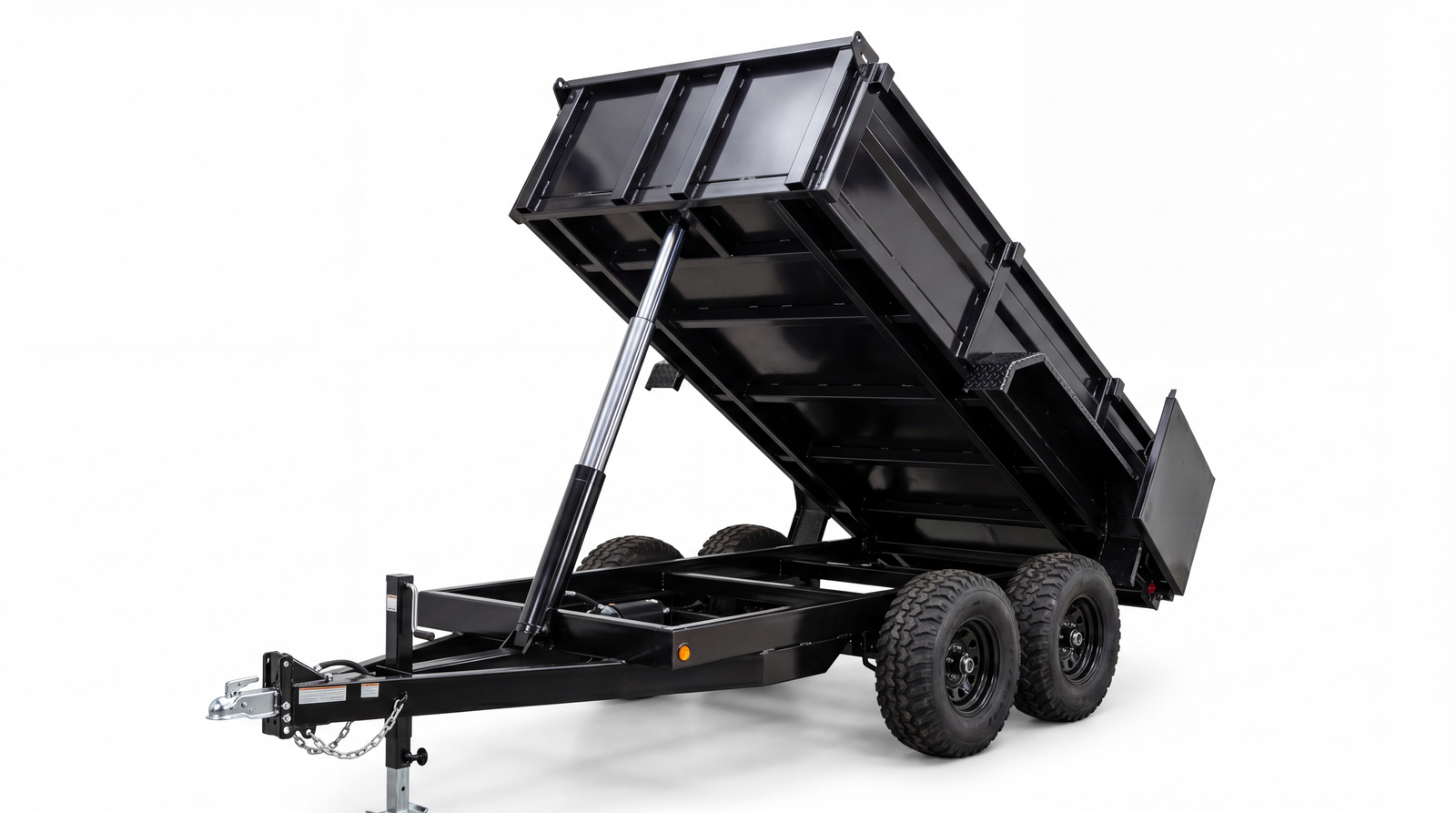
Walk to the front of the trailer. Look at the welds where the tongue meets the main frame. Cracks, rust-through, or evidence of repair welding (different weld bead pattern) is a major red flag. The tongue takes the highest impact load on the trailer; tongue failure causes serious accidents.
Inspect the coupler (the part that latches to your hitch ball). Latch should fully open and close cleanly. Lock pin should engage. Look for cracks at the coupler-to-tongue weld.
Main frame rails
Walk the length of both frame rails. Look for:
- Rust-through (holes you can poke a screwdriver through)
- Cracks (especially at axle hangers and crossmember welds)
- Bent or twisted sections (sight down the length of each rail; both should be straight)
- Repair patches or weld evidence (small repairs are normal; large repair patches suggest accident damage)
Crossmembers and frame underside
Get under the trailer (or use a mirror, or have the dealer lift it). Look at the crossmembers connecting the two main rails. They should all be intact, straight, and welded cleanly to the rails.
Surface rust on frame undersides is normal on trailers more than 2 years old. Through-rust (visible holes) is not normal and indicates the trailer needs serious frame work.
Axles and Suspension (5 minutes)
Axle visual inspection
Look at the axle tubes from underneath. They should be straight (sight down the axle from one side). Bent axles cause uneven tire wear, alignment issues, and can fail catastrophically.
Check axle U-bolts (the U-shaped bolts holding the leaf springs to the axle). They should be tight, no movement when you push or pull on the spring assembly.
Leaf springs
Look at each leaf spring (typically 4 to 8 leaves stacked together). All leaves should be intact and arched. A broken spring leaf is visible (cracked metal, sometimes drooping). Replacement spring kits run $80 to $200 each plus labor.
Spring shackles and bushings
The shackles connect each spring end to the frame hangers. Bushings (rubber or polyurethane) inside the shackle pivots wear out. Push and pull on the spring assembly. Any visible wobble or movement at the shackle indicates worn bushings ($30 to $80 per shackle to replace).
Wheels and Tires (5 minutes)
Tire age (more important than tread)
Trailer tires age out at 6 to 8 years regardless of tread depth or mileage. UV exposure and heat cycles cause sidewall failure even on tires that look new.
Find the DOT date code on each tire\’s sidewall. The last 4 digits of the DOT number are the manufacture week and year (e.g., \”2823\” = week 28 of 2023). Tires older than 6 years are at end-of-life. Tires older than 8 years are safety hazards regardless of appearance.
Replacement: $150 to $400 for a pair of trailer tires. Factor this into used trailer pricing if the tires are 5+ years old.
Tread depth and wear pattern
Tread depth: 4/32 inch is end-of-life for trailer tires. Use a tread depth gauge or insert a quarter (Washington\’s head down). If you can see the top of his head, replace.
Wear pattern: even wear across the tread = normal. Center wear = over-inflation. Edge wear = under-inflation. One-side wear = bent axle or alignment issue. Cupping or scalloping = bad bearings or shock absorber problems.
Wheel bearings
Spin each wheel by hand. It should rotate smoothly without grinding, clicking, or excessive resistance. Listen for noises that indicate dry or worn bearings ($60 to $150 per wheel to replace).
Grab the top and bottom of each tire and rock it. Any visible play indicates worn bearings or a loose axle nut.
Brakes (3 minutes)
If the trailer has electric brakes (most do, above 3,000 lb GVWR):
- Connect to a tow vehicle with a brake controller
- Have someone press the manual override lever on the brake controller
- Listen for brake activation at each wheel (audible click or hum from the brake magnet)
- Try to push the trailer forward by hand (with brakes engaged); resistance confirms brakes work
If brakes don\’t activate or activate weakly: could be wiring issues ($100 to $300 to fix), worn brake magnets ($60 to $150 per wheel), or brake controller incompatibility (check brake controller settings first).
Wiring and Lights (3 minutes)
Plug the trailer\’s 7-pin connector into the tow vehicle. Test all lights:
- Running lights (parking lights on)
- Left turn signal
- Right turn signal
- Brake lights (press tow vehicle brake)
- Backup lights (if equipped)
Lights that don\’t work or flicker indicate ground wire corrosion or bulb failure. Ground wire corrosion is the most common trailer wiring issue. The trailer\’s ground bolt to the frame should be clean metal-to-metal contact, no corrosion. Replacing a ground point is a 15-minute repair if you do it yourself.
Inspect the 7-pin connector itself. Look for corrosion inside the female socket. Bent or broken pins indicate previous damage and need replacement.
Floor and Walls (3 minutes)
Walk the deck
Walk the entire trailer deck (open deck or enclosed cargo). Note any soft spots. Soft spots in a wood deck indicate water damage and impending floor failure. Replacement cost: $400 to $1,200 depending on size and material.
Inspect floor seams
Look at where the floor meets the walls (in enclosed cargo trailers) or where decking boards meet (in open utility trailers). Sealed seams should be intact. Cracked or missing sealant indicates water has been getting in.
Inspect underside of floor (if accessible)
From under the trailer, look at the floor underside. Water staining, soft spots, or visible rot are deal-breakers on used trailers.
Walls (enclosed cargo only)
Walk the interior of an enclosed cargo trailer. Look for:
- Soft spots on side walls (water intrusion at roof or side seams)
- Daylight visible through joints (leaks)
- Stains on ceiling or walls (water tracking down)
- Rivets pulling through wall panels (structural movement)
Documentation Review (1 minute)
- Title in seller\’s name (or dealer for new purchases)
- VIN on title matches VIN sticker on trailer (front-left corner of trailer body)
- No liens on title (or seller can pay off lien at sale)
- Manufacturer warranty paperwork (if new)
- Service records (if used, indicates good ownership history)
After the Inspection
If the trailer passes all checks: proceed with purchase.
If the trailer has wear-item issues (old tires, worn shackle bushings, weak brakes): negotiate the purchase price down by the cost of repairs, or factor those costs into your post-purchase budget.
If the trailer has frame, axle, or floor structural issues: walk away. These repairs cost more than the trailer is worth in most cases.
Trailer Inspection Questions
How long should a used trailer inspection take?
30 to 45 minutes for a thorough walkthrough. Frame inspection (10 min), axles and suspension (5 min), wheels/tires (5 min), brakes (3 min), wiring/lights (3 min), floor and walls (3 min), documentation (1 min). Skipping the inspection is the most common cause of post-purchase regret.
What's the most important thing to check on a used trailer?
Frame integrity. Bent, cracked, or rust-through frame components are expensive to repair and dangerous if missed. Other issues (tires, brakes, lights) are routine wear items. Frame issues are deal-breakers.
How old is too old for a used trailer?
Trailers from quality manufacturers (Big Tex, BWise, Sport Haven, Carry-On) hold up well for 15 to 25 years with proper maintenance. The trailer\’s age matters less than condition. A 20-year-old well-maintained trailer with current tires beats a 5-year-old beater.
Do I need a mechanic to inspect a trailer?
Not for the basics. Frame, tires, lights, and floor are visible to anyone with a flashlight and 30 minutes. For mechanical (axle bearings, brake magnets, wiring), a competent friend or trailer mechanic helps. New trailer purchases at a dealer don\’t need third-party inspection.
What's the deal with old tires?
Trailer tires age out at 6 to 8 years regardless of tread depth or mileage. UV exposure causes sidewall failure even on tires that look new. Check the DOT date code on each sidewall. Tires older than 6 years should be replaced before highway use; older than 8 years is dangerous.
Should I buy a trailer with rust?
Surface rust (cosmetic) is normal and easily treated. Through-rust (holes in the frame) is a deal-breaker. Repair patches over old rust are concerning unless professionally welded. Get under the trailer and inspect the frame underside before deciding.
Related Guides and Inventory
Ready to buy? Get a free quote within 24 hours, or call us at (360) 560-5472.