Going mobile as a mechanic means converting your shop into a trailer that you can roll up to the customer’s vehicle. Done right, mobile mechanic operations bill at higher rates than fixed-shop work (customers pay for the convenience), eliminate the cost of commercial shop space, and let you serve customers in geographic areas that don’t support a fixed shop.
Done wrong, you’re wasting money on a trailer that doesn’t hold the right tools or doesn’t have the electrical capacity to run your equipment. This guide walks through the complete setup with real spec recommendations.
Trailer Size for Mobile Mechanic Work
7×14 V-nose enclosed cargo (entry-level mobile mechanic)
The minimum viable mobile mechanic trailer. Holds basic hand tools, air tools, compact compressor, small parts inventory, and 2 to 3 floor jacks. Tow vehicle requirement: half-ton or 3/4 ton pickup.
Limitations: tight workspace, limited parts inventory storage, single-person operations only.
Cost: $7,500 to $10,500 for trailer. $4,000 to $8,000 for tools and equipment to outfit. Total entry: $12,000 to $18,500.
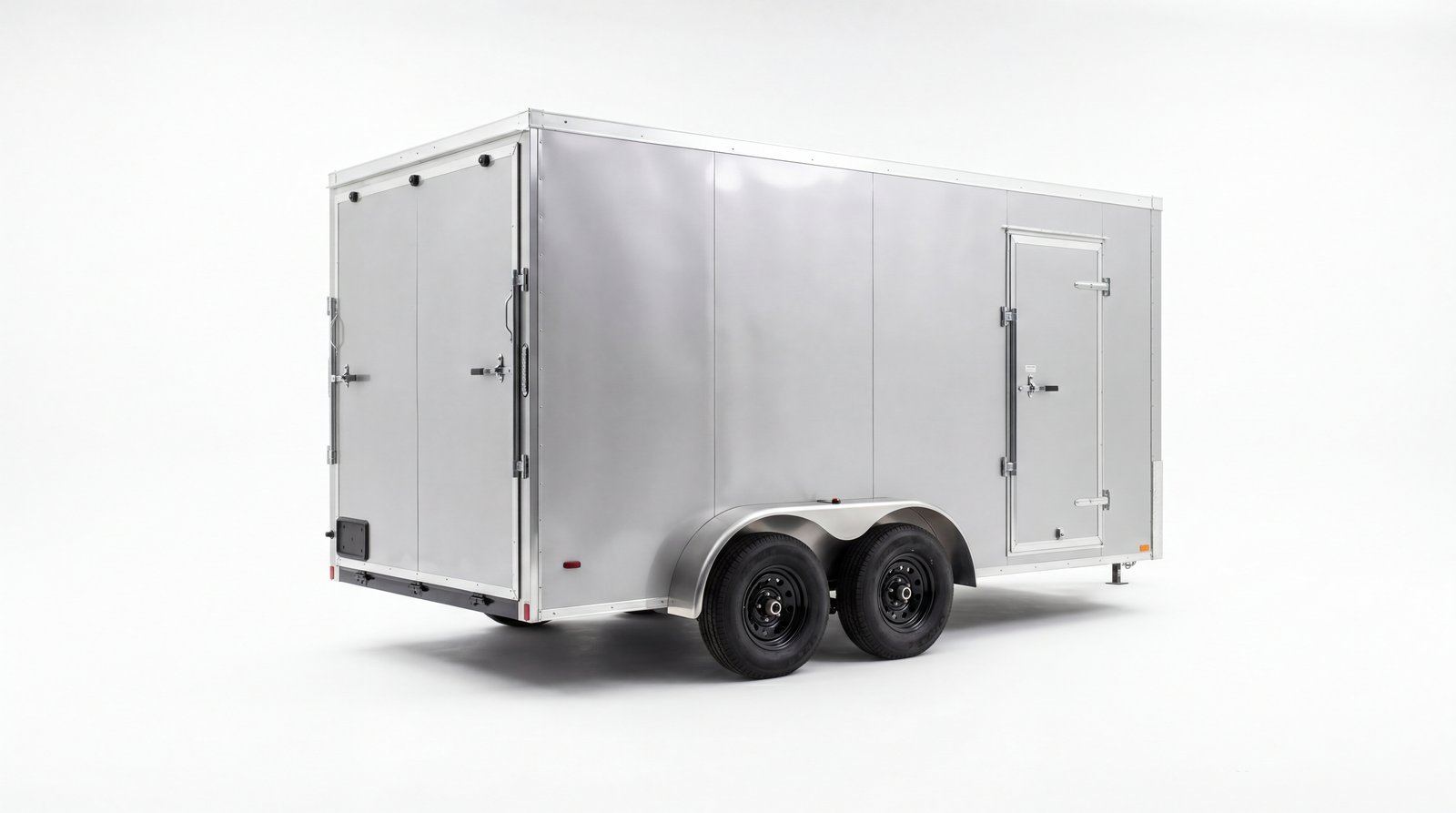
7×16 V-nose enclosed cargo (most common)
The sweet spot for mobile mechanic work. Holds full hand tool inventory, air tools, mid-size compressor, decent parts inventory, transmission jack, and a small workbench. Adequate for solo operator with occasional helper.
Cost: $9,000 to $13,000 for trailer. $6,000 to $12,000 for tools and equipment. Total: $15,000 to $25,000.
8.5×20 V-nose enclosed cargo (full mobile mechanic)
The professional setup. Holds everything in the 7×16 plus a hydraulic lift, larger parts inventory, multiple workstation positions for 2 to 3 person crews. Standard setup for mobile shops handling fleet work, dealership outsource work, or specialty repair.
Cost: $13,000 to $18,000 for trailer. $15,000 to $30,000 for tools and equipment. Total: $28,000 to $48,000.
Tool Storage and Organization
Wall-mounted tool panels
Pegboard or French cleat systems mounted to trailer walls hold hand tools (wrenches, sockets, screwdrivers, pliers) where they’re visible and easy to grab. Saves time vs digging through drawers. Standard installation: pegboard with hooks costs $200 to $400 for a 7×16 trailer’s wall coverage.
Toolboxes
Stacking toolbox systems (Snap-On, Harbor Freight US General, or generic) hold air tools, specialty tools, and parts inventory. Standard configuration: one rolling cabinet with multiple drawers for primary tool storage, plus 2 to 3 wall-mounted boxes for specialty tools.
Cost: $1,500 to $5,000 for a complete toolbox setup.
Parts shelving
Wire shelving (NSF or commercial-grade) along one wall holds parts inventory: filters, belts, fluids, fasteners, common consumables. Adjustable shelves accommodate different part sizes.
Cost: $300 to $700 for shelving systems.
Heavy tool storage
Floor jacks, jack stands, transmission jack, and other heavy tools store in a dedicated floor area near the rear ramp. Use wheel chocks to prevent rolling during transit.
Electrical System
Shore power inlet
30 amp 110V shore power inlet (locking marine-style or RV-style) lets you plug into a customer’s house, shop, or generator. This powers your interior lights, charge stations, and any plug-in tools.
Cost: $200 to $400 installed.
Interior lighting
LED ceiling lights (4 to 8 fixtures depending on trailer size) provide work-grade illumination. 12V LED lights work from the trailer’s battery; 110V LED lights work from shore power.
Cost: $200 to $500 for a complete LED interior lighting installation.
Power outlets
4 to 8 110V duplex outlets distributed along the walls let you plug in tools without extension cords. GFCI protection on all outlets is required by code.
Cost: $300 to $700 for outlet installation.
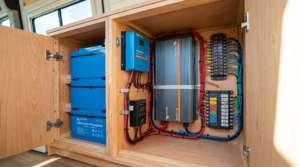
Battery and inverter (optional)
For off-grid mobile work (no shore power available), a deep-cycle battery + 1,500 to 3,000 watt inverter powers tools without a generator. Useful for emergency roadside calls or remote-area service.
Cost: $1,200 to $3,000 for a battery + inverter setup with proper isolation from the trailer’s electrical system.
Air Compressor
Compressor selection
Mobile mechanic compressor needs: 5 to 15 CFM at 90 psi (depending on the air tools you run). Most single-person mobile shops use a 30 to 60 gallon compressor with 5 to 8 CFM rating. Larger shops use 80 to 120 gallon compressors with 10+ CFM.
Cost: $800 to $2,500 for a quality compressor. Avoid ultra-cheap compressors; they fail under daily commercial use.
Mounting and venting
Compressors mount to the trailer floor at the front of the trailer (closest to the tongue, lowest noise impact when working at the rear). Vent the compressor exhaust outside the trailer through a wall vent. Inside-trailer compressor exhaust creates carbon monoxide hazard plus heat buildup.
Air line distribution
Run permanent air lines from the compressor to 2 to 4 quick-disconnect points along the trailer walls. This eliminates dragging hoses across the work area. Cost: $200 to $500 for hard-pipe air distribution.
Lighting and Environment
Exterior work lighting
Mount 2 to 4 LED flood lights on the exterior of the trailer near the rear ramp. These illuminate the work area when you’re working on the customer’s vehicle outside the trailer. 12V or 110V depending on power source.
Cost: $200 to $600 for exterior lighting installation.
Heating and cooling
For year-round operation, climate control matters. Roof-mounted RV-style AC unit ($600 to $1,200) handles cooling in summer. Catalytic propane heater ($300 to $600) or electric ceramic heater handles winter cold.
Ventilation
Roof vent (powered or passive) helps cycle air during work, especially when running gas-powered tools or working with chemicals. Powered roof vent: $150 to $400 installed.
Fluid and Waste Management
Used oil collection
30 to 50 gallon used oil tank (mounted to trailer floor) holds drain oil from oil changes. Empty at recycling stations between jobs. Cost: $200 to $500 for tank + plumbing.
Coolant collection
Separate 5 to 10 gallon coolant collection drum (smaller volume since coolant changes are less frequent). Required to be separate from oil for recycling compliance.
Waste container
Sealed waste container for old filters, rags, and other shop waste. Empty at customer’s dumpster or hazardous waste facility per local regulations.
Real Mobile Shop Setup Example (Pacific Northwest)
A solo mobile mechanic in the Northeast bought a 7×16 V-nose enclosed cargo trailer in March 2024. Initial setup:
- Trailer: $10,500 (V-nose Carry-On with side door, electrical package)
- Pegboard wall system + hooks: $300
- Stacking toolbox set (US General): $2,200
- Parts shelving: $400
- 30-gallon air compressor (Industrial Air): $1,100
- Air line distribution + 4 quick-disconnect outlets: $350
- LED interior lighting: $300
- Exterior LED work lights (2): $250
- Used oil tank (30 gal): $250
- Floor jack, transmission jack, jack stands: $1,200
- Hand tools and air tools: $4,500 (started with existing tools, upgraded over 6 months)
Total setup cost: $21,350.
Year 1 revenue: $94,000. Year 1 costs (parts, fuel, insurance, marketing): $42,000. Year 1 net before owner pay: $52,000.
The trailer paid back in 5 months of operations. Year 2 onward is pure revenue contribution to owner pay.
Mobile Mechanic Trailer Setup Questions
What size trailer for mobile mechanic work?
Solo operator with limited tools: 7×14 V-nose enclosed cargo. Solo operator with full tool inventory: 7×16 V-nose. Multi-person crew or specialty service: 8.5×20 V-nose. Most mobile mechanics start with 7×16 as the best balance of cost and workspace.
How much electrical capacity do I need?
30 amp 110V shore power inlet handles most mobile mechanic operations. For larger trailers with multiple tool stations or compressor + AC running simultaneously, upgrade to 50 amp service. Always include GFCI protection on all outlets.
What size air compressor for mobile work?
Solo operator: 30 to 60 gallon compressor with 5 to 8 CFM at 90 psi. Multi-person crew: 80+ gallon compressor with 10+ CFM. Avoid ultra-cheap compressors; commercial-grade Industrial Air, Quincy, or Ingersoll Rand pay back through reliability.
Do I need a generator for mobile mechanic work?
Not if you can plug into the customer’s shore power. A 3,500 to 5,000 watt inverter generator becomes useful for off-grid emergency calls and remote-area service. Cost: $700 to $2,500 for a quality generator.
How much does a complete mobile mechanic trailer setup cost?
Entry-level (7×14): $12,000 to $18,500 total (trailer + tools + setup). Mid-range (7×16): $15,000 to $25,000 total. Full professional (8.5×20): $28,000 to $48,000 total. Plan for the trailer to pay back in 6 to 12 months of active mobile operations.
Can I work in the trailer in winter?
Yes, with proper heating. Catalytic propane heater ($300 to $600) or electric ceramic heater handles winter cold in an enclosed cargo trailer. Insulation upgrades ($800 to $2,000) extend year-round operation comfort. Many the Northeast mobile mechanics work through winter with proper heating setup.
Related Guides and Inventory
Ready to buy? Get a free quote within 24 hours, or call us at (360) 560-5472.